
Medical diagnoses rarely define daily function, making functional assessments and tailored home modifications the true key to long-term veteran independence.





Adaptive living is not a surrender to physical limitation or a measure of what you can no longer do. It is a systematic method for modifying your environment, tools, and daily routines so you can maintain autonomy. True independence does not mean doing everything without help. It means having control over your choices, staying safe in your home, and participating in your community.
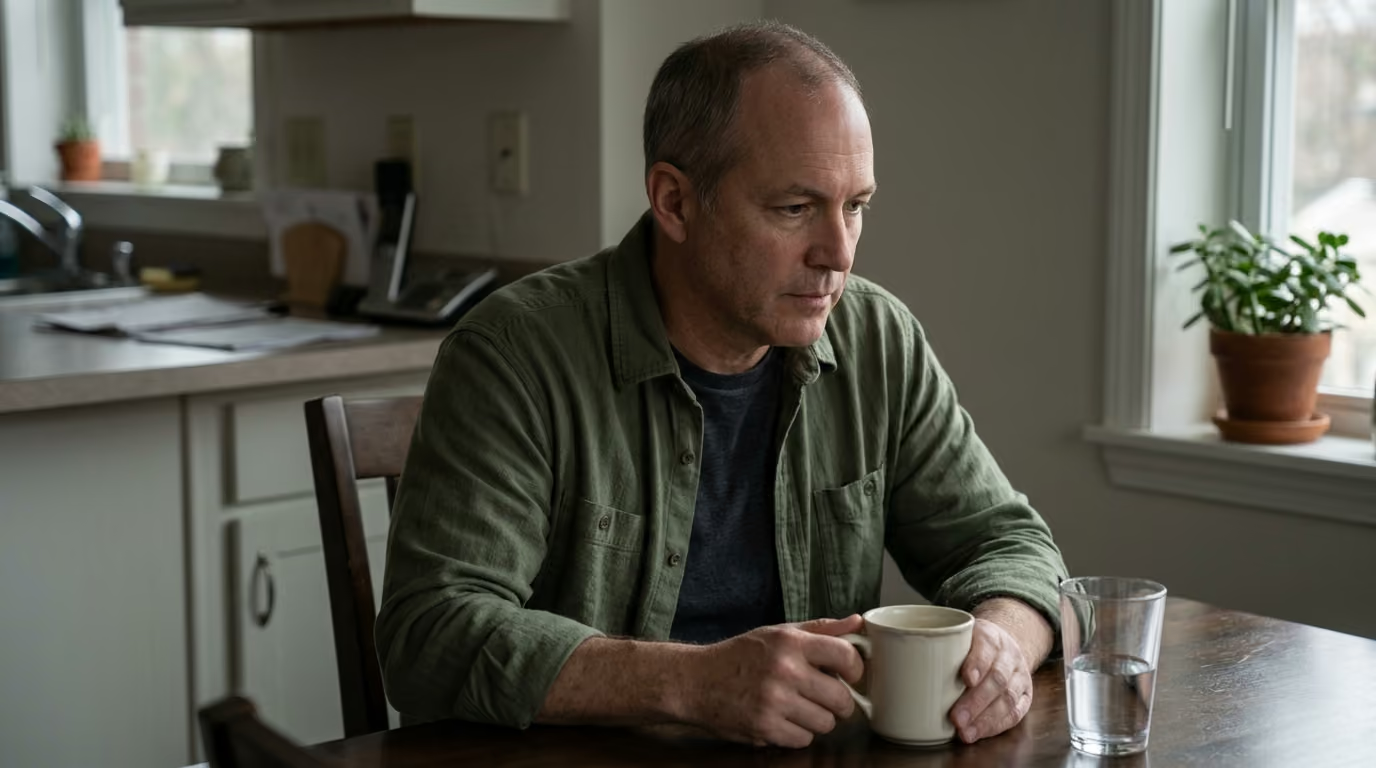
The alarm sounds at dawn, but getting out of bed requires a calculated sequence of movements to manage a stiff lower back and an unstable knee. Crossing the hallway means navigating low lighting, narrow door frames, and slick floorboards before reaching the bathroom. Preparing a simple meal or leaving the house for an appointment demands energy that should be reserved for your family, your work, or your recovery. When your daily living environment works against you, simple routines turn into exhausting obstacles.
Planning for accessibility requires evaluating what you need to do each day, where tasks break down, and which environmental or technological changes restore your ability to act.
Adaptive living succeeds when you evaluate your actual physical and cognitive performance instead of relying solely on a medical diagnosis. By assessing your living space, selecting appropriate assistive technology, adapting your workplace, and using available support programs, you can build a sustainable routine that preserves your energy and autonomy over the long term.
Medical diagnoses describe pathology, but they rarely describe daily function. Two veterans with identical spinal cord injuries or blast-related joint damage may experience completely different limitations. Differences in baseline strength, pain levels, cognitive processing, home architecture, and social support shape what each person can accomplish. A successful independence plan begins with functional assessment rather than a diagnostic label.
To understand accessibility, you must separate several related concepts:
Both the Centers for Disease Control and Prevention and the Department of Veterans Affairs evaluate disability through functional domains. These domains include seeing, hearing, mobility, communication, cognition, self-care, and independent living. Looking at your daily life through these functional domains allows you to pinpoint exact breakdowns in your routine.
The person, task, environment, technology, and support framework offers a reliable way to solve daily barriers. The person represents your current physical, sensory, and cognitive capacity. The task represents the exact sequence of actions required to complete an activity. The environment includes the physical spaces, lighting, noise levels, and terrain where the task occurs. Technology includes the tools and modifications used to bridge performance gaps. Support encompasses the family, clinicians, and community networks assisting you.
Independence should never be defined as the complete absence of equipment or personal assistance. A veteran who uses a power wheelchair, a modified van, voice-recognition software, and a personal care attendant to work and manage a household exercises substantial autonomy. True independence means maintaining choice, self-direction, and safety in the activities that matter to you.
Assessing a home requires examining the complete path of travel from the street to your most frequent daily activities. An inaccessible entryway or an unsafe bathroom can undermine an otherwise functional living situation. Evaluating your home systematically helps you identify hazards before they cause falls or chronic strain.
Your exterior evaluation begins at the parking area or sidewalk. Look at the route you take to enter your home:
Inside the home, clear pathways ensure you can move between rooms without unnecessary physical effort:
Bathrooms present a high risk for injury due to hard surfaces, moisture, tight turning radiuses, and frequent transfers. A functional bathroom must support safe entry, hygiene, and exit:
Grab bars must always be secured directly into wall studs or specialized solid blocking. Standard towel bars, decorative handrails, and suction-cup handles are not engineered to support body weight and should never be used for balance or transfers.
Kitchen modifications should reduce prolonged standing, eliminate overhead reaching, and minimize burn risks:
Sleep disruption and nighttime transfers create distinct safety concerns, especially when waking in a disoriented or fatigued state. Exploring healthy aging guidance for veterans can help you plan for long-term home safety as your physical needs evolve. Key bedroom considerations include:
Clinical research demonstrates that structured home environmental interventions preserve independence and reduce physical injury. A systematic review published in the American Journal of Occupational Therapy evaluated thirty-three studies on home modifications and fall prevention. The strongest functional outcomes occurred when home evaluations and modifications were integrated with other supportive elements, such as targeted exercise, vision checks, medication management, and assistive technology training.
A comprehensive meta-analysis of ten clinical trials involving nearly two thousand participants found that structured home-hazard modification programs produced a statistically significant seven percent reduction in overall falls. While much of the existing fall-prevention literature focuses on older community-dwelling adults, the underlying mechanics apply directly to veterans with service-connected physical impairments. Removing physical barriers directly decreases the frequency of balance loss and joint strain.
It is equally important to recognize the limits of current research. Home modifications alone cannot resolve underlying neuromuscular deficits, medication side effects, or progressive neurological conditions. Clinical data confirms that environmental renovations are most effective when paired with comprehensive rehabilitation and personalized functional training.
Understanding the distinction between design approaches helps you choose the right home modifications:
Meeting standard commercial accessibility codes does not guarantee a home will work for you. Building codes establish minimum geometric baselines for public spaces. Your personal home modifications must be tailored directly to your transfer patterns, reach ranges, and daily routines.
Assistive technology spans a broad spectrum from simple mechanical aids to sophisticated microprocessor-controlled systems. The goal of any assistive device is to reduce the energy cost of daily tasks, preserve physical safety, and enhance functional independence.
Assistive technology serves multiple functional domains across daily military and veteran life:
Selecting equipment requires evaluating practical usage factors to ensure the tool fits into your daily routine. Reviewing these ten criteria helps prevent device abandonment:
Device abandonment is a common problem in rehabilitation. High-tech equipment is frequently discarded when it creates excessive cognitive burden, requires frequent charging, or feels socially stigmatizing. Simple, durable tools often provide more reliable long-term service than complex digital systems.
Assistive technology should be evaluated by asking three core questions: Does this device make me safer? Does it give me greater personal control? Does it allow me to participate in the activities that matter most to me?
A common misconception in veteran rehabilitation is treating mobility devices as a strict hierarchy where walking is always superior to using a wheelchair. Mobility equipment is not a symbol of physical capacity. It is an energy-conservation and safety tool designed to keep you active in your community.
Forcing yourself to walk when balance is compromised or pain is severe can drain energy needed for work, family life, and community engagement. Using wheeled mobility for long distances preserves physical endurance and protects your joints from secondary overuse injuries.
Different mobility tools serve distinct functional purposes based on stability, energy expenditure, and terrain:
A comprehensive mobility plan often involves using different tools for different environments. You might use an orthosis or a cane inside your home, a rollator for navigating a crowded grocery store, and a power scooter for traveling across a large medical center campus or outdoor park.
Mobility planning must account for functional variations and less visible symptoms:
Personal transportation is a cornerstone of community participation and employment. Evaluating transportation requires looking beyond whether you can steer a vehicle. You must assess the complete travel sequence, including approaching the vehicle, transferring into the seat, stowing mobility equipment, operating controls safely, and exiting at your destination.
A breakdown at any point in this sequence creates a trip-chain failure. If you can drive a modified vehicle but cannot safely transfer out of the driver seat onto a wet parking surface, your travel chain is broken.
Adaptive driving systems range from minor mechanical adjustments to extensive structural vehicle modifications:
The Department of Veterans Affairs provides specific financial and adaptive equipment programs for eligible veterans with service-connected disabilities. Under established statutory guidelines, the VA Automobile Allowance provides a one-time grant toward the purchase of a qualifying vehicle for veterans with specific service-connected conditions:
In addition to the one-time vehicle purchase allowance, the VA Adaptive Equipment program can provide repeated grants to modify vehicles with lifts, hand controls, power steering adaptations, and lowered floors. Veterans with service-connected ankylosis of one or both knees or hips may also qualify for adaptive equipment benefits even if they do not meet the criteria for the one-time vehicle purchase grant.
Veterans apply for these vehicle benefits using VA Form 21-4502. However, receiving administrative approval for financial benefits is distinct from a clinical driving assessment. Before purchasing or modifying a vehicle, complete an evaluation with a certified driver rehabilitation specialist through the VA or an accredited clinical driving program. These specialists evaluate your reaction time, vision, cognitive processing, physical strength, and transfer safety in real traffic conditions.
When driving is not clinically advisable or financially feasible, a comprehensive transportation strategy should integrate alternative community options:
Workplace accommodation is a collaborative, practical process designed to help you perform your essential job functions. Under Title I of the Americans with Disabilities Act and Section 501 of the Rehabilitation Act for federal employees, covered employers must provide reasonable accommodations to qualified individuals with disabilities, unless doing so creates an undue hardship for the organization.
The Job Accommodation Network emphasizes that workplace accommodations should focus on practical functional solutions rather than clinical medical diagnoses. An accommodation plan should identify the essential functions of your role, pinpoint the physical or cognitive barriers in the work environment, and select effective modifications.
Accommodations should be tailored to your specific functional needs in the workplace:
When requesting workplace modifications, you do not need to disclose your entire medical history or service record. Focus your communication on how your functional limitations interact with specific job tasks. Using structured resources from veteran lifestyle and healthcare resources can help you prepare for these conversations.
Structure your request clearly by outlining your current position, the specific essential job duty that is currently difficult to perform, the environmental or operational barrier causing the issue, and your proposed accommodation solution. Employers are permitted to request basic medical documentation establishing that you have a covered impairment and that the requested accommodation is functionally necessary.
Approaching workplace adjustments as a problem-solving dialogue ensures you maintain professional credibility while securing the tools and flexibility you need to succeed.
Accessing federal and local adaptive living programs requires understanding the distinct eligibility criteria, application pathways, and documentation requirements of each program. Programs must not be confused with one another, as each serves specific housing, mobility, or clinical needs.
The HISA program provides financial grants to eligible veterans to make medically necessary structural alterations to their primary residence. HISA is administered through the VA Prosthetic and Sensory Aids Service and is tied directly to a clinical prescription.
Common home modifications covered under HISA include:
HISA provides distinct lifetime benefit limits for service-connected conditions and non-service-connected conditions. Because these statutory funding limits and clinical eligibility rules are updated periodically, you should consult directly with your local VA Prosthetics representative to verify current benefit amounts.
Unlike HISA, which focuses on specific structural changes for medical access, the Specially Adapted Housing (SAH) and Special Home Adaptation (SHA) programs provide comprehensive grants to help severely disabled veterans buy, build, or remodel a permanent home:
SAH and SHA grants require formal disability determinations and property eligibility approvals administered through VA Loan Guaranty Services.
The VA Prosthetic and Sensory Aids Service is the largest provider of assistive technology and specialized medical devices in the United States. During fiscal year 2020 alone, the VA provided approximately twenty-one million prosthetic devices and items, serving more than fifty-two percent of all veterans receiving VA healthcare.
PSAS provides a comprehensive array of items, including artificial limbs, hearing aids, orthotic braces, wheeled mobility systems, blind rehabilitation aids, cognitive assistive devices, home medical equipment, and adapted recreational gear. To access these services, you must be enrolled in VA healthcare and obtain a clinical referral from your primary care physician, physical therapist, occupational therapist, or specialty rehabilitation team.
Federal programs should be paired with local and state-level independent living systems:
Building an accessible lifestyle is an evolving process. Avoiding common planning mistakes saves valuable time, prevents unnecessary spending, and reduces the risk of injury:
Reviewing stress and physical resilience tools can help you build supportive routines that complement your physical modifications.
Examining real-world functional patterns demonstrates how the person, task, environment, technology, and support framework operates across diverse veteran scenarios.
A veteran with severe degenerative joint disease in both knees and lumbar spine nerve compression can walk short distances using a rolling walker. However, stepping over a nineteen-inch bathtub wall creates extreme pain and dangerous instability.
Rather than focusing on the degenerative diagnosis, the functional assessment evaluates the transfer sequence: stepping, unweighting, balancing on one foot, and lowering onto a low surface.
The practical solution combines a HISA-funded curbless shower conversion, two securely anchored vertical-to-horizontal grab bars, a padded height-adjustable shower chair, a handheld wand, and non-slip floor treatment. This intervention eliminates the need to balance on a single leg on a wet surface, restoring full bathing independence.
A veteran working in a corporate office struggles with focus, working memory, and sudden anxiety triggered by sudden noises and high foot traffic behind their desk. The limitation is not an inability to complete the technical tasks of the job, but an environmental mismatch that overwhelms cognitive processing.
Working through the Job Accommodation Network framework, the veteran requests specific workplace adjustments: repositioning the desk so their back faces a solid wall with a clear view of the doorway, using noise-canceling headphones, receiving weekly project milestones in written bullet points, and having permission to take five-minute sensory decompression breaks in a quiet room.
These low-cost adjustments eliminate environmental triggers and allow the veteran to maintain high productivity.
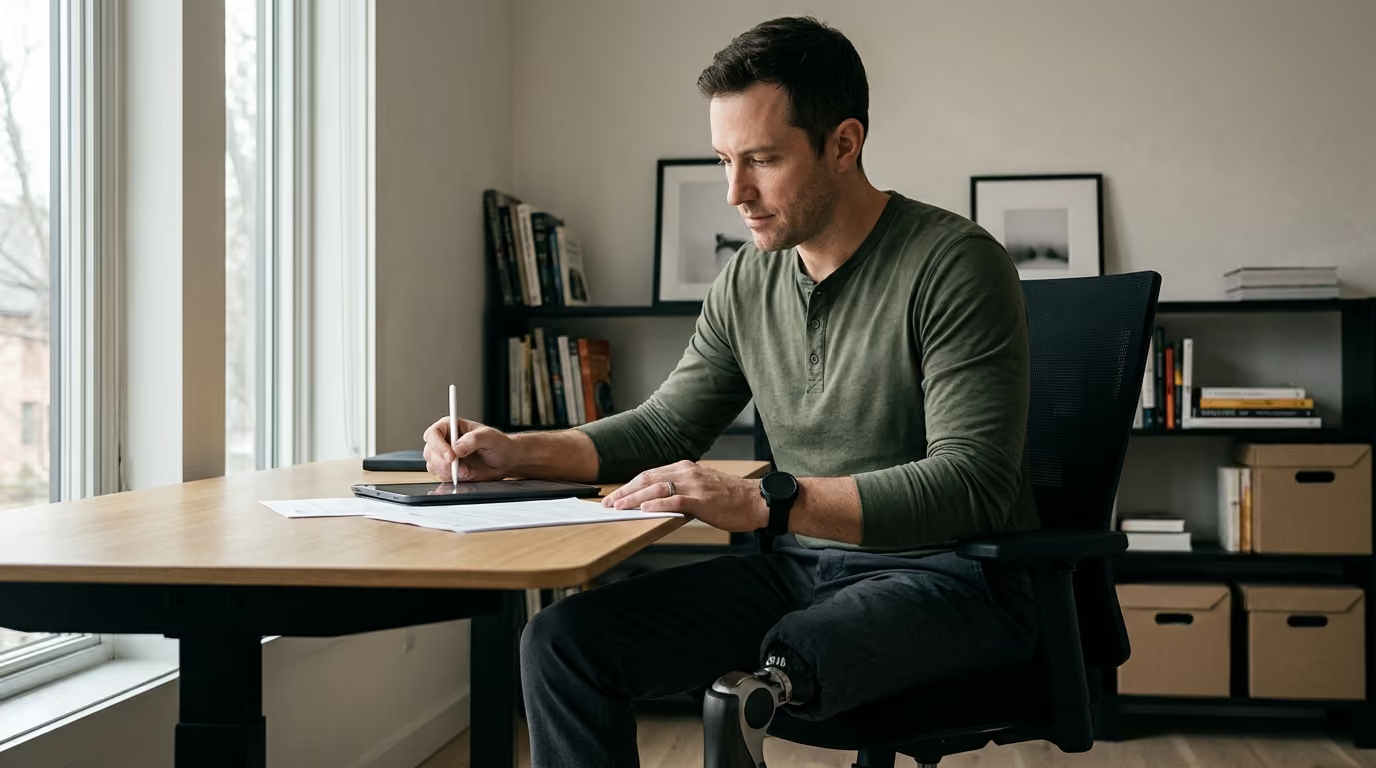
A veteran with a transtibial amputation uses an advanced prosthetic limb for daily walking around the house and neighborhood. However, walking more than half a mile causes skin irritation at the socket interface, leading to painful tissue breakdown and weeks of forced bed rest.
Recognizing that walking everywhere is counterproductive, the veteran works with their VA Prosthetics team to establish a dual mobility strategy. The veteran continues walking short distances with the prosthesis for exercise and household tasks, but uses a compact folding power scooter for grocery shopping, community events, and medical appointments.
A hitch-mounted vehicle lift allows independent transport of the scooter. This hybrid approach protects skin integrity while expanding community participation.
A veteran with a history of blast-related mild traumatic brain injury experiences executive dysfunction, including working memory lapses, difficulty tracking complex schedules, and missed medication doses.
The intervention focuses on structured cognitive assistive technology and environmental cues. The home is equipped with an automated, locked medication dispenser that sounds an audible alarm and flashes a visual light when it is time to take prescriptions. Daily routines are organized onto a digital visual wall calendar synchronized with their smartphone.
Kitchen appliances are fitted with automatic shutoff timers to prevent fire hazards. These structured tools preserve the veteran's independence without requiring constant supervision from family members.
A veteran with systemic autoimmune disease and chronic fatigue experiences unpredictable symptom flares. On good days, the veteran walks without assistance and completes standard daily tasks. On bad days, severe joint inflammation and overwhelming exhaustion make walking and standing difficult.
The functional plan incorporates an adaptable, two-tier strategy. The home is organized so essential items remain within mid-level reach, eliminating the need to climb step stools or bend to floor level. The veteran keeps a lightweight transport wheelchair ready for community outings during flare-ups and maintains an interactive telework agreement with their employer that permits remote work when physical mobility is reduced.
Planning for both good and bad days removes the anxiety of unpredictable symptoms and prevents secondary injuries.
Transitioning from assessment to action requires a structured sequence. Following these clear steps helps you implement modifications safely and systematically:
For broader resources supporting your transition and long-term health, review our evidence-backed veteran health resources and explore articles covering veteran life and transition.
This guide is provided strictly for educational and informational purposes and does not constitute personalized medical, clinical, legal, or architectural advice. Home modifications, mobility equipment selection, driving adaptations, and workplace accommodations should always be evaluated and implemented in consultation with qualified healthcare professionals, certified rehabilitation specialists, licensed contractors, and appropriate legal authorities. Individual eligibility for Department of Veterans Affairs grants and programs must be verified directly with the VA.
The Home Improvements and Structural Alterations (HISA) program provides grants for medically necessary structural alterations to a primary residence, such as adding ramps, widening doorways, or updating bathrooms for access. It is available to veterans with both service-connected and non-service-connected disabilities under different funding limits. Specially Adapted Housing (SAH) grants provide significantly higher funding amounts specifically for veterans with severe, permanent service-connected disabilities to build, buy, or substantially remodel a home for comprehensive barrier-free living.
No. Using a mobility device is an energy-conservation and joint-preservation strategy, not a personal defeat. Many veterans use wheelchairs or power scooters for long-distance community travel to manage pain and avoid fatigue, while continuing to walk short distances at home or during physical therapy. Using the right tool for the right environment expands your independence.
Yes. While the one-time Automobile Allowance vehicle purchase grant requires specific severe service-connected disabilities, the VA Adaptive Equipment program has broader eligibility criteria. For example, veterans with service-connected ankylosis of one or both knees or hips may qualify for adaptive vehicle modifications and equipment even if they do not meet the criteria for the vehicle purchase allowance.
The process begins with your VA primary care provider or rehabilitation team. Request a clinical referral for an occupational therapy or physical therapy home assessment. The clinical team will evaluate your functional mobility, write the required medical prescription, and assist you in completing VA Form 10-0103 to submit your HISA grant application to the local Prosthetic and Sensory Aids Service.
Follow BattleVet for practical guidance on military and veteran health, strength, recovery, testosterone, sleep and healthy aging. Stay connected for new articles, research backed insights and clear information to help you stay capable for the years ahead.


Build better habits around strength, recovery, sleep, hormones and healthy aging with practical guidance for active military personnel and veterans.
Explore BattleVet