
Unilateral strength training corrects hidden muscle imbalances and boosts single-limb power through targeted exercises like split squats and single-arm presses.





You wake up after a long week of training, carry a heavy rucksack down the stairs, and notice your left knee aches while your right hip feels completely fine. When you test a heavy back squat, your body naturally twists to shift the weight toward your dominant side. You step onto the gym floor to do a set of split squats, and the sudden loss of balance reveals that your legs produce force in completely different ways.
Unilateral strength training is not a replacement for traditional lifting, and it is not a circus trick focused purely on unstable surfaces. It is the systematic practice of training one limb at a time to build force, balance, coordination, and tissue tolerance across isolated movement patterns. This guide provides a complete, research-backed framework for understanding single-limb mechanics, fixing meaningful side-to-side deficits, and integrating unilateral lifts into a comprehensive training plan.
Quick Take: Unilateral training builds side-specific strength, trunk stability, and joint control by loading one limb at a time, making it an essential complement to bilateral lifting rather than a total replacement.
Unilateral training requires one arm or leg to perform the primary mechanical work of an exercise. While bilateral exercises like the barbell back squat or bench press allow the stronger side to mask deficits, single-limb exercises expose individual weaknesses and demand independent joint stabilization. Incorporating movements such as split squats, single-leg hinges, and suitcase carries improves real-world physical capability, enhances movement quality, and protects long-term joint health.
To understand single-limb performance, you must first understand how force production changes when both limbs are not working together. Resistance training movements fall into distinct mechanical categories based on how the body shares load and stabilizes joints.
A bilateral exercise requires both limbs to produce or resist force at the same time. Classic examples include back squats, deadlifts, barbell overhead presses, and bilateral leg presses. These movements are unmatched for handling heavy absolute loads. They allow you to apply high mechanical tension across large muscle groups simultaneously.
A unilateral exercise places the primary mechanical load onto a single limb. True single-limb movements include single-leg squats, step-ups, single-leg Romanian deadlifts, and one-arm dumbbell presses. The non-working limb may assist with light balance, but it cannot contribute meaningful mechanical work.
The line between these categories is not always absolute. A rear-foot-elevated split squat is mechanically unilateral because the front leg performs roughly eighty to ninety percent of the work. However, the back foot still contacts a bench to provide balance and slight assistance. A standard split squat distributes even more load to the rear leg. Recognizing these differences helps you select the right exercise for your exact training goal.
Asymmetrical training is a broader category that includes unilateral work. An asymmetrical exercise distributes load unevenly across the body, even if both feet remain planted on the floor.
Examples of asymmetrical movements include:
Asymmetrical loading challenges the trunk, pelvis, and shoulder girdle to resist rotation and lateral bending. Even when both feet stay on the ground, your core musculature must fire intensely to keep your spine aligned. This makes asymmetrical loading a practical bridge between traditional bilateral lifts and pure single-limb work. For more on structuring balanced physical development, review our strength and conditioning resources.
Every single-limb movement presents two distinct challenges. The first challenge is local muscular strength, which measures whether the working limb can generate enough force to complete the repetition. The second challenge is global control, which measures whether the nervous system can stabilize the pelvis, spine, and ribcage while that force is being applied.
Consider a single-leg Romanian deadlift. An athlete might fail a heavy repetition because their hamstrings lack raw strength. Alternatively, they might fail because their foot arches collapse, their hips rotate open, or their vestibular system loses balance. When programming single-limb work, you must identify whether an exercise is limited by local muscle capacity or whole-body stability.
You can categorize single-limb movements by their primary constraint to program them accurately:
Understanding these constraints stops you from treating all single-limb exercises as balance drills. When you want to build maximum leg size, you choose high-stability variations. When you want to train dynamic balance, you choose unsupported variations.
Exercise scientists have compared unilateral and bilateral training for decades. Modern research clarifies how these modalities affect muscle size, maximum strength, sprint speed, and neural pathways.
A common belief is that bilateral exercises are superior for building muscle mass because they allow heavier total loads. However, the scientific evidence shows that muscle growth depends primarily on mechanical tension, adequate volume, proximity to muscular failure, and sufficient range of motion.
A systematic review and meta-analysis published in 2025 directly compared muscle growth between bilateral and unilateral resistance training programs. The researchers analyzed multiple controlled trials and found no significant difference in muscle hypertrophy between the two approaches. The quadriceps, glutes, and upper-body musculature grew at comparable rates when training sets were taken close to muscular failure.
Unilateral training provides specific programming advantages for hypertrophy:
These findings show that single-limb training is a primary muscle-building tool. It is not merely a warm-up drill or an accessory option.
Strength adaptations follow the principle of specificity. Your nervous system gets better at the exact movement patterns, joint angles, and stabilization demands that you practice regularly.
The 2025 meta-analysis confirmed this clear pattern. Bilateral training produced greater improvements in bilateral strength tests, such as the barbell back squat and bench press. Unilateral training produced superior gains in single-limb tests, such as the single-leg squat and unilateral leg press.
A 2021 systematic review published in the Physical Activity and Health journal examined athletic performance adaptations across diverse training groups. The authors found that both unilateral and bilateral training significantly improved strength, change of direction, and running speed. Neither method was universally superior across every metric. The takeaway is simple: if you want to lift heavy bilateral weights, you must practice bilateral lifts. If you want high single-limb output, you must train unilaterally.
Running and cutting are inherently single-limb actions. During sprinting, your body alternates between rapid unilateral force production and single-leg impact absorption. This has led many coaches to assume that unilateral lifting is inherently better for athletic development.
The research literature shows a more balanced reality. A 2021 meta-analysis found no overall difference between bilateral and unilateral training for bilateral jump height or straight-line sprint speed. However, subgroup analysis showed that unilateral training created greater improvements in single-leg horizontal and vertical jumping performance.
A subsequent meta-analysis in 2023 supported this distinction. Bilateral training was more effective for improving two-legged jumping power, while unilateral training was more effective for single-limb propulsion. Research examining horizontal athletic tasks confirms that both modalities improve sprint speed, with neither method establishing clear dominance. Combining heavy bilateral lifts with dynamic unilateral movements produces the most complete athletic transfer. To study how recovery affects these adaptations, read our recovery and sleep strategies.
One of the most fascinating aspects of unilateral training is the cross-education effect. Cross-education describes the increase in strength observed in an untrained limb after training the opposite limb.
A comprehensive meta-analysis of contralateral strength adaptations found an average strength increase of roughly twelve percent in the untrained opposite limb. Lower-body interventions produced an average strength transfer of sixteen percent, while upper-body interventions produced a nine percent gain. An earlier meta-analysis estimated that the untrained limb gains approximately thirty-five percent of the strength achieved by the trained limb.
This strength transfer is driven by neural mechanisms rather than muscle growth:
A 2026 meta-analysis of upper-limb research confirmed that cross-education increases one-repetition maximum strength without causing measurable muscle hypertrophy in the untrained side. If you suffer a broken wrist, an ankle sprain, or an injury that immobilizes one limb, training your healthy side helps preserve strength and neural function in the injured limb.
Interlimb asymmetry describes a measurable difference in strength, power, range of motion, or movement quality between the right and left sides of the body. Assessing these differences is common in military and sports environments, but the data must be interpreted carefully.
To track differences accurately, you must use a standardized calculation method. Small changes in mathematical formulas can dramatically alter your reported asymmetry numbers.
A standard percentage difference equation is:
Asymmetry Percentage = ((Stronger Side - Weaker Side) / Stronger Side) * 100
For example, if your right leg can complete a split squat with 100 pounds for eight repetitions, but your left leg can only complete eight repetitions with 85 pounds, the calculation is:
((100 - 85) / 100) * 100 = 15% Asymmetry
Consistency is essential when recording these values. Pick one calculation method and use it across all testing sessions to track meaningful trends over time.
Many fitness resources claim that an asymmetry greater than ten percent automatically increases injury risk and ruins performance. Current sports science research does not support this rigid rule.
A 2021 methodological review examined ten years of asymmetry data and concluded that the standard ten-to-fifteen percent threshold is largely arbitrary. A systematic review of prospective cohort studies found inconsistent evidence linking lower-limb functional asymmetries directly to athletic injury.
Human bodies are naturally asymmetrical. A pitcher, a right-footed soccer player, or a service member carrying gear on a preferred side will develop functional side-to-side differences. A ten percent difference should be treated as a screening marker for further investigation, not as an automatic medical problem or a reason to stop training.
Asymmetry is not a fixed bodily trait. An individual can display significant asymmetry in one physical test while appearing completely balanced in another.
Consider these contrasting scenarios:
Differences depend on the speed of the movement, the joint angles involved, and whether the test measures strength, power, or mobility. You should assess asymmetry using movements that directly reflect your physical goals rather than searching for generic symmetry.
A common testing mistake is failing to account for test order. If you test your right leg first and immediately test your left leg, the second side may perform poorly due to systemic fatigue.
Follow these testing rules to ensure accurate data:
Standardized testing prevents you from mistaking normal workout fatigue for a true muscular deficit. For insights on maintaining peak operational capability, explore our military health research.
A comprehensive unilateral training plan requires a balanced selection of knee-dominant, hip-dominant, pressing, pulling, and loaded carry exercises. Each movement pattern builds unique joint capabilities and movement control.
Split squats form the foundation of lower-body single-limb training. They develop the quadriceps, gluteus maximus, and adductors while testing pelvic stability.
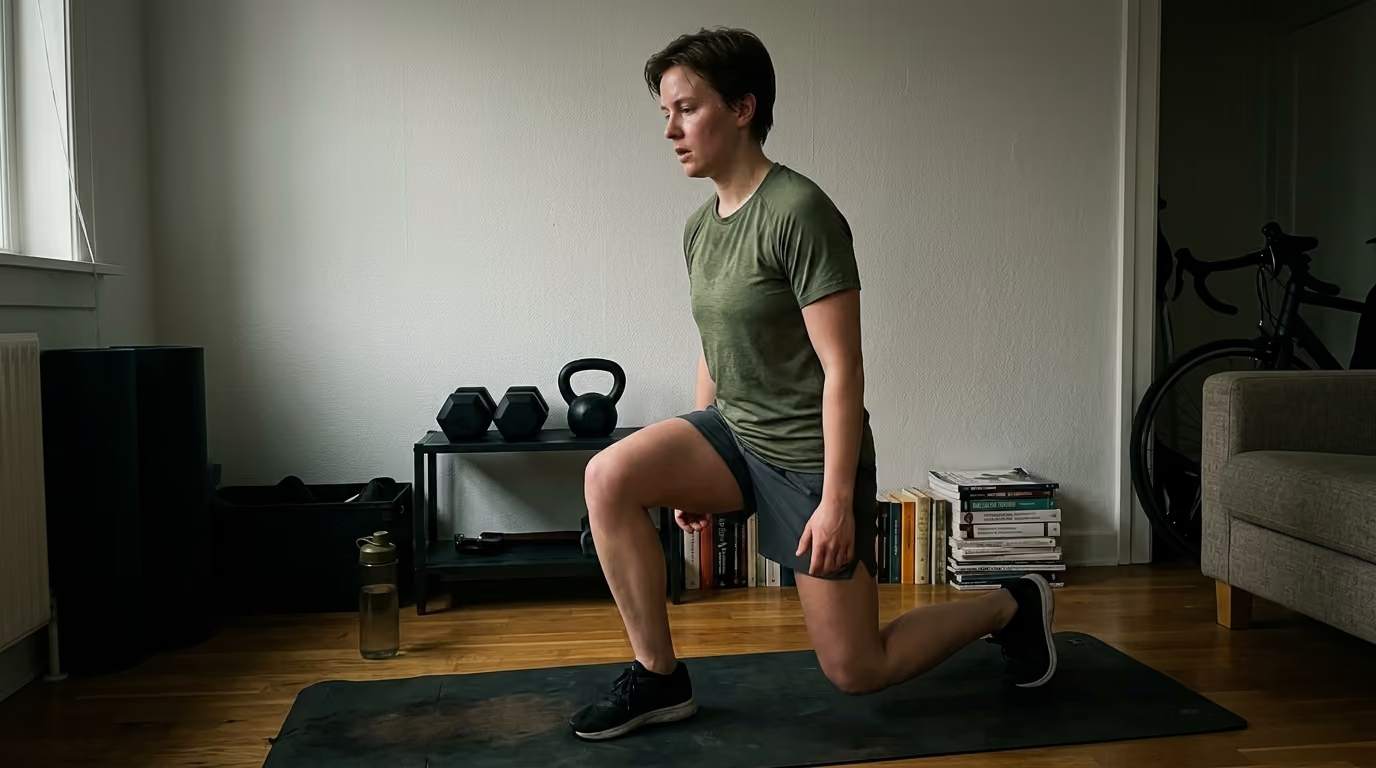
The standard split squat keeps both feet stationary on the floor in a staggered stance. Because the feet do not move between repetitions, it is easier to balance than a walking lunge. It allows lifters to master pelvic alignment and knee tracking before adding complex balance demands.
To perform the movement correctly:
Often called the Bulgarian split squat, this variation places the top of your rear foot on an elevated bench or pad. Elevating the rear leg shifts roughly eighty-five percent of the load onto the front working limb, dramatically increasing the demand on the front quadriceps and glutes.
Common execution errors include elevating the back foot too high, which hyperextends the lumbar spine, or placing the front foot too close to the bench. Set the bench height around mid-shin level and maintain a strong core brace throughout the set.
Dynamic lunges require stepping into and out of each repetition. Reverse lunges are generally easier on the knees because the stepping motion allows for a vertical shin and controlled deceleration. Forward lunges create higher braking forces, challenging the quadriceps to decelerate your body weight.
Lateral lunges move the body into the frontal plane. They build strength in the adductors, abductors, and gluteus medius while challenging hip mobility. Lateral lunges prepare the lower body to handle unexpected sideways forces and uneven terrain.
Single-leg hinges target the hamstrings, gluteus medius, and spinal erectors while demanding high levels of balance and foot control.
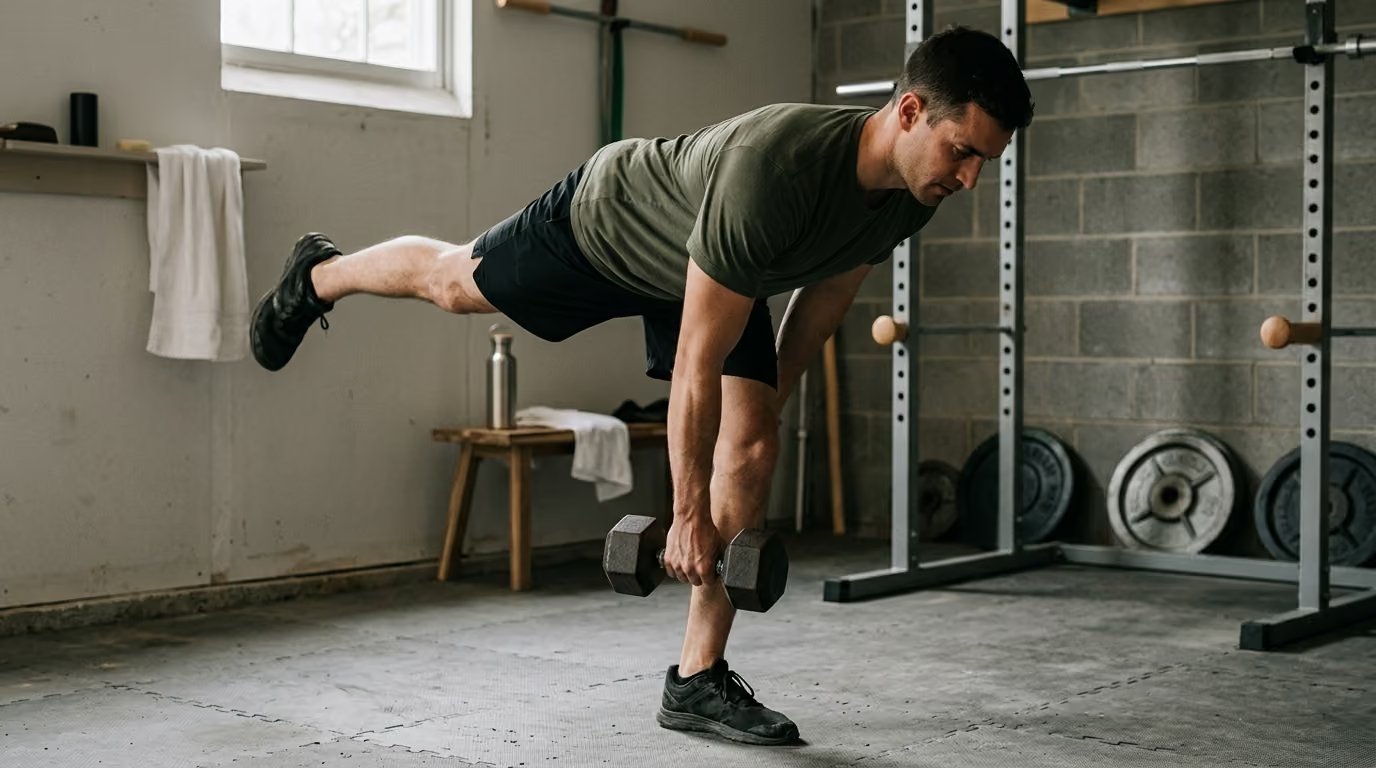
The single-leg Romanian deadlift requires you to hinge at the hip while standing on one leg, extending the opposite leg behind you as a counterbalance. It builds powerful posterior chain strength and trains the foot to maintain an active tripod arch.
Key technique cues include:
The kickstand variation is an asymmetrical hinge where the non-working foot rests lightly on the floor roughly one step behind the working leg. The rear toes provide balance like a bicycle kickstand, allowing you to load the front hamstring and glute with heavy weights without being limited by balance.
Use the kickstand variation when your primary goal is maximal posterior chain hypertrophy or strength. Use the unsupported single-leg hinge when your primary goal is balance, foot stability, and rotational control.
Step-ups and step-downs isolate unilateral knee extension and eccentric deceleration with minimal lower-back strain.
The step-up emphasizes unilateral propulsion and hip extension. A common mistake is using the rear leg to push off the floor, which turns a unilateral exercise into a jumping movement.
To perform a strict step-up:
The step-down targets the quadriceps and patellar tendon through controlled eccentric loading. Stand on the edge of a low box, keep your pelvis level, and slowly lower the opposite heel toward the floor by bending the stance knee.
Step-downs expose knee valgus, where the knee collapses inward, and pelvic drop. Performing step-downs with a slow three-second lowering phase builds robust patellar tendon tolerance and exceptional landing control.
Loaded carries combine locomotion with intense isometric trunk stability. They force your core musculature to stabilize your spine against moving, asymmetrical loads.
The suitcase carry requires holding a heavy dumbbell or kettlebell in one hand while walking forward in a straight line. The weight tries to pull your torso into lateral flexion. Your lateral abdominal wall, internal obliques, and contralateral glute medius must contract intensely to keep your shoulders level.
Maintain a normal walking cadence without rushing. Avoid leaning away from the weight or resting the dumbbell against your thigh.
Holding a weight in the unilateral front-rack position elevates the center of mass, challenging your thoracic spine and anterior core. The single-arm overhead waiter carry places the weight directly overhead, demanding upward scapular rotation, rotator cuff activation, and strict ribcage control while walking.
Unilateral upper-body exercises correct pressing imbalances, improve scapular mobility, and train rotational core stability.
Key upper-body variations include:
These movements allow your shoulder blades to glide naturally along the ribcage, reducing joint irritation compared to fixed barbell movements. To see how functional movement supports long-term physical capability, review our healthy aging and longevity guides.
Progressing single-limb exercises is not just about grabbing heavier dumbbells. Because unilateral movements involve balance and multi-planar control, you can adjust several training variables to increase difficulty.
You can increase the neurological demand of an exercise by gradually reducing the amount of external support.
Follow this systematic stability progression:
This progression lets you build foundational motor control before exposing your joints to complex, unsupported positions.
You can increase the difficulty of a movement without adding external load by adjusting joint angles, elevation, and lever arms.
Slowing down the repetition speed removes momentum and forces the working muscles to produce tension throughout the entire range of motion.
Incorporate a three-second lowering phase followed by a two-second pause in the stretched bottom position of a split squat or single-leg deadlift. This technique strengthens tendons, improves positional awareness, and produces high levels of muscular tension with relatively light weights.
Once you demonstrate solid strength and eccentric control, you can progress to unilateral power development.
Follow this power progression sequence:
Athletes must master the ability to absorb landing forces before progressing to repeated, high-speed plyometric drills.
A complete training program does not force a choice between bilateral and unilateral lifts. The most effective strategy integrates both modalities to maximize absolute strength, hypertrophy, and single-limb stability.
Your training goals determine how you balance bilateral and unilateral exercises within your training week.
Single-limb exercises that require high balance and coordination should be placed early in the workout when your nervous system is fresh.
Follow this logical session structure:
If a specific single-limb exercise is limited by balance, perform it before fatigue degrades your coordination. If your goal is pure muscle fatigue, choose supported variations later in the session.
To resolve strength and volume differences between sides, follow structured programming rules.
Always begin your unilateral sets on your weaker or less coordinated limb. Count the clean repetitions completed on that side. When you switch to the stronger side, perform only the exact number of repetitions completed by the weaker limb, using identical weight and tempo.
This prevents your dominant side from performing extra volume, allowing the weaker limb to catch up naturally over time.
If a meaningful asymmetry persists after several months of equal-volume training, you can add one or two extra sets to the weaker limb at the end of the exercise. Use this method carefully. Weakness is often caused by motor control limitations or past joint irritation rather than a simple lack of training volume.
Use these sample workout structures to integrate unilateral training based on your specific goals.
For more detailed programming structures, check out our training and performance articles.
Unilateral exercises introduce balance and alignment variables that do not exist during bilateral lifting. Avoiding these ten common pitfalls will keep your training productive and safe.
Claiming that single-limb training should replace bilateral lifting ignores the law of specificity. Bilateral lifting remains the most efficient way to handle heavy absolute loads and develop maximum two-legged force. Use both methods for their distinct benefits.
A dumbbell split squat uses less absolute weight than a heavy barbell back squat, but it places intense mechanical tension on the working quadriceps and glutes. Judge the difficulty of a single-limb set by its technical execution and proximity to muscular failure, not by the number printed on the dumbbell.
Standing on an unstable foam pad while trying to perform heavy single-leg squats reduces force production and increases injury risk. Instability should come from your body position, not from unstable surfaces under your feet. Use stable ground so your muscles can produce meaningful force.
Panicking over an eight-to-twelve percent strength difference between your legs is unnecessary. Human bodies are naturally asymmetrical due to limb dominance, sports backgrounds, and daily habits. Focus on steady strength progression and movement quality rather than striving for artificial, perfect symmetry.
Testing your left leg immediately after a grueling set on your right leg will produce inaccurate data due to fatigue. Always allow full cardiovascular and muscular recovery between sides when evaluating strength differences. Alternate which side you test first across different training blocks.
Allowing your stronger leg to perform twelve repetitions while your weaker leg can only manage eight widens your strength imbalance. Always set the repetition target using your weaker side, and match that volume on your stronger side.
If an athlete struggles with a single-leg squat, the issue is not always weak quadriceps. Ankle mobility restrictions, poor big-toe extension, or impaired hip rotation can cause movement breakdowns. Assess joint range of motion before assuming a strength deficit.
Using the back foot to bounce out of the bottom of a split squat or step-up removes the load from the front working leg. Keep the trailing foot passive and drive purely through the working midfoot to isolate the target musculature.
Many training programs include only forward and backward unilateral movements, such as lunges and split squats. Neglecting the frontal and transverse planes leaves the adductors, abductors, and rotational core muscles underdeveloped. Program lateral lunges, rotational carries, and offset presses regularly.
Attempting an overhead, unsupported single-leg squat before mastering a basic split squat creates poor movement habits. Master stable, supported unilateral exercises before adding complex balance demands, dynamic speed, or multi-planar loads.
Single-limb training provides practical solutions for lifters working through injuries, managing chronic joint discomfort, or navigating age-related physical changes.
When an acute injury or surgical procedure immobilizes one limb, you should continue training the healthy opposite side. As supported by cross-education research, training the uninjured arm or leg stimulates the nervous system and preserves strength in the resting limb.
While cross-education does not prevent muscle atrophy entirely, it reduces neural degradation and helps maintain motor unit recruitment pathways. When medical clearance is given to begin loading the recovering limb, the rehabilitation process proceeds faster because neural drive has been preserved.
Bilateral barbell lifting locks both hands or feet into fixed positions, which can irritate sensitive wrists, shoulders, hips, or knees. Unilateral exercises allow joints to move freely along their natural anatomical paths.
If a conventional back squat causes lower-back discomfort, switching to a heavy dumbbell split squat reduces axial spinal compression while delivering high quadriceps stimulus. If an unsupported single-leg deadlift irritates a hip joint, moving to a kickstand variation provides external stability and allows for pain-free posterior chain loading.
For older adults and beginners, maintaining single-limb strength is essential for balance, fall prevention, and independent daily function. However, unsupported single-leg exercises can be intimidating and unstable.
Start older lifters with hand-supported split squats, low box step-ups, and supported kickstand hinges. Research shows that single-limb balance training creates rapid neural practice effects. As coordination improves, external hand support can be gradually removed.
Athletes in sports like baseball, tennis, javelin, soccer, or golf perform thousands of asymmetrical movements over their careers. Their bodies adapt specifically to handle these sport-specific rotations and unilateral impacts.
The goal of strength training for asymmetrical athletes is not to force both sides into identical symmetry. The goal is to ensure both sides have sufficient strength, joint mobility, and eccentric control to handle training workloads safely. Single-limb training builds balanced foundational capacity while respecting the natural adaptations of the sport.
This article is provided for educational and informational purposes only. It is not intended to provide medical advice, diagnosis, or treatment. Always consult with a qualified physician, physical therapist, or healthcare provider before beginning any new exercise program, particularly if you are recovering from an injury or managing chronic joint pain.
Unilateral training cannot fully replace bilateral lifting if your primary goal is maximizing absolute strength in bilateral movements like the back squat or deadlift. Strength adaptations are specific to the movement patterns trained. Bilateral lifts allow you to handle heavier total loads and develop high bilateral force. A well-rounded physical program uses bilateral lifts for raw force production and unilateral lifts for side-specific strength, trunk stability, and joint control.
Strength differences between ten and fifteen percent are common and generally considered normal across both athletic and tactical populations. Research shows that minor asymmetries do not automatically cause injuries or degrade overall performance. Treat a ten percent difference as a general screening marker rather than a serious problem. Focus on moving with good technique, building balanced capacity, and letting the weaker side set your training volume.
Your choice depends entirely on your training goal for that specific exercise. If your goal is maximum muscle hypertrophy or strength, choose supported variations like kickstand deadlifts or split squats, where balance does not end the set prematurely. If your goal is improving dynamic balance, ankle stability, and whole-body coordination, choose unsupported single-leg hinges and step-downs with lighter external loads.
Always start every unilateral exercise with your weaker side. Complete a technically sound set, count your completed repetitions, and perform only that exact number of repetitions on your stronger side. Keep load, tempo, and rest intervals identical for both limbs. Avoid adding excessive extra sets to the weaker side, as imbalances often stem from motor control limits or past joint restrictions rather than a simple lack of workout volume.
Follow BattleVet for practical guidance on military and veteran health, strength, recovery, testosterone, sleep and healthy aging. Stay connected for new articles, research backed insights and clear information to help you stay capable for the years ahead.


Build better habits around strength, recovery, sleep, hormones and healthy aging with practical guidance for active military personnel and veterans.
Explore BattleVet