
A well-rounded strength training program becomes effortless to build when you master fundamental movement patterns across both lower and upper body planes.





You step out of bed, and your knees feel stiff from yesterday's heavy loading. Bending down to tie your boots requires focus on your lower back. Reaching for a bag in the trunk demands shoulder control and balance. Daily life does not test your body in isolated muscle groups, yet many workout routines still isolate body parts rather than training functional human movements.
Organizing your strength training around fundamental movement patterns creates balanced physical capability, protects joint health, and builds sustainable strength for life.
A complete movement-pattern framework focuses on training mechanical tasks rather than chasing isolated muscle groups. By structuring weekly workouts around the squat, hinge, lunge, push, pull, carry, brace, rotation, and locomotion, you build comprehensive strength. This approach uses whatever tools you have available while adapting to your specific physical needs, previous injuries, and long-term goals.
Traditional fitness routines often split training days by body parts, such as chest day or leg day. This approach can build muscle, but it often misses how the human body naturally generates and transfers force. In real life, sports, and occupational tasks, muscles never work in complete isolation.
Movement patterns represent the mechanical tasks your skeleton and muscular system perform. The National Strength and Conditioning Association categorizes lower-body actions primarily as knee-dominant or hip-dominant. Upper-body actions are divided into horizontal and vertical planes of pushing and pulling.
To build an effective training program, you must understand five distinct concepts:
A movement pattern is the foundational mechanical task being trained. Examples include hinging at the hips, squatting with the knees, or pressing weight overhead. The pattern describes how joints bend and straighten together to complete a task.
An exercise is a specific practical execution of a pattern. A barbell front squat, a dumbbell goblet squat, and a bodyweight box squat are different exercises. However, all three train the exact same underlying knee-dominant pattern.
A tool is the external resistance or equipment used to load the exercise. Common tools include barbells, dumbbells, kettlebells, resistance bands, suspension trainers, cable stacks, machines, and sandbags. You can train almost every fundamental pattern using several different tools.
The training effect is the physiological adaptation you want to achieve. This includes maximal strength, muscular hypertrophy, explosive power, muscular endurance, joint mobility, or balance. The way you dose sets, reps, load, and tempo determines the resulting training effect.
A constraint is any limiting factor that shapes exercise selection. Constraints include existing joint pain, limited range of motion, equipment availability, technical skill level, or accumulated fatigue. A well-designed framework adjusts the exercise and tool around constraints without abandoning the necessary movement pattern.
When you understand these distinctions, exercise selection becomes flexible and practical. If your lower back feels aggravated by heavy barbell back squats, you do not need to abandon knee-dominant training. You can substitute a supported split squat or a leg press to achieve the desired stimulus. Exploring strength, fitness, and body composition guides can help you match exercises to your equipment and goals.
Lower-body training forms the foundation of physical independence, athletic power, and structural resilience. The three core lower-body patterns distribute mechanical stress across the ankles, knees, hips, and spine in distinct ways.
The squat is a knee-dominant pattern characterized by simultaneous flexion and extension of the hips and knees. The torso stays relatively upright compared to a deadlift. The center of mass drops down between a symmetrical or near-symmetrical base of support.
Primary physical qualities developed through the squat pattern include:
Bilateral squat variations include the barbell back squat, front squat, safety-bar squat, Zercher squat, goblet squat, box squat, and machine leg press. Unilateral or staggered squat variations include split squats, Bulgarian split squats, single-leg box squats, and step-ups.
When programming the squat, adjust depth according to individual hip anatomy, ankle mobility, and joint comfort. A common mistake is forcing every lifter to achieve a specific depth regardless of their hip structure. Another mistake is believing that the knees must never pass the toes during a squat. Forward knee travel is a normal part of deep knee flexion that distributes load across the lower-body joints.
The hinge is a hip-dominant pattern where the hips travel backward and forward with minimal forward knee travel. The spine stays organized in a stable position while the posterior chain absorbs and produces force.
Primary physical qualities developed through the hinge pattern include:
Hinge exercises fall into two distinct mechanical categories:
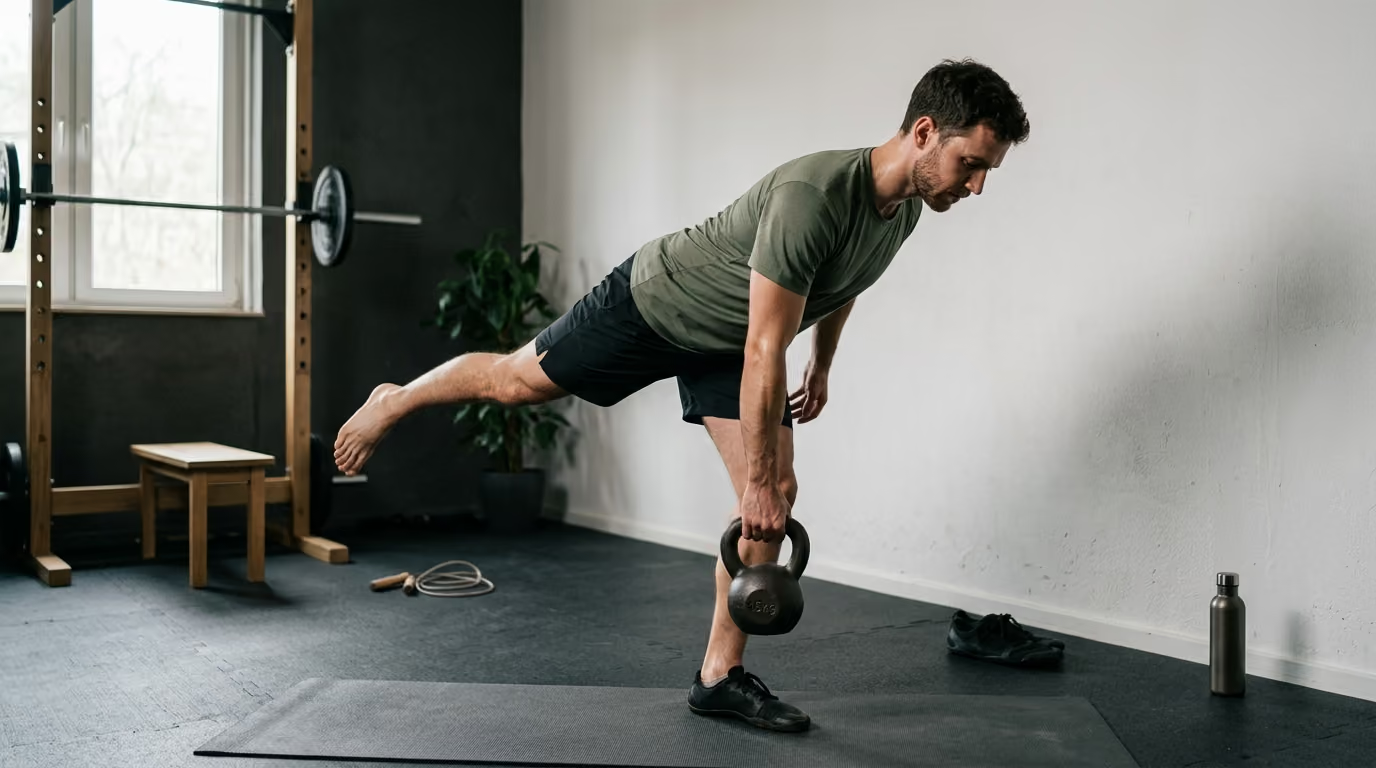
Slow-strength hinges focus on controlled force production against high resistance. Examples include conventional deadlifts, Romanian deadlifts, sumo deadlifts, stiff-leg deadlifts, good mornings, and cable pull-throughs. Unilateral hinges include single-leg Romanian deadlifts and kickstand deadlifts.
Ballistic hinges focus on rapid hip extension and high velocity. Examples include kettlebell swings, dumbbell snatches, high pulls, and barbell power cleans.
Progress hinges by increasing load, increasing range of motion, or shifting to single-leg variations. Do not turn a hinge into a squat by bending the knees excessively. Maintain an intentional spinal position to protect force transfer between the hips and upper body.
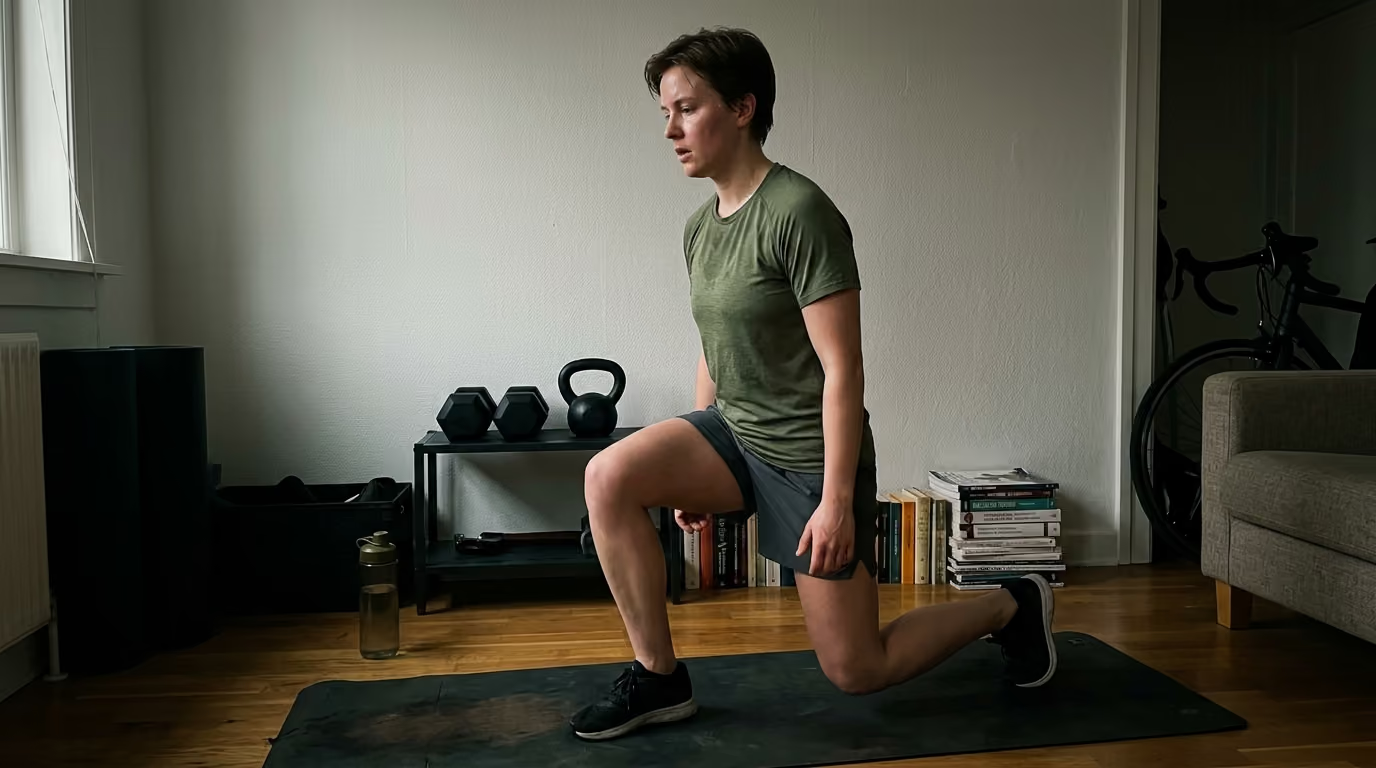
The lunge is an asymmetrical lower-body pattern where one leg carries the majority of the load. While lunges share mechanical qualities with squats and locomotion, they challenge balance, hip stability, and joint control in unique ways.
Unilateral training develops vital athletic and functional qualities:
National Strength and Conditioning Association research highlights that tactical personnel and athletes rely heavily on unilateral movement in field environments. Unilateral work places greater demands on ankle and trunk stabilizers than bilateral movements.
Exercise variations include reverse lunges, forward lunges, walking lunges, lateral lunges, Cossack squats, and step-ups. Reverse lunges are generally easier to control because stepping backward reduces deceleration forces on the front knee. You can load lunges with dumbbells at your sides, a kettlebell in the goblet position, or offset loading in a single hand.
Upper-body strength requires balancing pushing and pulling forces across horizontal and vertical planes. Balancing these movement vectors maintains healthy shoulder mechanics and builds balanced muscular development.
A horizontal push moves an external load away from the chest or presses the body away from a stationary surface in the horizontal plane.
Key exercises include standard push-ups, flat barbell bench presses, dumbbell floor presses, and horizontal machine chest presses. These movements primarily train the pectoralis major, anterior deltoids, and triceps.
Horizontal pressing demands stable shoulder blades and a solid torso brace. Modifying grip width, elbow angle, or using dumbbells can relieve joint strain for individuals with previous shoulder issues. Performing push-ups also trains serratus anterior function and natural scapular movement better than fixed-bench pressing.
A vertical push drives resistance upward overhead or presses the body upward vertically.
Key exercises include standing overhead barbell presses, seated dumbbell shoulder presses, kettlebell presses, landmine presses, and push presses. These movements target the deltoid musculature, upper trapezius, and triceps while demanding trunk stability.
If an individual lacks the thoracic mobility or shoulder flexion needed to press directly overhead safely, the landmine press is an excellent alternative. The angled pressing path reduces stress on the glenohumeral joint while retaining vertical pressing benefits.
A horizontal pull draws resistance toward the torso from a position in front of the body.
Key exercises include one-arm dumbbell rows, barbell bent-over rows, seated cable rows, chest-supported machine rows, and bodyweight inverted rows. These exercises target the latissimus dorsi, rhomboids, middle trapezius, rear deltoids, and elbow flexors.
Horizontal pulling is essential for posture, shoulder health, and counteracting prolonged seated positions. Use a controlled tempo without excessive torso momentum to ensure the upper-back musculature does the work.
A vertical pull moves resistance downward toward the collarbone or pulls the body upward toward an overhead anchor point.
Key exercises include standard pull-ups, chin-ups, lat pulldowns, and neutral-grip assisted pull-ups. These movements build width in the latissimus dorsi, develop grip strength, and train scapular depression and downward rotation.
A comprehensive upper-body program should incorporate both horizontal and vertical pulling across the training week. Do not rely exclusively on pulldowns or pull-ups. Balance vertical pulling with horizontal rowing to support complete shoulder health and upper-back density. Additional training and performance articles provide specific exercise pairings for balanced upper-body development.
The core musculature functions primarily to transfer force, stabilize the spine, and resist unwanted movement. Rather than focusing on repetitive spinal flexion like traditional sit-ups, an effective movement-pattern framework emphasizes carrying, bracing, and controlled rotation.
Loaded carries require you to support heavy resistance while walking over distance or time. Carries connect grip strength, shoulder stability, trunk rigidity, and gait into a single functional challenge.
Common carry variations include:
Carries can be programmed for strength using heavy loads over short distances of 15 to 30 meters. They can also be used for conditioning by carrying moderate loads over longer distances or for set time intervals.
Bracing refers to creating stiffness throughout the trunk musculature to protect the spine and transfer force efficiently. Physical therapist and sports medicine definitions frame core stability as controlling trunk position to optimize force transfer between the upper and lower extremities.
Comprehensive trunk training addresses four distinct stabilization demands:
Resisting backward arching or collapse of the lower back under load. Key exercises include front planks, ab-wheel rollouts, dead bugs, and body saws.
Resisting forward rounding of the spine when loaded anteriorly. Key exercises include heavy deadlifts, front squats, and barbell good mornings.
Resisting sideways bending of the spine under asymmetrical loads. Key exercises include side planks, suitcase carries, and offset dumbbell lunges.
Resisting twisting forces acting on the torso. Key exercises include the Pallof press, single-arm cable holds, and offset push-ups.
While anti-rotation trains the body to resist twisting, true rotational training develops the ability to produce and control rotational power intentionally. Rotational capacity is critical for throwing, striking, swinging tools, and athletic maneuvering.
Rotational exercises should distribute motion through the hips and thoracic spine rather than isolating the lumbar spine. Effective rotational exercises include medicine ball rotational scoop throws, cable woodchops, cable rotational lifts, landmine rotations, and controlled Russian twists.
Train rotation using low-load mobility drills, moderate-load strength work, or high-velocity medicine ball throws based on your specific performance goals.
Locomotion is the fundamental human ability to travel through space. It includes walking, rucking, jogging, sprinting, crawling, climbing, and multi-directional agility drills. Locomotion is not merely cardiovascular conditioning. It is a complex motor skill that tests balance, foot mechanics, force absorption, and unilateral coordination.
Gait integrates every joint from the big toe through the pelvis and up to the shoulder girdle. Walking and running require alternating cycles of single-leg support, balance control, and rotational arm swing.
Exercise families within the locomotion pattern include:
The World Health Organization physical activity guidelines recommend that adults accumulate 150 to 300 minutes of moderate-intensity aerobic physical activity weekly, or 75 to 150 minutes of vigorous-intensity activity. The guidelines also recommend muscle-strengthening activities involving all major muscle groups on two or more days per week. For older adults, the guidelines emphasize incorporating multi-component physical activity that emphasizes balance and functional locomotion to prevent falls. Reviewing healthy aging and longevity resources provides practical ways to sustain these locomotion baselines as you age.
A movement pattern can be trained using various training tools. Each piece of equipment offers distinct mechanical advantages, stability demands, and practical limitations.
Barbells allow for the highest external loading and the most straightforward progressive overload. They are the premier tool for building maximal bilateral strength in the squat, hinge, bench press, and overhead press. However, barbells lock the hands and feet into fixed positions, which may aggravate joint issues for some trainees. They also require higher baseline skill and dedicated gym equipment.
Dumbbells allow each limb to move independently through a natural, comfortable joint path. They make unilateral training and offset loading simple and effective. Dumbbells are ideal for single-arm rows, split squats, flat and incline presses, and suitcase carries. Their main limitation is that loading increments are sometimes limited in home gym setups.
Kettlebells feature a displaced center of mass that sits away from the grip. This unique geometry makes them exceptional for ballistic hip hinges like swings, snatches, and cleans. Kettlebells also excel in front-rack carries, goblet squats, and Turkish get-ups. They challenge grip strength and shoulder stabilizers in ways standard dumbbells cannot match.
Machines provide a fixed path of motion and high external stability. This eliminates balance demands, allowing you to train a targeted muscle group close to fatigue with minimal technical risk. Machines like the leg press, seated cable row, chest press, and lat pulldown are valuable tools for muscle hypertrophy, rehabilitation, and joint deloading. However, machines do not train the balance, stabilization, and multi-planar control developed by free weights.
Cables and elastic bands provide continuous resistance across multiple planes and angles. They are ideal for anti-rotation holds, cable chops, face pulls, lateral raises, and horizontal pressing variations. Bands provide variable resistance that increases as the band stretches, making them useful for accommodating resistance and home workouts.
Sandbags, logs, and heavy stones have shifting centers of mass that require significant full-body bracing. Lifting and carrying odd objects builds real-world grip strength, trunk stiffness, and physical resilience. However, precisely tracking and progressing load is more difficult with sandbags than with calibrated iron plates.
Bodyweight training requires no equipment and can be performed anywhere. Push-ups, pull-ups, dips, single-leg squats, inverted rows, planks, and bear crawls effectively train fundamental patterns. You can progress bodyweight movements by changing levers, adjusting tempo, pausing at difficult angles, or elevating feet rather than simply adding external weight.
Understanding what scientific research supports helps you avoid training trends and design sustainable programs.
Substantial research shows that weekly set volume is a primary driver of muscular hypertrophy and strength development. An umbrella review examining resistance-training variables reported that training volume consistently influences both strength and hypertrophy adaptations. Higher weekly volumes generally produce greater muscular gains up to an individual recovery limit.
However, research also demonstrates that high volume is not always necessary for progress. A 2025 study in resistance-trained individuals found that maintaining approximately 12 weekly sets per muscle group produced hypertrophy comparable to higher volumes when training effort was maintained close to failure.
For older adults, a 2024 meta-analysis revealed that low-volume resistance training substantially improves physical function, lean mass, and muscle size. Higher volumes were only necessary when chasing maximal strength adaptations. This evidence indicates that you do not need excessive volume to achieve meaningful strength and health benefits.
A 2024 systematic review on resistance training frequency confirmed that when total weekly volume is matched, training frequency does not have a major independent effect on muscle growth. Whether you perform 12 weekly sets for a movement pattern across two full-body sessions or four split sessions, adaptations remain similar.
Training frequency is primarily a scheduling and fatigue-management tool. Spreading volume across multiple sessions per week allows you to maintain higher movement quality, manage joint stress, and avoid severe muscle soreness.
The evidence surrounding core stability training requires a balanced perspective. A 2025 systematic review found that dedicated core training reliably improves trunk strength, core endurance, dynamic balance, and sprint speed in athletes. However, the review found less certain effects on jumping height and change-of-direction agility.
A critical review on core stability emphasized that while trunk control is essential for postural alignment and force transfer, broad claims that core exercises prevent all injuries or directly enhance all athletic skills lack strong empirical backing. Core training is valuable, but it should be viewed as one component of a complete movement system rather than a universal cure for back pain or physical limitations.
Designing a balanced strength routine is straightforward when using a movement-pattern framework. Follow this step-by-step process to build your training plan.
Select at least one exercise from each core category to include across your weekly schedule:
Distribute your selected exercises across the week based on your schedule and recovery capacity.
This schedule is ideal for busy individuals, beginners, or those combining strength training with heavy cardiovascular or occupational work.
This schedule fits intermediate lifters looking to accumulate more volume while managing fatigue.
Progress does not require maxing out your lifts every week. You can drive progress by adjusting several variables systematically:
Keep most strength and hypertrophy sets within 1 to 3 repetitions in reserve. This means stopping each set when you could still perform 1 to 3 more clean reps before technical breakdown. This manages nervous system fatigue, reduces joint wear, and keeps training repeatable. Prioritizing recovery and sleep guidance ensures your body can repair and adapt between these training sessions.
To apply this framework successfully over months and years, keep your long-term consistency at the forefront.
Never force your body into an exercise that causes sharp or pinching joint pain simply because someone labeled it essential. If a straight-bar barbell back squat irritates your hips, switch to a safety-bar squat, goblet squat, or split squat. The movement pattern is what matters, not the specific piece of equipment.
A heavy lift completed with compromised mechanics builds joint irritation rather than resilient strength. Master the mechanics of each pattern using light to moderate loads before pushing heavy resistance. Train your movement patterns with intent and solid bracing on every repetition.
Monitor your upper-body pushing and pulling balance. For every pressing set you perform across the week, aim to perform at least one corresponding pulling set. Ensuring equal parts horizontal rowing and vertical pulling protects long-term shoulder stability.
Do not rely solely on gym workouts for your physical activity. Build a daily habit of walking 7,000 to 10,000 steps. Add a weekly ruck march or low-impact sled dragging session to build aerobic capacity and leg endurance without joint impact.
Keep your primary movement patterns consistent, but rotate specific exercise variations every 8 to 12 weeks. Shifting from a flat dumbbell press to an incline dumbbell press, or from a trap-bar deadlift to a Romanian deadlift, introduces novel stimulus while reducing repetitive joint stress.
This article is provided for educational and informational purposes only and does not constitute medical, physical therapy, or personal training advice. Before beginning any new exercise program, consult with a qualified healthcare professional or physician. This is particularly important if you have a history of cardiovascular disease, musculoskeletal injury, chronic joint pain, or other medical conditions.
No. You do not need to include every movement pattern in a single workout session. The goal of this framework is to ensure your total weekly training program exposes your body to all the major patterns. A full-body routine may include four or five patterns per workout, while an upper/lower split trains specific patterns on designated days.
The barbell back squat is not mandatory. It is simply one tool and exercise used to train the knee-dominant squat pattern. You can build exceptional lower-body strength and muscle mass using front squats, safety-bar squats, dumbbell goblet squats, Bulgarian split squats, or a commercial leg press.
If an exercise causes joint pain, modify the constraint rather than abandoning the pattern. You can shorten the range of motion, reduce the load, change the tool, slow down the tempo, or switch to a unilateral variation. If pain persists, worsens, or causes instability, consult a qualified healthcare provider for a thorough physical evaluation.
Anti-rotation exercises train the trunk musculature to resist unwanted twisting forces, building stiffness and spinal stability through movements like the Pallof press. Rotational training actively generates and controls twisting power through the coordinated movement of the hips, torso, and shoulders, using exercises like cable chops or medicine ball throws. Both are valuable components of a complete training program.
Revisit this movement-pattern framework whenever you feel your training routine has become stale, when persistent joint irritation emerges, or when your schedule requires a simplified workout structure. Use this system as a roadmap to audit your weekly workouts, ensure balanced physical development, and sustain your strength and physical capability over a lifetime of training.
Follow BattleVet for practical guidance on military and veteran health, strength, recovery, testosterone, sleep and healthy aging. Stay connected for new articles, research backed insights and clear information to help you stay capable for the years ahead.


Build better habits around strength, recovery, sleep, hormones and healthy aging with practical guidance for active military personnel and veterans.
Explore BattleVet