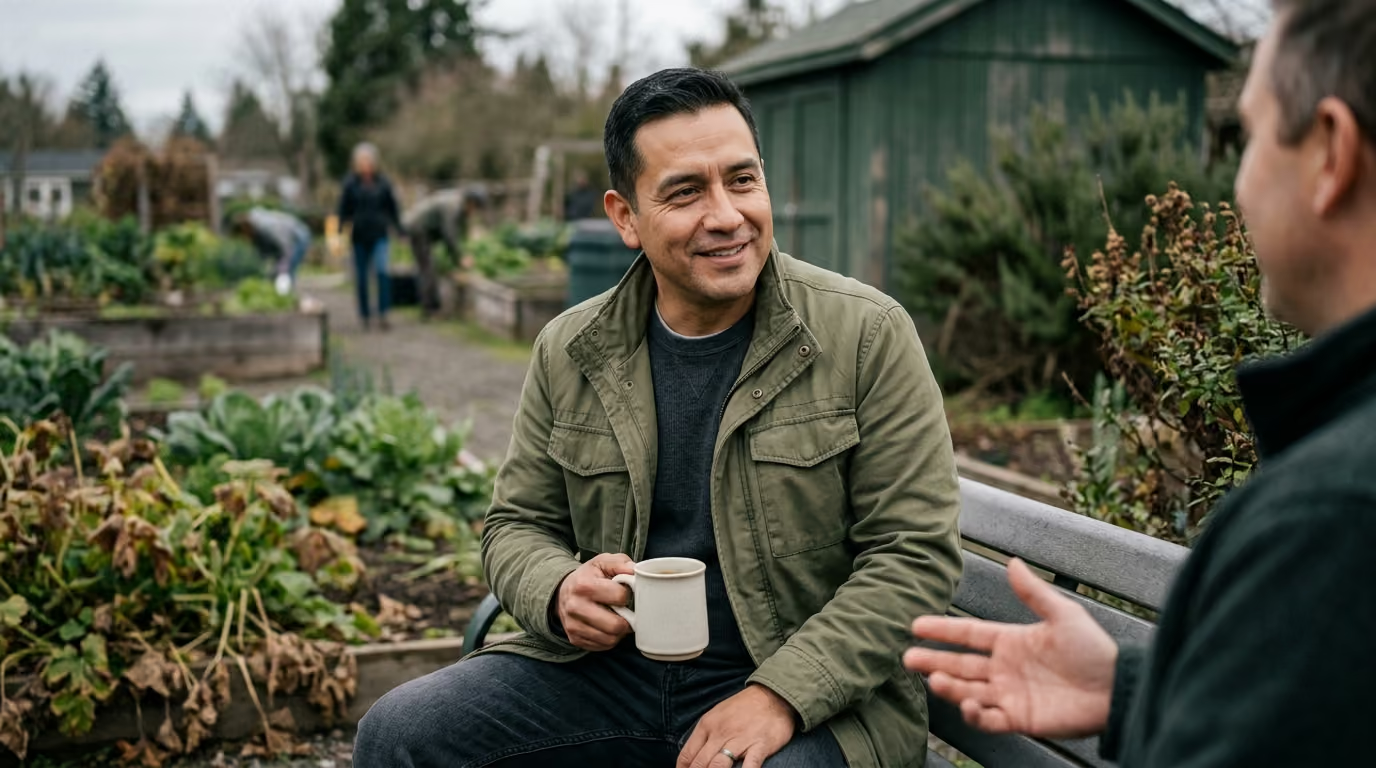

Post-military life requires a deliberate shift from tactical operational tempo toward sustainable civilian routines that protect mental health and purpose.





If you are in immediate danger, call 911. For 24/7 support, call or text 988 and press 1 for the Veterans Crisis Line, or text 838255.
You wake up at 0500 with an alarm you no longer need, stare at an open calendar, and feel an uncomfortable surge of restlessness. Your joints ache from years of load-bearing movement, your sleep was broken three times during the night, and your morning lacks the clear mission that once organized every minute of your day. You search for how to rebuild a daily routine after military discharge because the total lack of schedule feels disorienting, yet returning to rigid operational discipline only brings back chronic fatigue and stress.
A healthy post-service structure maintains predictability, movement, and purposeful progress without reproducing the chronic sleep deprivation, constant emergency mindset, or rigid physical toll of military life.
Building a sustainable routine after military service requires replacing top-down operational control with flexible, self-directed anchors. Instead of trying to maintain constant tactical readiness, you design a life architecture around five core domains: sleep restoration, physical vitality, daily responsibility, social connection, and personal meaning. This guide provides the complete scientific evidence, practical frameworks, and step-by-step systems needed to build a sustainable daily and weekly structure in civilian life.
Leaving the military is rarely just a change of job or a change of address. A systematic review of 18 qualitative and mixed-methods studies published in psychological and healthcare literature found that military-to-civilian transition is characterized by extensive, overlapping losses. These include the loss of role, loss of social status, loss of a shared culture, and the sudden removal of an external structure that once dictated daily priorities.
When that external structure disappears, many veterans experience a profound disorientation. The military provides clear objectives, constant accountability, and predictable feedback. In contrast, civilian life requires individuals to generate their own structure from scratch. Without deliberate planning, this absence of framework can lead to either complete drift or an overcompensating rigidity.
Research on veteran career transitions outlines a three-stage model of identity adjustment: realizing, relinquishing, and reconceptualizing.
The realizing phase occurs when you notice that your former military habits, communication styles, and operational rhythms no longer fit your daily circumstances. You may notice friction at work or frustration with family members who do not operate with military urgency.
The relinquishing phase involves acknowledging and grieving what you left behind. This means letting go of the expectation that civilian environments will run with tactical precision. It also means releasing the belief that high operational stress is the only valid way to live.
The reconceptualizing phase is where healthy structure takes root. In this stage, you integrate the best assets of your military background, such as discipline, reliability, and teamwork, into a broader civilian identity. Service becomes a foundational chapter of your life rather than the only standard by which you measure your worth. You can explore broader perspectives on this process through our veteran life and community adjustment resources.
To create a routine that lasts, you must understand the difference between operational tempo and healthy structure. Operational routines are built for short-term mission success, collective survival, and functioning under severe external stress. They often demand the sacrifice of sleep, personal health, and family communication to accomplish immediate objectives.
Healthy civilian structure serves the opposite purpose. It is designed to support long-term physical health, emotional stability, personal autonomy, and fulfilling relationships. When veterans attempt to recreate military routines in civilian life, they often recreate operational strain without the accompanying mission context.
A central tool for civilian planning is the capacity budget. Time is not your only constraint; your physical energy, cognitive focus, and emotional bandwidth fluctuate from day to day. A rigid schedule assumes you have 100 percent capacity every day, which leads to frustration when injuries, poor sleep, or stress interfere. A capacity-based structure adapts to your actual state:
On green days, your sleep is adequate, pain levels are low, and mental focus is sharp. You can pursue demanding projects, complete intense physical training, and handle complex personal tasks.
On yellow days, your capacity is reduced due to poor sleep, joint flare-ups, or elevated stress. You scale back to core tasks, shorten your workout, and protect your evening recovery rather than forcing maximum output.
On red days, you face severe exhaustion, mental distress, or major life disruptions. Your priority shifts entirely from productivity to stabilization, basic nutrition, gentle movement, and seeking clinical or social support if needed.
Recognizing these capacity shifts prevents the common all-or-nothing trap where a single difficult day is treated as a total failure of discipline.
Sleep is the biological foundation of daily structure. In the military, sleep is frequently treated as an operational variable that can be cut to meet mission needs. Over years of service, this mindset creates chronic sleep debt, circadian disruption, and long-term health consequences.
The Centers for Disease Control and Prevention recommends at least 7 hours of sleep per night for adults aged 18 to 60. For adults aged 61 to 64, the recommendation is 7 to 9 hours, and for those 65 and older, 7 to 8 hours. Meeting these targets requires treating sleep as an intentional daily event rather than an afterthought.
Sleep disturbances are widespread among former service members. Data from the Millennium Cohort Study indicated that 92 percent of active-duty personnel with post-traumatic stress disorder reported clinically significant insomnia, compared to 28 percent of those without PTSD. Studies of Vietnam-era veterans with PTSD showed insomnia rates between 90 and 100 percent.
For veterans with chronic insomnia or trauma-related sleep disruption, sleep problems often become independent medical conditions. They do not simply disappear when military stress ends. The VA and Department of Defense clinical practice guidelines identify Cognitive Behavioral Therapy for Insomnia as the first-line treatment for veterans suffering from insomnia. Controlled clinical trials demonstrate that this therapy produces significant, lasting improvements in sleep efficiency and reduces disruptive nocturnal behaviors.
Building a sleep-supportive foundation relies on evidence-backed circadian habits supported by public health research:
If you experience chronic nightmares, repeated nocturnal waking, or suspect sleep apnea, seek formal medical evaluation rather than attempting to out-discipline the condition. You can read more detailed analysis within our sleep and physical recovery library.
Military training conditions the nervous system for acute mobilization and hypervigilance. These responses are vital for survival in combat and field environments. However, when the nervous system remains locked in a high-alert state during civilian life, it turns into chronic physiological activation.
Chronic activation manifests as constant muscle tension, irritability, elevated resting heart rate, digestive issues, and emotional numbness. A core objective of post-service routine design is learning how to deliberately stand down.
Decompression is not an accidental event; it is an active skill that requires structured time. Implementing predictable recovery rituals helps mark the boundary between the demands of the day and evening rest.
A daily transition ritual should be brief, repeatable, and sensory-driven. Examples include:
In addition to daily rituals, use a weekly stress-cycle review. Ask yourself what fixed demands are approaching, which optional tasks can be dropped, and where your rest periods are scheduled. If you want to build stronger resilience systems, review our sleep, stress, and resilience resources.
Physical training in the military is often tied to testing standards, selection courses, or collective punishment. After separation, veterans frequently alternate between extreme high-intensity workouts and total physical inactivity due to joint pain, injury, or burnout.
The World Health Organization physical activity guidelines recommend that all adults complete 150 to 300 minutes of moderate-intensity aerobic activity per week, or 75 to 150 minutes of vigorous aerobic activity, alongside twice-weekly muscle-strengthening exercises. The WHO evidence base emphasizes that replacing sedentary time with physical movement of any intensity delivers meaningful health benefits, supports cognitive function, and improves sleep quality.
In our experience working with transitioning personnel, shifting away from tactical readiness toward long-term physical capability requires a fundamental change in mindset. Trying to maintain the physical loading of operational units years after service often accelerates joint degeneration. Connecting strength training with joint mobility and cardiovascular health is the true key to staying capable over the lifespan.
Adopting a three-tier model ensures you stay consistent without worsening injuries. On days when joint pain or fatigue makes a full lifting session unwise, completing a maintenance routine preserves the habit without physical breakdown. You can find detailed programming within our training and performance protocols and our healthy aging and longevity resources.
Social connection is an essential component of a stable daily routine. In uniform, social structure is built into the environment. You live, train, work, and eat alongside peers who share the same mission and clear cultural expectations.
In civilian life, relationships require conscious scheduling and active maintenance. Without intentional planning, veterans can drift into isolation, which significantly increases the risk of depression and transition stress.
Military communication relies heavily on direct commands, standard operating procedures, and brevity. Applying this communication style at home or in civilian workplaces can create friction, as civilian relationships require negotiation, mutual disclosure, and shared problem-solving.
Improving relationship dynamics involves distinct communication adjustments:
Treating personal relationships as an essential domain of your schedule protects both your mental health and your family stability.
Employment provides financial stability, but it should not be the only pillar supporting your identity. Many veterans struggle when civilian work feels less urgent or significant than military operations. Finding purpose is an active process built through repeated, meaningful contributions rather than something discovered all at once.
The Department of Labor Veterans' Employment and Training Service supports over 200,000 transitioning service members annually through programs that address employment preparation and technical training. The VA also provides vocational counseling and skill-translation services.
A major challenge during transition is translating operational experience into civilian terms. Translating competencies allows civilian organizations to understand your true value:
The Transition Assistance Program provides mandatory pre-separation counseling and workshops for departing personnel. However, a report from the Government Accountability Office revealed that nearly 25 percent of service members who needed the most transition support failed to attend a required two-day class. Engaging early and proactively with transition resources prevents administrative delays and eases the adjustment process.
Beyond employment, purpose can be built through continuing education, mentoring youth, participating in athletic organizations, volunteering, or learning skilled trades.
Building structure that lasts requires clear execution strategies and an understanding of typical pitfalls. Many veterans fall into predictable behavioral traps during their first year of transition:
To bridge the gap between intention and action, use implementation intentions. These are structured "if-then" plans that define exactly what action you will take when a specific situation or obstacle occurs.
Examples of effective implementation intentions include:
Implementation intentions remove the need to make decisions in moments of high stress or low energy, which keeps your routine intact over time.
Transition plans must account for individual life circumstances, medical requirements, and safety protocols. A standard routine must be adapted for specific situations:
Veterans working night or rotating shifts cannot maintain standard daylight schedules. Anchor your sleep opportunity in a pitch-black, soundproofed room using blackout curtains and white noise. Maintain consistent shift-specific meal times and avoid heavy physical training directly before your daytime sleep window.
Serving in the Reserve or National Guard requires moving repeatedly between civilian life and military environments. Protect your civilian routine by scheduling a half-day recovery window immediately following drill weekends or annual training to reset your home schedule and sleep rhythm.
If you are transitioning with service-connected disabilities or chronic injuries, prioritize rehabilitation, physical therapy, and medical management over standard physical performance goals. Pacing strategies should dictate your daily output rather than arbitrary benchmarks.
Transition is a high-stress period that carries documented health risks. According to the VA 2024 National Veteran Suicide Prevention Annual Report, 6,407 veterans died by suicide in 2022. The unadjusted suicide rate for veterans was 34.7 per 100,000, compared to 17.1 per 100,000 for non-veterans, with firearms involved in 74 percent of veteran suicide deaths. The VA also documented an elevated suicide rate of 46.2 per 100,000 among service members during their first year of separation.
Structure is a powerful supportive framework, but it is not a substitute for clinical intervention. If you or a veteran you know is struggling with overwhelming stress, severe depression, or suicidal thoughts, immediate and confidential help is available:
Most veterans require six to eighteen months to fully adapt to civilian schedules. The process involves multiple stages of identity adjustment and emotional processing. Building consistency across basic daily anchors like sleep and light movement speeds up adjustment more effectively than forcing a rigid schedule.
No. An early wake time is only beneficial if you can obtain adequate, high-quality sleep beforehand. The CDC recommends at least seven hours of total sleep per night for adults. If waking up at 0500 results in chronic sleep restriction, adjust your schedule to ensure you get sufficient rest.
Request a direct meeting with your supervisor to clarify key priorities, performance metrics, and project deadlines. Outside of work, create your own structured milestones for physical health, personal development, and household tasks to maintain clarity and forward momentum.
Reframe recovery as an active, necessary component of personal health and cognitive function rather than wasted time. The human body and nervous system require regular decompression periods to repair tissues, consolidate memory, and manage stress. Rest is a deliberate requirement for sustained capability.
Building a sustainable lifestyle after military service is an ongoing process of refinement. Focus on applying small, reliable adjustments rather than overhauling your entire routine in a single day.
Medical Disclaimer: The educational material provided in this guide is for informational purposes only. It is not a substitute for professional medical advice, diagnosis, or treatment. Always consult a qualified healthcare provider regarding individual health conditions, persistent sleep disorders, mental health concerns, or changes to physical exercise regimens.
Use this checklist to establish your core daily framework this week:
Follow BattleVet for practical guidance on military and veteran health, strength, recovery, testosterone, sleep and healthy aging. Stay connected for new articles, research backed insights and clear information to help you stay capable for the years ahead.


Build better habits around strength, recovery, sleep, hormones and healthy aging with practical guidance for active military personnel and veterans.
Explore BattleVet