
Remote work and travel often disrupt gym routines, but minimal gear like bands and weighted packs delivers complete strength and hypertrophy adaptations.





You step into a bare hotel room after twelve hours of travel, or you drop your bags at a remote duty station with no barbell in sight. Your lower back feels compressed from sitting, your shoulders are tight, and your scheduled training session seems out of reach without a gym. You have a heavy duffel bag, two elastic loop bands, a solid door frame, and forty-five minutes before your evening meal. Maintaining physical capability does not require specialized machines if you know how to challenge your muscles with whatever resistance is available.
Effective strength training depends on mechanical tension and progressive overload, which can be achieved through bodyweight, backpacks, bands, and improvised objects just as reliably as standard gym equipment.
You can build and preserve muscular strength, hypertrophy, and functional capability without standard gym equipment by preserving the intended movement pattern, manipulating mechanical leverage, controlling repetition tempo, and training within two to four repetitions of technical muscular failure.
Muscles do not possess optical sensors to determine whether tension originates from a calibrated steel plate, an elastic band, or a canvas bag loaded with books. Skeletal muscle fibers respond to mechanical tension, motor unit recruitment, and metabolic stress. When a muscle fiber experiences sufficient mechanical strain through a controlled range of motion, it initiates intracellular signaling cascades that lead to protein synthesis and structural adaptation. The central nervous system coordinates these contractions by recruiting motor units in an orderly fashion from smallest to largest according to the load demands.
Traditional resistance training standards established by the American College of Sports Medicine emphasize that progressive overload, exercise specificity, and systematic variation govern physical adaptation rather than the specific equipment used. A novice trainee can stimulate significant neuromuscular adaptations across a wide spectrum of loads, traditionally categorized in the 8 to 12 repetition range. More experienced individuals require precise stimulus management, utilizing heavier resistance for absolute force production and sufficient training volume for muscular growth.
Scientific literature clearly separates established principles from areas of ongoing investigation. Systematic reviews have established that low load training and high load training produce similar muscle hypertrophy when individual sets are performed close to muscular failure. Research also confirms that elastic resistance can produce upper and lower body strength gains comparable to conventional free weights and weight machines. Conversely, early and uncertain research surrounds the idea that unstable surfaces or suspension systems uniquely enhance functional athletic power. While instability increases the activation of joint stabilizing muscles, it often reduces total force output, making it less effective for maximal strength development.
The World Health Organization recommends that all adults perform muscle strengthening activities involving all major muscle groups on at least two days per week. When standard gym access is interrupted by field deployments, travel, remote work, or austere living conditions, meeting these basic health and performance standards requires an adaptable training framework. Understanding the biological mechanisms of resistance allows you to generate a valid training stimulus in any environment. You can explore broader strength and physical conditioning resources to see how these foundational principles integrate into long term athletic development.
The primary error in improvised training is attempting to copy the visual appearance of a gym exercise rather than replicating its physiological stimulus. A barbell bench press and a standard push-up both involve horizontal pressing, but an advanced lifter may find twenty bodyweight push-ups far too easy to stimulate maximal force production. Effective substitution requires analyzing the gym movement across five fundamental parameters before selecting an improvised alternative.
First, classify the movement pattern. Human movement divides into horizontal push, vertical push, horizontal pull, vertical pull, squat, hinge, unilateral knee dominant movement, loaded carry, and trunk stabilization. Second, identify the prime movers and synergists responsible for joint action. A barbell row targets the latissimus dorsi, rhomboids, posterior deltoids, and elbow flexors while demanding isometric endurance from the spinal erectors and hamstrings.
Third, assess the resistance direction. Free weights rely on gravity pulling mass straight down toward the floor. Resistance bands provide directional force along the line of elastic stretch, which can pull horizontally, diagonally, or vertically depending on the anchor point. Suspension trainers direct force toward their overhead mounting fixture based on your body angle. Fourth, define your training intent, whether you are targeting high force production, local muscular endurance, hypertrophy, or joint stability. Fifth, identify the limiting factor of the exercise. If grip fatigue or balance fails before the target muscle is stimulated, the movement must be modified to keep tension on the working muscle.
When external weight is limited, you can manipulate six mechanical levers to increase exercise difficulty without adding iron:
A practical hierarchy ensures that your improvised substitutions remain effective:
Improvised training uses a diverse range of common items and portable tools. Each tool exhibits unique mechanical traits, loading constraints, and safety considerations that dictate how it should be integrated into your program.
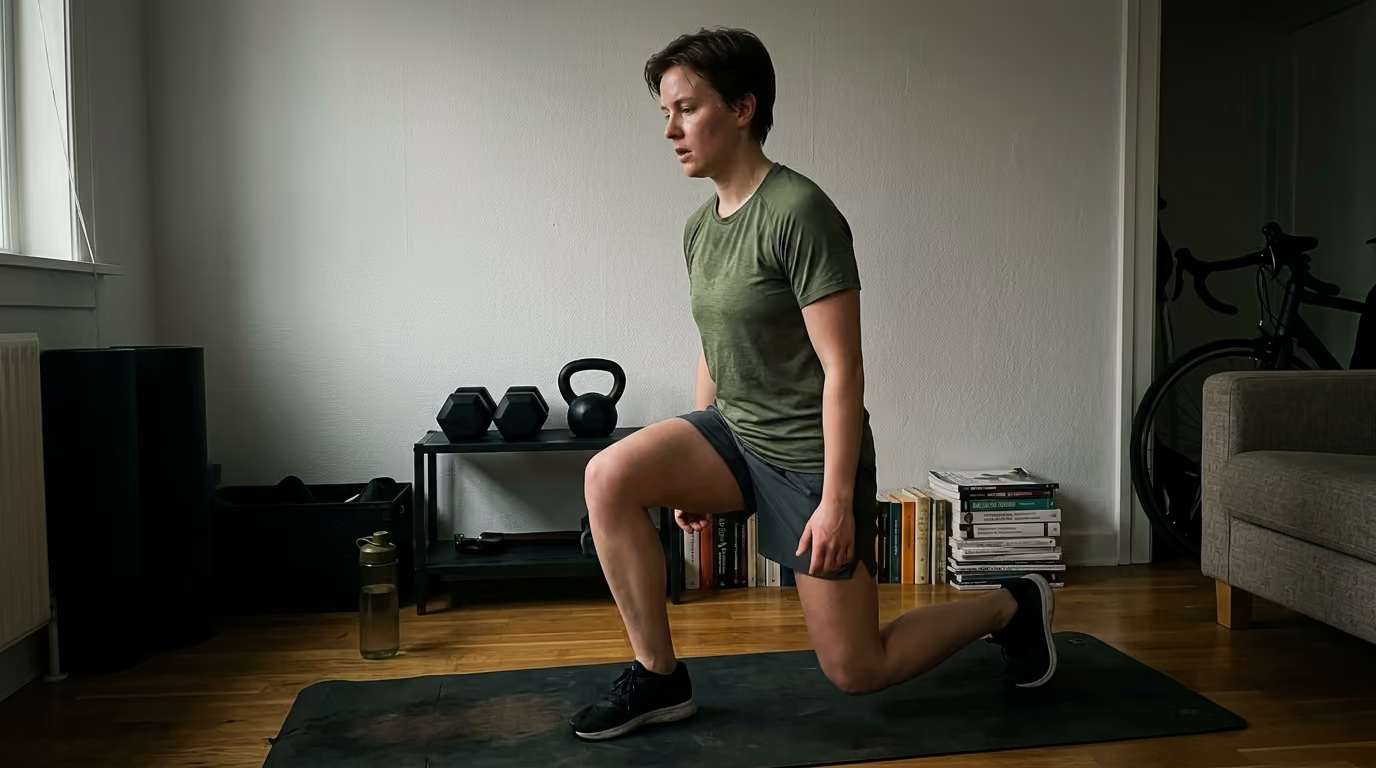
Bodyweight exercise is always accessible, making it the bedrock of austere training. It excels at training horizontal pushing, vertical pushing, squatting, lunging, and core stability. The major limitation of calisthenics is that your body mass remains static. Progression requires altering leverage, shifting to unilateral execution, or increasing mechanical disadvantage.
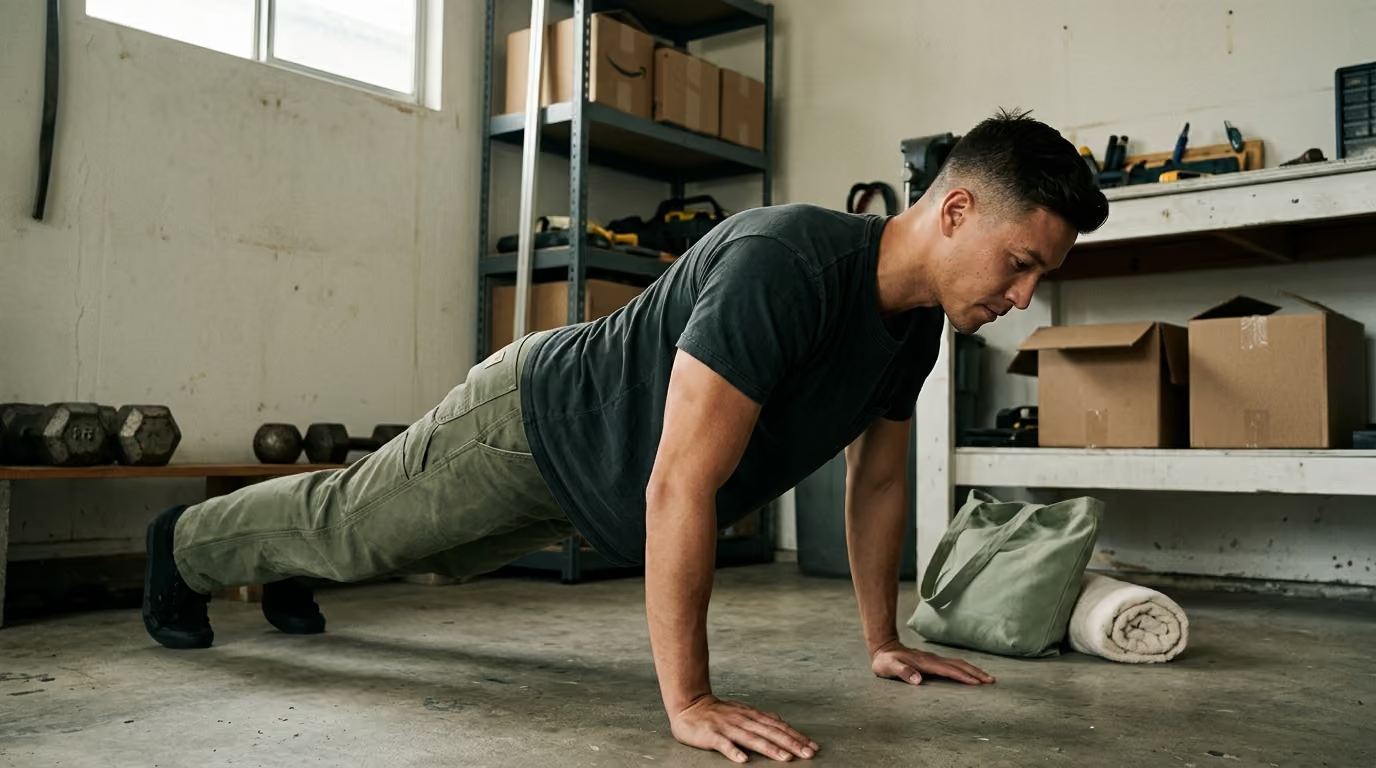
Beginners can build substantial muscle with basic bodyweight movements, but experienced trainees often find bilateral squats and standard push-ups insufficient for strength. If an exercise allows you to perform more than thirty continuous repetitions without approaching muscular fatigue, it shifts from a strength stimulus to local muscular endurance. Progressing from standard push-ups to feet elevated push-ups, archer push-ups, and handstand push-up variations preserves the high tension required for upper body development.
A sturdy backpack or military style rucksack is an exceptionally versatile loading implement. You can incrementally adjust its mass using books, sandbags, water bottles, dry food rations, or dense hardware. Loading the bag tightly with soft items around hard objects prevents shifting and protects your spine during dynamic movements.
Backpacks can be worn on your back for push-ups and step-ups, held against your chest for goblet squats, or gripped by the top handle for heavy single arm rows and Romanian deadlifts. However, a backpack does not behave identically to a barbell of equal mass. The center of mass sits further away from your body, which increases demand on the postural muscles of your trunk. Research examining military load carriage demonstrates that backpack mass alters stride frequency, torso lean, and spinal loading mechanics. Treat heavy backpack strength training as a distinct discipline from long distance rucking.
Water containers, including one gallon jugs, five gallon utility canisters, and specialized water bags, provide easily adjustable resistance. Because water weighs approximately 8.34 pounds per gallon (one kilogram per liter), you can precisely quantify your training loads by measuring fluid volume. A five gallon container filled completely provides roughly 41.7 pounds of external resistance.
Water offers an unstable training stimulus because fluid shifts across changes in direction. This sloshing effect increases the demand on grip strength, shoulder stabilizers, and deep abdominal musculature during presses, carries, and lunges. Always ensure containers feature durable, reinforced handles and leakproof caps. Do not rely on brittle plastic milk containers that can rupture under high dynamic pressure.
Elastic resistance bands provide highly portable, continuous tension across multiple movement planes. They allow you to train vertical pulling, horizontal pulling, leg curls, and lateral hip abduction in environments where gravity dependent free weights are ineffective. High quality layered latex loop bands and heavy duty tube bands with reinforced carabiners are the gold standard for portable resistance.
Unlike free weights, which provide a constant gravitational force profile, elastic bands exhibit ascending resistance. As the band stretches, tension increases exponentially, meaning the exercise is lightest at the beginning of the movement and heaviest near complete lockout. A systematic review published in scientific literature confirmed that elastic resistance produces strength gains equivalent to conventional free weights when matching volume and effort. To maximize band effectiveness, establish clear anchor points, control the eccentric return phase, and step further away from the anchor to increase initial tension.
Suspension systems utilize non-elastic adjustable straps anchored to a door, beam, pull-up bar, or tree limb to suspend part of your bodyweight. By adjusting strap length and the angle of your feet relative to the anchor point, you can instantly scale the difficulty of an exercise from very light to near maximal bodyweight load.
Suspension systems excel at horizontal pulling, rear deltoid work, deep hamstring curls, chest presses, and anti-extension core exercises. A systematic review of suspension training literature highlighted significant improvements in muscular strength, balance, and core stabilizer recruitment. However, the inherent instability of suspended straps reduces the absolute maximal force you can express compared to a stable floor or bench. Use suspension trainers for strength endurance, joint integrity, unilateral control, and upper body pulling rather than absolute one repetition maximum strength.
If your travel or home setup accommodates compact hardware, a pair of quick adjusting dumbbells or a single plate-loadable kettlebell handle offers the highest loading precision. These tools allow standard bilateral and unilateral loading across presses, rows, deadlifts, and loaded carries without requiring full sized racks.
When using a single dumbbell or kettlebell, asymmetrical loading becomes a primary training feature. Performing single arm overhead presses or single sided suitcase carries forces your trunk musculature to resist lateral flexion and rotation, increasing total functional demand. Ensure all adjustment pins and collar locks are fully engaged before lifting weights overhead.
To stimulate muscle growth and retain strength, training variables must be managed with precision. When equipment is improvised, you cannot simply add five pounds to a barbell each week. You must manipulate volume, intensity, proximity to failure, and rest periods systematically.
Intensity in resistance training refers either to the percentage of your one repetition maximum (1RM) or the relative effort exerted during a set. Repetitions in Reserve (RIR) provides a reliable method to measure effort without testing formal maximums. An RIR of 2 means you ended the set when you could have performed exactly two more technically sound repetitions before reaching absolute failure.
When training with lighter improvised loads, training proximity to failure becomes critical. With a heavy 5RM barbell load, high threshold motor units are recruited from the first repetition. With a light backpack or bodyweight exercise allowing fifteen to twenty repetitions, full motor unit recruitment only occurs during the final demanding repetitions. Meta-analyses examining training to failure demonstrate that both failure and non-failure training produce equivalent hypertrophy and strength, provided sets finish within 1 to 3 RIR. You should avoid absolute failure on technically complex or unstable movements, such as heavy single leg squats, while taking safe, stable movements closer to failure.
Weekly training volume is best measured by the number of challenging, hard sets performed per muscle group rather than total poundage moved. Research summaries from the American College of Sports Medicine identify approximately 10 hard sets per muscle group per week as an effective target for driving hypertrophy and retaining functional strength.
Beginners and those recovering from minor injuries can progress on 4 to 6 hard sets per week, while highly trained individuals may require 12 to 16 sets. When using minimal equipment, distribute these sets across two to four weekly sessions to maintain high movement quality and avoid excessive soft tissue fatigue.
The human body recovers from local muscular stress based on systemic nutrition, sleep quality, and the magnitude of muscle damage incurred during training. Minimal equipment workouts often cause less connective tissue trauma than maximal heavy barbell lifting, allowing for higher weekly training frequencies if daily volume is kept moderate.
Aim to train each major movement pattern two to three times per week. Avoid performing identical high rep bodyweight exercises to absolute failure every single day. Daily max effort push-up challenges frequently produce chronic shoulder impingement and elbow tendonitis rather than sustained muscle growth. For structured approaches to systemic rest and tissue repair, review these recovery and sleep guidelines.
Controlling repetition cadence is a primary method for increasing muscular tension without adding mass. Adopt a standard three digit tempo code, such as 3-1-1. This translates to a three second eccentric lowering phase, a one second isometric pause in the stretched position, and a one second explosive concentric contraction. Pausing at the bottom of a push-up or split squat dissipates stored elastic energy in your tendons, forcing your muscle fibers to generate force from a dead stop.
Rest intervals should match the physiological demand of the set. For heavy improvised movements such as high rep rear foot elevated split squats or loaded single arm rows, rest two to three minutes between sets to allow full phosphagen system recovery. For lighter accessory movements, core exercises, and isolation work, sixty to ninety seconds of rest is sufficient. Always prioritize a full, pain-free range of motion over partial repetitions, as training muscles at long muscle lengths provides superior hypertrophic signaling.
Progression is the non-negotiable rule of physical adaptation. If the training stimulus does not increase over time, your body has no biological reason to retain or build muscle tissue. Use these structured progression systems to ensure continuous advancement with limited gear.
Double progression is the most reliable progression method for backpacks, water jugs, and resistance bands. Select a specific repetition range, such as 8 to 12 repetitions, and fix your load or leverage. Perform all prescribed sets, attempting to add repetitions over consecutive workouts until you hit the top number across every set.
When external load cannot be increased, systematically adjust your body position to increase mechanical disadvantage. This progression works exceptionally well for calisthenics and suspension trainers.
Mechanical drop sets allow you to extend a working set past the normal point of fatigue without dropping external weight. When you reach technical fatigue on a mechanically difficult variation, immediately transition to an easier variation of the same movement pattern without resting.
Begin with feet elevated push-ups for 8 to 10 repetitions until reaching 1 RIR. Without resting, place your feet on the floor and immediately complete 4 to 6 standard push-ups. Finally, place your hands on a sturdy chair or desk to finish the set with 4 to 6 incline push-ups. This technique creates high levels of metabolic fatigue and motor unit recruitment using only your bodyweight.
If you cannot alter load or leverage, increase training density by completing the same total volume of work in less time, or add additional working sets. Reducing your rest intervals from two minutes down to seventy-five seconds while maintaining the same repetition count increases metabolic stress and muscular endurance. Alternatively, you can progress from performing 3 sets of 10 repetitions to 4 sets of 10 repetitions before adjusting any other training parameter.
Use this catalog to replace standard gym exercises with functional minimal-equipment alternatives that preserve the primary movement pattern and target musculature.
Standard gym benchmarks include the barbell bench press, dumbbell flat press, and chest press machine. These movements primarily target the pectoralis major, anterior deltoids, and triceps brachii.
Standard gym benchmarks include the standing barbell overhead press, seated dumbbell shoulder press, and machine military press. These exercises train the deltoids, clavicular pectorals, triceps, and upper trapezius.
Standard gym benchmarks include the bent over barbell row, seated cable row, and chest supported dumbbell row. These exercises target the latissimus dorsi, rhomboids, middle trapezius, posterior deltoids, and biceps.
Standard gym benchmarks include the wide grip lat pulldown, seated cable pulldown, and assisted pull-up machine. These movements train the latissimus dorsi, teres major, lower trapezius, and elbow flexors.
Standard gym benchmarks include the barbell back squat, front squat, leg press, and hack squat. These movements train the quadriceps, gluteus maximus, adductors, and spinal erectors.
Standard gym benchmarks include the conventional deadlift, Romanian deadlift, and barbell good morning. These exercises train the hamstrings, gluteals, spinal erectors, and latissimus dorsi.
Standard gym benchmarks include the farmer's walk, cable woodchopper, hanging leg raise, and abdominal crunch machine. These movements build rotational control, anti-extension stability, and grip strength.
These five distinct training templates provide structured, ready-to-use routines tailored to specific gear constraints. Follow each program two to four days per week on alternating days.
Designed for bare hotel rooms, austere field quarters, or emergency situations with zero external hardware.
Optimized for travel with a single backpack or standard duffel bag loaded to 25 to 50 pounds.
Designed for a compact home setup or travel kit featuring three looped latex resistance bands and a secure door anchor.
Engineered for trainees with a suspension trainer anchored to a solid overhead beam, bar, or door frame.
Built for home or deployed environments containing a single medium-to-heavy weight implement (35 to 55 pounds).
You can find more structured programming models in our broader training and performance strategies section.
Training with non-standard equipment presents unique challenges that require troubleshooting to maintain safety and progress.
If an exercise allows you to exceed twenty repetitions with ease, do not simply continue doing endless low tension repetitions. Elevate your feet, widen your grip, add a three second eccentric descent, or introduce a three second isometric pause at the hardest point of the movement. Shifting to an asymmetric or unilateral variation, such as switching from a two leg squat to a single leg split squat, instantly doubles the mechanical load on the working musculature.
If your grip gives out during backpack rows or your balance wavers during single leg deadlifts before your back or hamstrings fatigue, stabilize the setup. Rest your non-working hand on a sturdy wall or chair during single leg hinges to eliminate balance as a limiting factor. If a backpack strap digs painfully into your hands, loop a rolled hand towel through the handle to distribute pressure and reinforce your grip.
High volume floor push-ups can irritate the wrists due to sustained 90 degree wrist extension. Place your hands on push-up handles, hexagonal dumbbells, or flat wooden blocks to maintain a neutral, straight wrist alignment. If deep overhead pressing aggravates your shoulders, switch to an incline push-up angle or a landmine style press using a weighted bag propped into a corner.
Never anchor resistance bands or suspension trainers to hollow core interior doors, unbolted furniture, or sharp metal corners that can shear synthetic nylon. Inspect elastic bands for micro tears, peeling edges, and pinholes before every session, as damaged bands can snap under high tension. Always test your anchor point with a firm bodyweight pull before beginning your working sets.
Improvised resistance training must be adapted to individual health status, training background, and functional limitations.
Individuals new to strength training or returning after a prolonged layoff should begin with stable, low complexity variations. Systematic reviews on home-based resistance training in older adults show notable improvements in lower limb power, functional mobility, and balance, although improvements in grip strength and bone density require sufficient progressive loading. Beginners should focus on mastering movement mechanics and maintaining 3 to 4 repetitions in reserve rather than pushing to muscular failure. Read our healthy aging research for more details on functional preservation across the lifespan.
If you experience joint pain during improvised training, adjust your range of motion to stay within a pain-free envelope. Isometric holds at non-painful joint angles allow you to maintain muscle activation without placing shear stress on irritated tendons. Sharp, lancinating pain, progressive joint swelling, or neurological sensations such as numbness or tingling require cessation of the exercise and medical evaluation.
This field manual is designed exclusively for educational and informational purposes and does not provide personalized medical advice, clinical diagnosis, or rehabilitation prescriptions. Always consult a qualified physician, physical therapist, or certified healthcare professional before beginning any new exercise regimen, particularly if you have underlying cardiovascular conditions, uncontrolled hypertension, joint pathology, or are recovering from surgery.
Yes, bodyweight training can build significant muscle mass provided you select variations that challenge your muscles within an effective repetition range of 6 to 25 repetitions. As exercises become easier, you must alter mechanical leverage, increase range of motion, or use single limb variations to keep your working sets within two to three repetitions of technical failure.
Your backpack is heavy enough if you reach a state of high muscular exertion, leaving only one to three repetitions in reserve, within your target repetition window (typically 8 to 15 repetitions). If you can complete twenty-five repetitions with complete ease, the bag is too light and requires additional dense mass, slower repetition cadence, or a transition to a single leg or single arm movement.
Meta-analytic research demonstrates that elastic resistance can produce upper and lower body strength gains comparable to free weights and machines across general populations. While heavy free weights remain superior for absolute maximal 1RM strength due to their constant gravitational load, bands provide an effective stimulus for general strength, muscle hypertrophy, and joint conditioning.
The safest method is utilizing a manufacturer-approved door anchor placed over the top of a solid, exterior-facing door that closes toward you. Locking the door ensures no one accidentally opens it during a set. Never anchor straps to bathroom fixtures, drywall anchors, curtain rods, or flimsy interior hollow core doors.
Review this guide whenever you transition between training environments, such as entering a period of travel, starting a remote duty assignment, or recovering from a training plateau when gym access is interrupted. Revisit the progression hierarchies and substitution frameworks every six to eight weeks to ensure your improvised programming continues to provide progressive overload and measurable adaptation.
Understanding the mechanical principles of resistance ensures that your physical capability remains resilient, adaptable, and independent of any gym facility.
Follow BattleVet for practical guidance on military and veteran health, strength, recovery, testosterone, sleep and healthy aging. Stay connected for new articles, research backed insights and clear information to help you stay capable for the years ahead.


Build better habits around strength, recovery, sleep, hormones and healthy aging with practical guidance for active military personnel and veterans.
Explore BattleVet