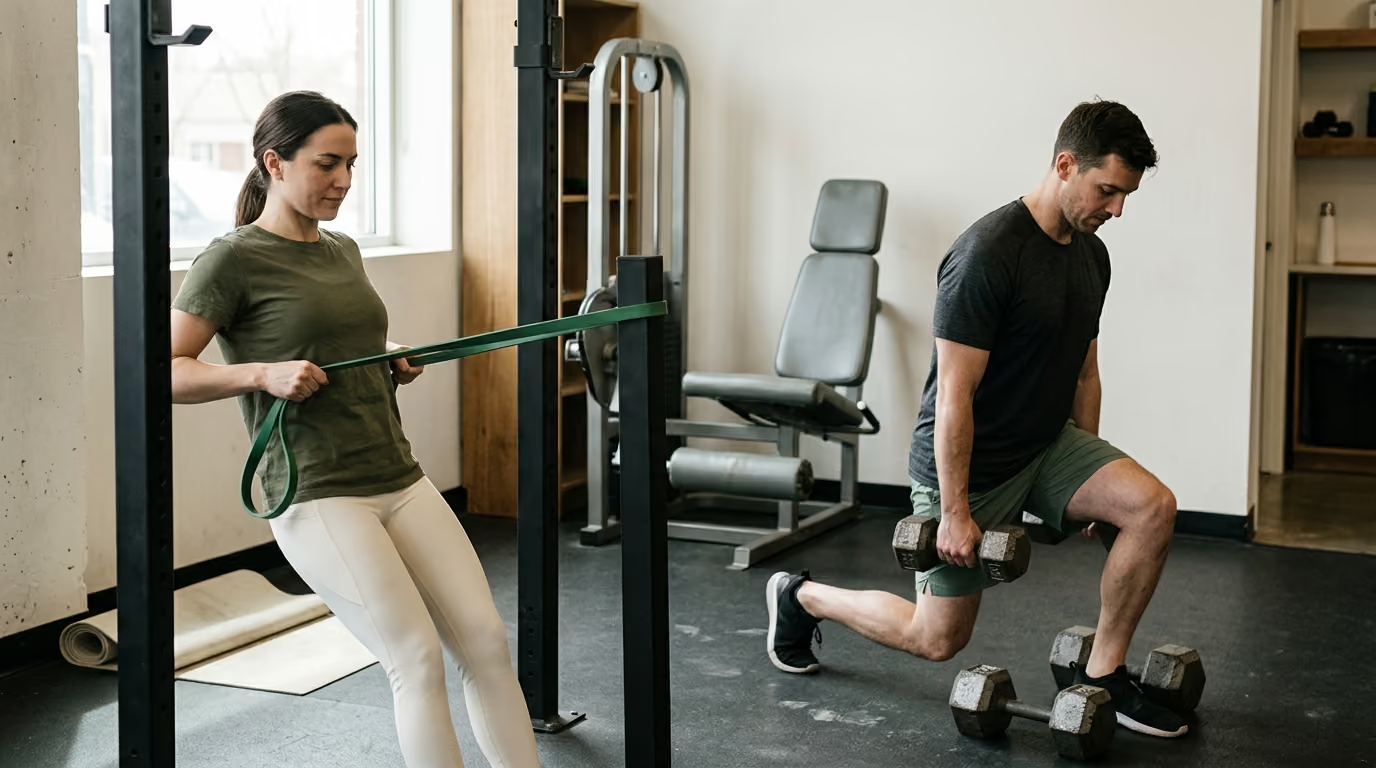

Comparing bodyweight, free weights, machines, and bands reveals how each resistance tool uniquely influences progressive overload, stability, and hypertrophy.





You wake up in an unfamiliar room with limited time, stiff joints, and a demanding schedule ahead. Your regular gym is miles away, leaving you with only the floor, a couple of resistance bands, and whatever heavy items are in your bag. You search for whether bodyweight movements and bands can actually build real strength or if you are simply wasting your energy without a barbell. You need a straightforward answer about what each training tool actually accomplishes so you can plan your sessions without second-guessing your progress.
Quick Take: Skeletal muscle adapts to mechanical tension, volume, and proximity to muscular fatigue regardless of whether that tension comes from an iron plate, a selectorized cable, an elastic loop, or your own body weight.
The most effective training tool is always the one that delivers the specific mechanical stimulus your goal requires while matching your joint tolerance, available equipment, and technical skill. Free weights excel at building absolute strength and multi-joint coordination through measurable loading. Machines offer superior stability for isolating muscle tissue and training close to failure with minimal injury risk. Bodyweight and resistance bands provide unmatched portability, joint-friendly variable resistance, and movement control, making them ideal for physical durability and training continuity. Understanding how to apply each method allows you to maintain progress in any environment.
Equipment does not build muscle or develop strength on its own. Your nervous system and muscle fibers only recognize tension, work volume, rate of force development, and fatigue. The physical implement is simply a delivery vehicle for mechanical stress. To evaluate any training tool fairly, you must measure it against the core principles of muscular adaptation.
Progressive overload is the gradual increase of stress placed upon the body during exercise. It is the primary stimulus for both muscle hypertrophy and strength development. Mechanical tension occurs when a muscle contracts against resistance through a full or partial range of motion. To continue driving adaptations, you must increase this tension over time.
Adding weight to a barbell is the most recognizable form of overload, but it is not the only valid method. You can increase mechanical tension by altering leverage, adjusting tempo, extending the range of motion, adding repetitions, or shortening rest intervals. The American College of Sports Medicine notes that systematic progression requires increasing the training stimulus as your capacity expands. When using bodyweight or bands, progression often relies on mechanical disadvantage rather than adding external iron.
Muscular hypertrophy can occur across a broad spectrum of loading ranges provided the sets are performed with high effort. Researchers use the Repetitions in Reserve concept to standardize training intensity. A set taken to zero repetitions in reserve means you could not complete another repetition with sound technique. Training within one to three repetitions of failure provides sufficient motor unit recruitment to stimulate muscle growth.
Meta-analytic reviews demonstrate that taking every set to complete failure is unnecessary for maximizing strength or muscle mass. In fact, consistently training to failure on complex, multi-joint movements increases systemic fatigue and elevates injury risk. Bodyweight exercises, machines, and bands can match heavy free weights for muscle growth when the total number of hard sets is equated and performed close to the failure threshold.
Strength is a specific neuromuscular skill. Your brain must learn to coordinate motor units, stabilize adjacent joints, and balance external resistance along an efficient path. The principle of specificity dictates that adaptations are greatest in the exact movement pattern, contraction speed, and posture used during training.
If your primary objective is increasing your barbell back squat, you must squat with a barbell. A leg press or a band-resisted split squat will build the quadriceps, but it will not fully develop the balance and spinal bracing required for a maximum barbell attempt. Conversely, if your goal is general lower-body strength and physical resilience, multiple modalities can achieve that outcome equally well. You can review broader programming concepts in our guide to training and performance principles.
Training a muscle through a full active range of motion generally produces superior hypertrophy and functional strength compared to partial repetitions. Research shows that loading a muscle at longer lengths creates greater mechanical tension and promotes longitudinal muscle growth.
However, full range must always be defined by individual joint structure and movement tolerance. Forcing a joint into an unnatural position under load to achieve an arbitrary range can cause connective tissue irritation. Each training modality offers distinct advantages for adjusting and respecting individual joint mechanics.
Bodyweight training uses your own mass as the primary source of resistance against gravity. It requires zero financial investment, requires minimal space, and directly improves your strength relative to your body mass. Understanding how to scale bodyweight movements allows you to build a highly capable physique without conventional weights.
The primary challenge of calisthenics is that you cannot simply slide a five-pound plate onto your body. Progression requires altering body angles, adjusting lever lengths, and changing base support. By manipulating these mechanical factors, you alter the percentage of your body weight that the target muscles must move.
Consider the standard push-up. An incline push-up against a wall reduces the load to a fraction of your body weight. Moving to the floor requires you to press roughly 64 percent of your weight. Elevating your feet on a bench increases that load to over 70 percent. Progressing to an archer push-up or a one-arm push-up forces a single limb to manage the vast majority of your mass, creating intense muscular tension.
Most bodyweight exercises are closed kinetic chain movements, meaning your hands or feet remain fixed against an immovable surface. Closed-chain exercises naturally demand co-contraction of stabilizing muscles around the active joints. Push-ups, dips, pull-ups, and single-leg squats recruit core stabilizers and joint rotators more dynamically than many fixed machine alternatives.
This closed-chain dynamic improves spatial awareness and kinesthetic control. For service members and active individuals, mastering movement through space translates directly to field tasks, obstacle negotiation, and general athletic durability.
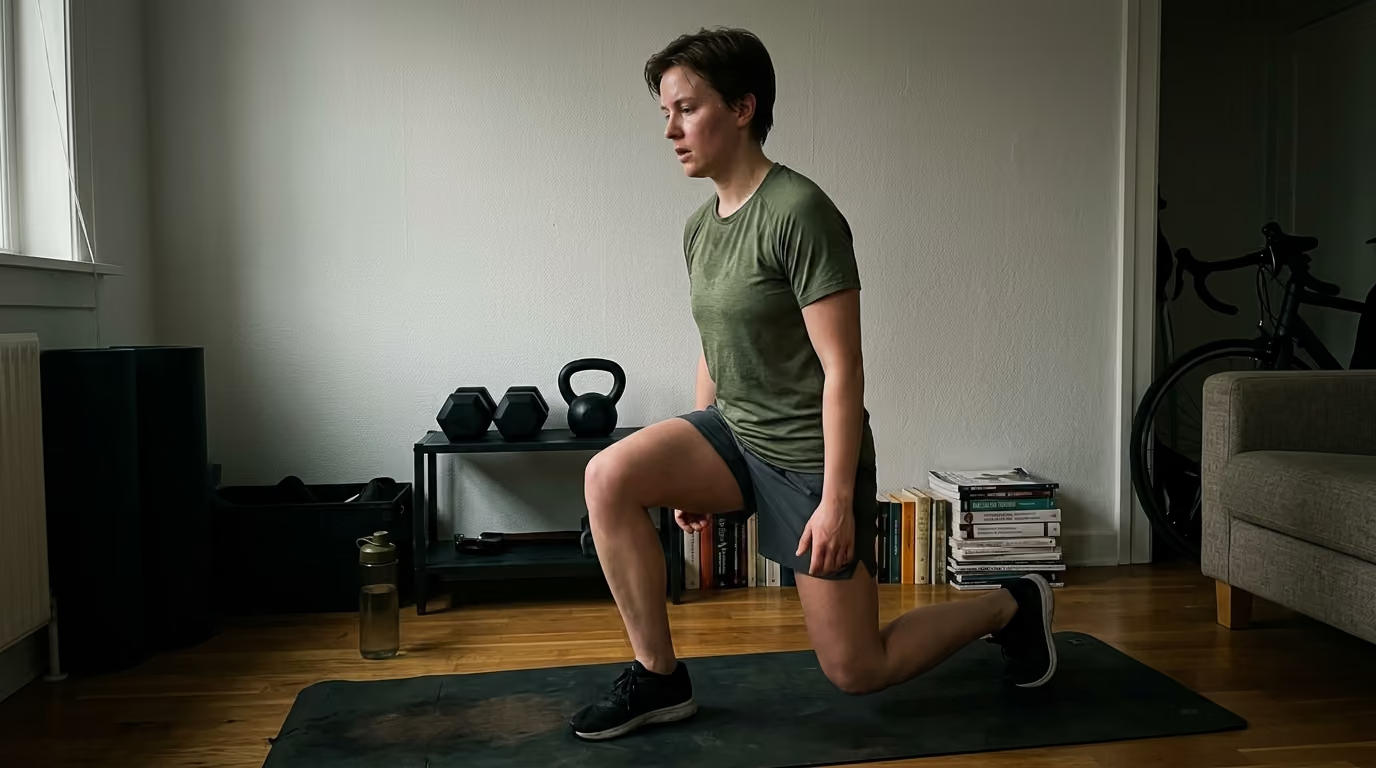
Bodyweight training has clear structural limitations. Developing maximum lower-body strength is difficult once you adapt to standard bilateral squats. While pistol squats, sissy squats, and explosive jump variations provide excellent stimuli, they do not replicate the high absolute force demands of a heavy deadlift or squat.
Pulling exercises also require dedicated infrastructure. While you can push against any flat floor, you need an overhead bar, suspension straps, or a sturdy ledge to perform horizontal rows and vertical pull-ups. Without these tools, balancing anterior and posterior upper-body development becomes challenging.
Free weights include barbells, dumbbells, kettlebells, and weight plates. Because they are unconstrained by tracks or levers, free weights move freely through three dimensions. They remain the gold standard for developing absolute force and measurable strength progression.
When lifting a barbell or pair of dumbbells, your muscular system must simultaneously generate prime-mover force while stabilizing the weight across three movement planes. This requirement recruits secondary stabilizer muscles, tendon structures, and the trunk musculature to maintain balance and bar path.
This stabilization requirement provides both advantages and drawbacks. It ensures comprehensive muscular engagement and strengthens joint structures under load. However, if your stabilizing muscles fatigue before your prime movers, the set may end before the target muscle receives an optimal stimulus for hypertrophy.
Free weights offer the most precise progression system in physical training. Standard Olympic plates allow you to increase resistance in increments as small as one to two and a half pounds. This micro-loading capability is vital for intermediate and advanced lifters who can no longer make large weekly leaps in resistance.
This precise measurement allows for accurate record-keeping and systematic programming. You know the exact load moved, the total volume completed, and the precise intensity percentage relative to your maximum capability. You can review detailed training protocols in our strength and fitness resources.
The primary drawback of free-weight training is the technical skill floor. Executing heavy barbell squats, deadlifts, and overhead presses requires mobility, trunk stability, and technical coaching. Poor technique under heavy spinal loading increases the risk of acute injury.
As fatigue accumulates during a hard session, technique in complex free-weight lifts naturally degrades. When your form breaks down, the load shifts away from the target muscle and places excessive shear force on ligaments and joints. For this reason, high-effort sets to absolute failure are best reserved for stable accessories rather than maximum compound free-weight lifts.
Resistance machines guide the movement through a fixed or semi-fixed track using weight stacks, cams, cables, or plate-loaded levers. Once dismissed by functional fitness purists, modern sports science confirms that machines are exceptional tools for building muscle tissue and maintaining safe training volume.
Machines eliminate the need to balance the load in three dimensions. By removing stabilization demands, your central nervous system can direct maximum neural drive directly into the target muscle group. This isolation allows for exceptional localized mechanical tension without the fatigue of stabilizing the entire body.
A 2023 systematic review and meta-analysis confirmed that machines and free weights produce equivalent muscle hypertrophy and power adaptations. If your goal is to grow the quadriceps, a seated leg extension or hack squat delivers an equivalent local growth stimulus to a barbell squat, often with significantly less systemic fatigue.
Many modern selectorized machines use specialized cams designed to match human strength curves. In free-weight movements, the exercise often becomes easy at certain joint angles and hard at others due to gravity acting straight down. A well-designed machine maintains continuous tension across the entire excursion of the muscle.
Furthermore, machines allow individuals with joint restrictions or asymmetrical limitations to train safely. If a wrist or shoulder injury prevents you from holding a heavy bar, a chest press machine or pec deck allows you to load the chest without placing torque on the compromised joint.
The main limitation of machines is their rigid geometry. A fixed lever arm moves along a predetermined arc that may not match your specific limb lengths, bone structure, or joint mobility. Forcing your body into an unnatural movement path under load can lead to chronic joint irritation.
Cable systems help bridge this gap. Modern cable machines provide the guided stability and constant tension of selectorized weights while allowing your hands and joints to move through their natural anatomical paths. For older adults and recovering athletes, cables offer an ideal balance of safety and freedom of movement, as outlined in our section on healthy aging and physical longevity.
Resistance bands use elastic deformation to generate tension. They come in flat continuous loops, covered tubes with handles, mini-bands, and heavy-duty powerlifting bands. Bands operate under fundamentally different physical laws than free weights or machines.
Free weights rely on gravity, providing a constant mass that feels heavier or lighter depending on mechanical leverage at different joint angles. In contrast, resistance bands provide variable, accommodating resistance. The tension generated by an elastic band increases exponentially as the material stretches.
This variable resistance curve means the exercise is lightest at the bottom of the movement and heaviest at full contraction. During a band-resisted push-up, the load is lowest when your chest is on the floor, protecting the shoulder joint at its most vulnerable angle. As you press up and gain mechanical leverage, the band stretches, forcing your chest and triceps to work against maximum tension at lockout.
Bands weigh almost nothing and fit into any travel bag, making them the premier tool for maintaining physical conditioning away from home. More importantly, bands are not bound by gravity. While free weights only provide downward vertical resistance, bands can apply force horizontally, diagonally, or rotationally.
This directional freedom makes bands exceptional for rotary core training, shoulder external rotator strengthening, and resisted lateral movements. They are also effective for warming up joint complexes, improving blood flow, and priming the nervous system before heavy loading.
The primary weakness of resistance bands is the difficulty in measuring precise load. A band labeled "30 to 60 pounds" does not deliver 45 pounds of resistance automatically. The actual force produced depends on how far the band is stretched, the anchor distance, your limb length, and material degradation over time.
This lack of precise measurement makes systematic progressive overload harder to track over long training blocks. Additionally, thick bands can be awkward to anchor securely, and lower-body compound movements like squats can become limited by your ability to hold the band rather than the strength of your legs.
When duty, travel, or remote living separates you from standard fitness equipment, you must adapt your environment. Improvised training uses everyday objects to create mechanical resistance. When planned logically, improvised training prevents muscular atrophy and maintains work capacity under austere conditions.
Training with improvised loads must follow the same physiological principles as standard gym training. You must find a way to apply progressive overload, maintain controlled movement speeds, and challenge the target muscles through an acceptable range of motion.
A sturdy backpack filled with books, sandbags, water containers, or tools provides a versatile training implement. A 40-pound backpack can be worn on your chest for push-ups, placed on your back for split squats, or held by the top handle for rows and overhead presses. Water jugs provide reliable, scalable weight, since one gallon of fresh water weighs approximately 8.34 pounds.
The critical difference between formal gym equipment and improvised gear is structural reliability. Gym equipment is engineered and rated for physical loading. Improvised tools can fail unpredictably, leading to acute injury.
Never use improvised anchors overhead or anchor heavy resistance bands to hollow doors, light furniture, or loose fixtures. Ensure that bags used for loading have reinforced stitching and heavy-duty zippers. Avoid holding awkward objects in positions where a sudden grip slip could drop the load onto your head or spine.
Selecting the right training tool requires matching the method to your specific physical objective. No single piece of equipment is best for every adaptation. Smart programming matches the tool to the intended physiological outcome.
If your primary goal is maximum force production, free weights hold a clear advantage. Lifting heavy external loads requires significant neuromuscular recruitment and develops structural bone density. While machines build the muscular engine, free weights teach you to express that force in an unsupported, real-world environment.
Bodyweight movements can build impressive relative strength, especially in the upper body via weighted pull-ups and dips. However, developing absolute lower-body power requires external loads that exceed your body weight. For maximum strength, build your foundation around barbells and heavy dumbbells, using other methods as assistance.
For pure muscle growth, equipment versatility is your greatest asset. Muscle tissue does not know the difference between a dumbbell, a plate-loaded machine, or a high-tension band. Hypertrophy requires accumulating challenging sets close to muscular failure while managing systemic fatigue.
Using a combination of free weights and machines is often the most efficient approach for muscle growth. Free-weight compound movements stimulate large amounts of muscle mass early in the workout. Selectorized machines and cables allow you to finish the session with high-effort isolation work without placing excessive fatigue on your lower back and stabilizing joints.
Muscular endurance is the ability to sustain repeated submaximal contractions without excessive fatigue. Bodyweight calisthenics, light kettlebells, and resistance bands excel in this domain. They allow for rapid transitions between exercises with minimal setup time, keeping your heart rate elevated and creating local metabolic stress.
Timed circuits using push-ups, bodyweight lunges, band rows, and mountain climbers develop high levels of local tissue endurance and cardiovascular conditioning. These circuits can be executed in small spaces, making them ideal for field environments or tight schedules. If your training recovery is compromised by external stress, you can explore our resources on recovery, sleep, and physical restoration.
You do not need to choose a single modality and abandon the rest. The most resilient training programs combine multiple tools within the same workout or across different phases of the year.
A highly practical way to combine training methods is the anchor and accessories framework. Choose one heavy, technically demanding free-weight movement to anchor your workout when you are fresh. Follow that anchor with stable machine or cable exercises to build volume, and finish with bodyweight or band movements for joint health and metabolic conditioning.
Exercise order should reflect the balance and coordination demands of each movement. Perform exercises requiring the highest technical skill, balance, and spinal loading at the beginning of the workout when your nervous system is fully alert.
As muscular and mental fatigue sets in, transition toward more stable training tools. Moving from a barbell squat to a machine leg press, and finally to a seated band leg extension, allows you to train your quadriceps to deep fatigue without risking a balance failure or spinal buckling.
Joint pain, previous injuries, or equipment shortages should never halt your training. Understanding movement patterns allows you to substitute equivalent exercises across different modalities immediately. When an exercise causes joint discomfort, simply swap the tool while preserving the underlying movement pattern.
Building a capable and resilient body requires consistency above all else. Use this practical checklist to evaluate your current setup and apply these training methods over the coming week.
Medical Disclaimer: The information provided in this guide is for educational purposes only and should not be taken as medical advice. Always consult with a qualified healthcare professional or certified strength specialist before beginning any new exercise regimen, especially if you have pre-existing injuries, cardiovascular conditions, or joint limitations.
Yes, you can build significant muscle using bodyweight exercises provided you make the movements challenging enough to reach one to three repetitions in reserve. To stimulate growth, you must progress to harder exercise variations, such as elevating your feet during push-ups or performing single-leg squats, rather than simply adding hundreds of easy repetitions.
Resistance bands are highly effective for building muscle, improving muscular endurance, and developing power. However, for developing absolute maximal strength in movements like the squat or deadlift, heavy free weights are superior because they provide precise, unyielding resistance that does not depend on stretch length.
Machines reduce balance demands and eliminate the risk of being pinned under a heavy load, which makes them safer when training to absolute muscular failure. However, free weights are not inherently dangerous when performed with sound technique and appropriate loading. Both tools are safe and effective when matched to your physical skill level.
Focus on high-intensity bodyweight variations, such as single-leg split squats, handstand push-ups, and single-arm push-up progressions, combined with portable resistance bands. By keeping your effort high and training close to muscular failure, you can maintain your strength and muscle mass for weeks without touching a barbell.
Follow BattleVet for practical guidance on military and veteran health, strength, recovery, testosterone, sleep and healthy aging. Stay connected for new articles, research backed insights and clear information to help you stay capable for the years ahead.


Build better habits around strength, recovery, sleep, hormones and healthy aging with practical guidance for active military personnel and veterans.
Explore BattleVet