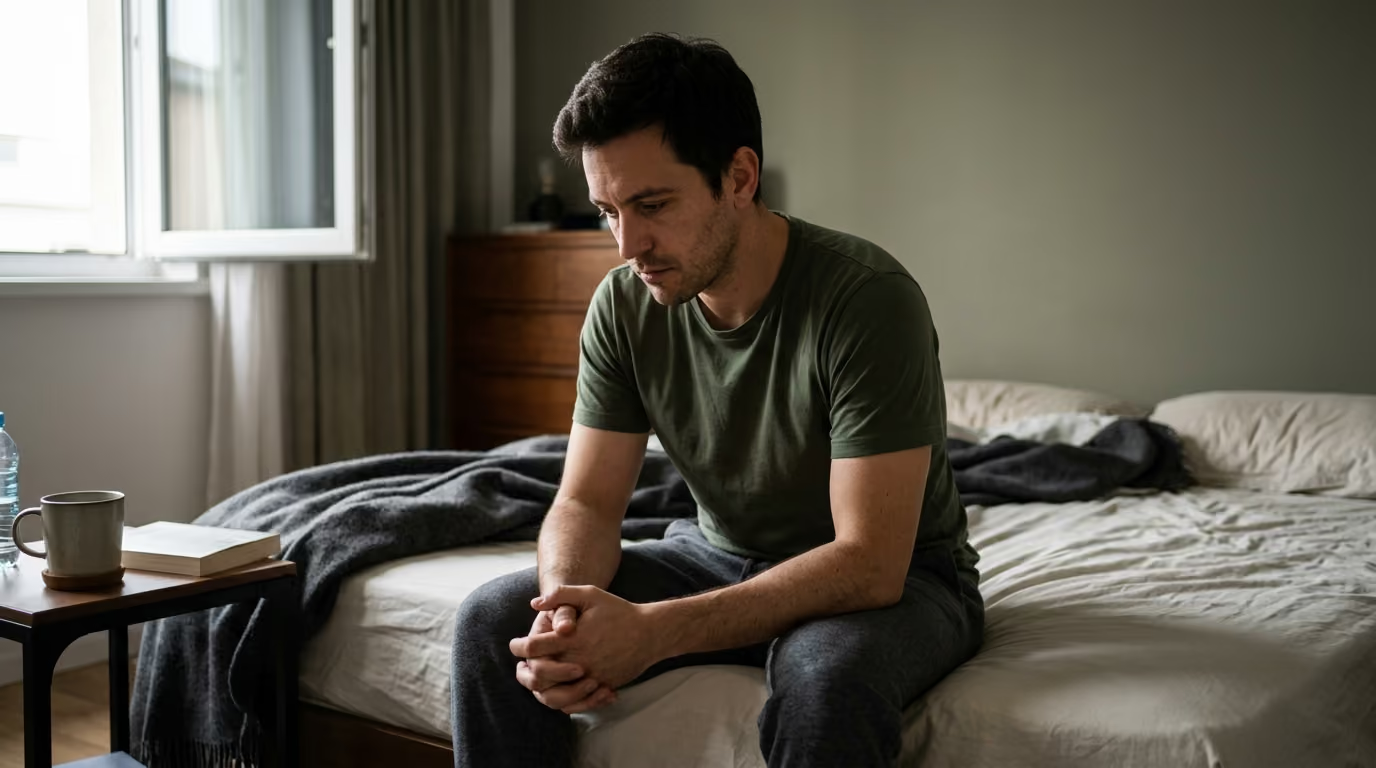

Many people assume insomnia stems from poor sleep hygiene, but physiological hyperarousal and anxiety cycles actually drive chronic sleep disruption.





If you are in immediate danger, call 911. For 24/7 support, call or text 988 and press 1 for the Veterans Crisis Line, or text 838255.
You stare at the glowing numbers on the nightstand as 2:14 a.m. rolls over to 2:15 a.m. Your heart beats with noticeable force, your shoulders remain locked in tension, and your mind races through tomorrow's work schedule. You calculate how many hours of rest remain if you fall asleep immediately, which only makes you more alert. You have likely searched online for how to stop anxiety before bed, how to break the cycle of nighttime panic, or how to turn off a racing mind. This comprehensive guide provides a definitive, evidence-backed framework for untangling stress from insomnia and restoring sustainable sleep patterns.
Sleep disruption driven by anxiety is a self-reinforcing cycle of threat appraisal, physiological hyperarousal, and counterproductive coping behaviors. Breaking this pattern requires systematic behavioral conditioning and cognitive restructuring rather than trying harder to force sleep.
When anxiety interferes with your rest, the core problem is rarely an inability to sleep. The core problem is that your brain perceives wakefulness, stress, or the bedroom itself as an active threat. Trying to force yourself to fall asleep activates your sympathetic nervous system, increases your heart rate, and keeps you awake. Lasting recovery requires separating genuine daytime problem-solving from nighttime rumination, removing unhelpful sleep effort, and systematically retraining your nervous system to associate the bed with genuine relaxation.
To resolve nighttime wakefulness, you must first understand how anxiety, stress, worry, and physiological hyperarousal interact with sleep regulation. While people often use these terms interchangeably, they represent distinct physiological and cognitive processes.
Stress is your psychological and physiological response to external demands, conflict, environmental overload, or life transitions. It generally has an identifiable external cause. Acute stress arrives with a distinct event and resolves when the event concludes. Chronic stress accumulates across months of work pressure, caregiving responsibilities, or financial obligations.
Anxiety represents an internal threat-anticipation system that continues long after an immediate demand passes. While adaptive anxiety helps you prepare for real challenges, persistent anxiety generates ongoing apprehension about hypothetical future problems. Generalized anxiety involves persistent worry across multiple life domains alongside physical tension, restlessness, and fatigue.
Worry is the verbal, cognitive component of this system. It consists of repetitive thoughts focused on preventing negative future outcomes. Worry feels productive because it mimics planning, but it rarely leads to constructive action. Instead, it seeks absolute certainty in situations where certainty is impossible.
Understanding the distinction between active problem-solving and unhelpful worry is essential for nighttime recovery:
Hyperarousal is a state of elevated central nervous system activation that directly opposes the physiological conditions required for sleep. Research from the National Institute of Mental Health notes that conditions like generalized anxiety disorder regularly feature restlessness, difficulty concentrating, muscle tension, and sleep disturbance.
Hyperarousal manifests in three distinct ways:
When somatic and cognitive arousal remain elevated, your body cannot initiate the physiological transitions that produce deep, restorative rest.
Anxiety-induced insomnia does not happen randomly. It follows a predictable, repeating cycle. Each stage reinforces the next, turning an isolated period of acute stress into chronic, conditioned sleeplessness.
The cycle begins with a precipitating stressor. This could be an intense work deadline, a medical diagnosis, marital conflict, financial strain, or a sudden change in schedule. In many cases, the trigger is simply an isolated night of poor sleep caused by illness or environmental noise. The trigger itself does not create chronic insomnia. The interpretation of that trigger determines what happens next.
Once the trigger occurs, you evaluate its meaning. If you view a night of poor sleep as a normal biological variation, your nervous system remains calm. However, anxiety leads to catastrophic appraisals:
These interpretations transform the bed from a place of recovery into an arena of high stakes.
Catastrophic appraisals immediately engage your autonomic nervous system. Your brain releases adrenaline and cortisol, shifting your body into a state of alertness. Your heart rate rises, your muscles tighten, and your attention sharpens to scan for threats. In this state, the brain views sleep as unsafe.
Because you believe that failing to sleep will cause disastrous consequences, you actively try to produce sleep. Sleep, however, is an involuntary biological process governed by circadian rhythms and homeostatic sleep pressure. You cannot force sleep through conscious willpower.
Sleep effort includes checking the clock to calculate remaining sleep time, trying to suppress thoughts, forcing yourself to lie perfectly still, and monitoring your body to see if you feel drowsy yet. These efforts require sustained cognitive control, which guarantees that you remain awake.
To cope with escalating fatigue, people adopt compensatory safety behaviors. These actions provide short-term emotional reassurance but worsen long-term sleep regulation:
Sleep deficiency has genuine daytime consequences. The National Heart, Lung, and Blood Institute documents that chronic sleep deficiency can impair emotional regulation, lower physical performance, reduce cognitive processing speed, and elevate long-term health risks.
However, individuals caught in an anxiety cycle exaggerate these risks. They treat normal afternoon dips in energy as definitive proof of cognitive decline. Ordinary mistakes at work are attributed entirely to lack of sleep, which amplifies anticipatory anxiety as the next evening approaches.
Over weeks or months of repeating this pattern, your brain forms a conditioned response. In classical conditioning terms, the bed, darkness, and your evening routine become conditioned stimuli for alertness and dread rather than sleep.
The moment you lie down, your brain prepares for a battle with wakefulness. This is why individuals with chronic insomnia often feel exhausted on the living room couch, but become wide awake the moment their head hits their bedroom pillow.
Resolving chronic anxiety-related sleep disruption requires proven clinical protocols. Understanding the scientific consensus helps you avoid marketing fads and focus on methods with strong therapeutic track records.
The American Academy of Sleep Medicine provides a strong clinical recommendation for Cognitive Behavioral Therapy for Insomnia (CBT-I) as the primary treatment for chronic insomnia in adults. The clinical guidelines emphasize that CBT-I targets the specific cognitive distortions and conditioned behavioral patterns that perpetuate insomnia.
A comprehensive meta-analysis published in the Annals of Internal Medicine demonstrated that CBT-I produces substantial, clinically meaningful improvements. On average, patients experienced:
Long-term follow-up studies confirm that these gains remain statistically and clinically significant at three, six, and twelve months after completing treatment. Furthermore, a systematic review across 67 randomized controlled trials involving 5,232 participants confirmed that CBT-I remains highly effective even in populations managing co-occurring chronic medical conditions.
Digital CBT-I programs delivered via structured web platforms or software applications have emerged as practical options for expanding care access. Systematic reviews demonstrate that internet-delivered CBT-I improves insomnia severity, sleep parameters, and co-occurring anxiety and depression symptoms, with benefits maintained over six months.
Comparative research indicates that while clinician-led in-person therapy provides tailored flexibility for complex presentations, digital platforms offer reliable outcomes for uncomplicated insomnia. However, automated programs are less suitable when sleep disruption involves active psychiatric crises, unmanaged substance use, or complex medical conditions.
The American Academy of Sleep Medicine states that sleep medications should not serve as a standalone, first-line treatment for chronic insomnia. Pharmacotherapy is primarily indicated when patients cannot access CBT-I, experience incomplete recovery following behavioral intervention, or require temporary stabilization during severe acute crises.
While short-term sedative use can induce sleep onset, medications do not resolve conditioned arousal or unhelpful sleep appraisals. Additionally, sedatives carry risks of physical tolerance, daytime grogginess, rebound insomnia upon discontinuation, and masking underlying medical issues like sleep apnea.
Popular health advice frequently emphasizes basic sleep hygiene habits, such as keeping the room cold, avoiding blue light, and drinking herbal tea. While an optimal environment supports healthy rest, clinical guidelines from the Department of Veterans Affairs and Department of Defense explicitly advise against using sleep hygiene alone as a treatment for chronic insomnia.
Sleep hygiene does not alter conditioned bedroom hyperarousal, change catastrophic beliefs about sleep loss, or correct the behavioral patterns that perpetuate chronic wakefulness. Treating sleep hygiene as a primary cure often frustrates individuals whose insomnia is driven by deeper cognitive and physiological arousal.
Explore our dedicated educational articles on recovery and sleep strategies to understand how training stress and central nervous system recovery intersect.
Cognitive reframing is not the practice of repeating empty positive affirmations. It is a systematic process of evaluating automatic, stress-inducing thoughts for accuracy, proportion, and practical utility.
A structured thought record helps you interrupt catastrophic predictions at night. When an anxious thought creates physiological tension, work through these five stages:
To build skill in cognitive restructuring, study these common cognitive distortions and their evidence-based replacements.
You can learn more about managing physical stress and systemic strain in our comprehensive resources on sleep, stress and resilience.
Attempting to forcefully suppress worry before bed causes a psychological rebound effect, making the intrusive thoughts more persistent. A proven cognitive method for managing rumination is the scheduled worry container protocol.
The worry container protocol moves the cognitive work of threat analysis from the vulnerable nighttime hours into an intentional, structured daytime window.
During your review session, classify every entry into one of four distinct categories:
When one of these thoughts resurfaces while you are lying in bed at midnight, you can tell yourself: "I have already processed this issue in my notebook, and it is scheduled for review tomorrow at 4:30 p.m. It does not belong in my bed tonight."
Behavioral modifications systematically break the learned association between your mattress and mental distress. By altering how you behave when awake in bed, you re-establish the bed as a reliable trigger for sleep.
Stimulus control is one of the most thoroughly validated interventions for conditioned insomnia. It relies on straightforward, non-negotiable rules designed to eliminate conditioned hyperarousal:
This process may require multiple transitions in and out of bed during the first week. However, this method breaks the conditioned habit of tossing and turning in frustration.
When people spend nine hours in bed but only sleep five hours, their sleep remains fragmented and shallow. Sleep restriction therapy temporarily reduces your total time in bed to match your actual average sleep duration, which rapidly consolidates sleep drive.
If you currently sleep an average of six hours while spending eight and a half hours in bed, a structured protocol restricts your initial time in bed to six or six and a half hours (for instance, 11:30 p.m. to 5:30 a.m. or 12:00 a.m. to 6:30 a.m.). Once your sleep efficiency (time asleep divided by time in bed) exceeds 85 to 90 percent over a full week, you expand your time in bed by 15 to 30 minutes.
Sleep compression uses a gentler, stepped approach, reducing time in bed by 15 minutes each week until sleep consolidates.
Sleep restriction temporarily increases daytime sleepiness. Because of this, strict precautions are necessary:
Relaxation techniques should not be used as an emergency switch to force immediate sleep. Instead, view relaxation as a way to down-regulate your autonomic nervous system and tolerate wakefulness without distress.
Shallow chest breathing signals distress to your brain. Diaphragmatic breathing stimulates the vagus nerve, engaging the parasympathetic nervous system to slow your pulse:
Progressive Muscle Relaxation (PMR) systematically trains you to identify and release somatic tension:
Explore broader discussions on tactical wellness and longevity in our military health editorial section.
Sleep disruption rarely exists in absolute isolation. Effective management requires identifying when insomnia is maintained by anxiety versus when it reflects underlying medical conditions, psychological trauma, or lifestyle factors.
Obstructive sleep apnea (OSA) frequently co-occurs with chronic insomnia and nighttime anxiety. When your airway collapses during sleep, your brain triggers a micro-awakening accompanied by a surge of adrenaline to resume breathing.
Patients often wake up abruptly with a racing pulse, gasping sensations, or a sudden spike in panic. If you mistakenly attribute these awakenings entirely to psychological anxiety, the underlying physical breathing obstruction goes untreated.
Clinical practice guidelines jointly developed by the Department of Veterans Affairs and Department of Defense emphasize screening for both insomnia and obstructive sleep apnea together. Red flags that warrant immediate medical evaluation and an overnight sleep study include:
For individuals with operational stress or post-traumatic stress, nighttime wakefulness is often driven by conditioned hypervigilance. In a dark, quiet room, the nervous system scans for tactical threats, making surrender to sleep feel dangerous. Nightmares create anticipatory anxiety, leading people to deliberately delay going to bed.
Standard relaxation protocols must be modified for trauma-related insomnia:
Veterans navigating service-connected health adjustments can review our comprehensive guides on veteran life health priorities.
A nocturnal panic attack is a sudden awakening from non-REM sleep in a state of acute terror, tachycardia, sweating, dizziness, and a feeling of impending doom. Unlike daytime panic attacks, they occur without an obvious conscious trigger.
It is vital to recognize that nocturnal panic is simply a misfiring of your physical alarm system during sleep stage transitions. It does not mean you are suffering a heart attack or stroke. Once a physician has ruled out cardiopulmonary conditions, the treatment focuses on recognizing the surge as a temporary physiological wave that will peak and clear within ten to fifteen minutes without harming you.
True insomnia must be distinguished from circadian rhythm sleep-wake disorders. Shift workers, first responders, and irregular-schedule personnel often attempt to force sleep at biological times when their internal circadian clock is programmed for maximum alertness.
In these cases, the primary issue is not an anxiety disorder, but circadian misalignment. Recovery involves optimizing bright light exposure, strategically planning blackout sleep environments, organizing anchor sleep schedules, and managing caffeine timing.
Severe chronic sleep disruption, profound anxiety, and depression can contribute to overwhelming psychological exhaustion and feelings of hopelessness.
The National Institute of Mental Health emphasizes recognizing warning signs of psychological crisis, which include expressing feelings of being an unbearable burden, withdrawing from loved ones, talking about wanting to die, or feeling trapped without options.
If you or someone you know is experiencing overwhelming despair or thoughts of self-harm, immediate professional assistance is available:
Review foundational health principles in the BattleVet military and veteran research library.
Restoring healthy sleep when anxiety and stress are high requires a steady, multi-week progression. Rather than trying to change every habit overnight, follow this five-phase roadmap.
The opening phase focuses on removing self-defeating coping habits and gathering clear, objective data:
The second phase breaks the conditioned association between your bed and mental distress:
The third phase targets the catastrophic beliefs that feed anticipatory anxiety:
The fourth phase strengthens your homeostatic sleep drive and broadens your psychological flexibility:
Even after your sleep improves, life stress, travel, or illness will occasionally cause a poor night. A relapse prevention plan keeps a single rough night from turning back into chronic insomnia:
Intrusive thoughts feel significantly more intense at night due to the absence of daytime external distractions. During the day, work, conversations, and environmental movement occupy your working memory.
At night, external inputs disappear, leaving your mind free to focus on unresolved concerns. Furthermore, biological changes in your circadian cycle and reduced executive control in the prefrontal cortex make it harder to dismiss negative thoughts during the early morning hours.
No. Sleep is an innate biological homeostatic drive, similar to hunger or thirst. Your body never loses its fundamental physiological ability to sleep.
Chronic insomnia is maintained by learned behavioral patterns, cognitive distortions, and physiological hyperarousal that temporarily override your sleep drive. When you address the hyperarousal and remove counterproductive coping habits, your natural sleep-wake cycle reasserts itself.
While psychological anxiety and medical sleep disorders frequently overlap, distinct symptoms point to physical causes.
If your wakefulness is accompanied by loud snoring, waking up gasping for air, restless or twitching legs, morning headaches, acid reflux, chronic joint pain, or severe daytime sleepiness, you need a thorough medical evaluation. A physician or board-certified sleep specialist can order diagnostic sleep testing to rule out physical conditions like obstructive sleep apnea or periodic limb movement disorder.
When applying evidence-based behavioral strategies like stimulus control and worry scheduling consistently, many individuals notice reduced nighttime distress within two to three weeks.
Standard clinical protocols for Cognitive Behavioral Therapy for Insomnia typically run for four to eight sessions. Sleep consolidation and the unlearning of conditioned hyperarousal occur gradually, so consistency is far more effective than trying to rush the process.
This educational guide is provided for informational and resource purposes only and does not constitute personalized medical advice, psychiatric diagnosis, or clinical treatment plans.
Persistent insomnia, severe anxiety, and chronic fatigue can stem from underlying medical, physiological, or psychiatric conditions that require formal clinical evaluation. Always consult a qualified healthcare professional, board-certified sleep physician, or licensed mental health provider before modifying medication regimens, undertaking sleep restriction protocols, or addressing chronic physical symptoms.
Use this practical checklist to put the recovery framework into action over the next seven days:
Follow BattleVet for practical guidance on military and veteran health, strength, recovery, testosterone, sleep and healthy aging. Stay connected for new articles, research backed insights and clear information to help you stay capable for the years ahead.


Build better habits around strength, recovery, sleep, hormones and healthy aging with practical guidance for active military personnel and veterans.
Explore BattleVet