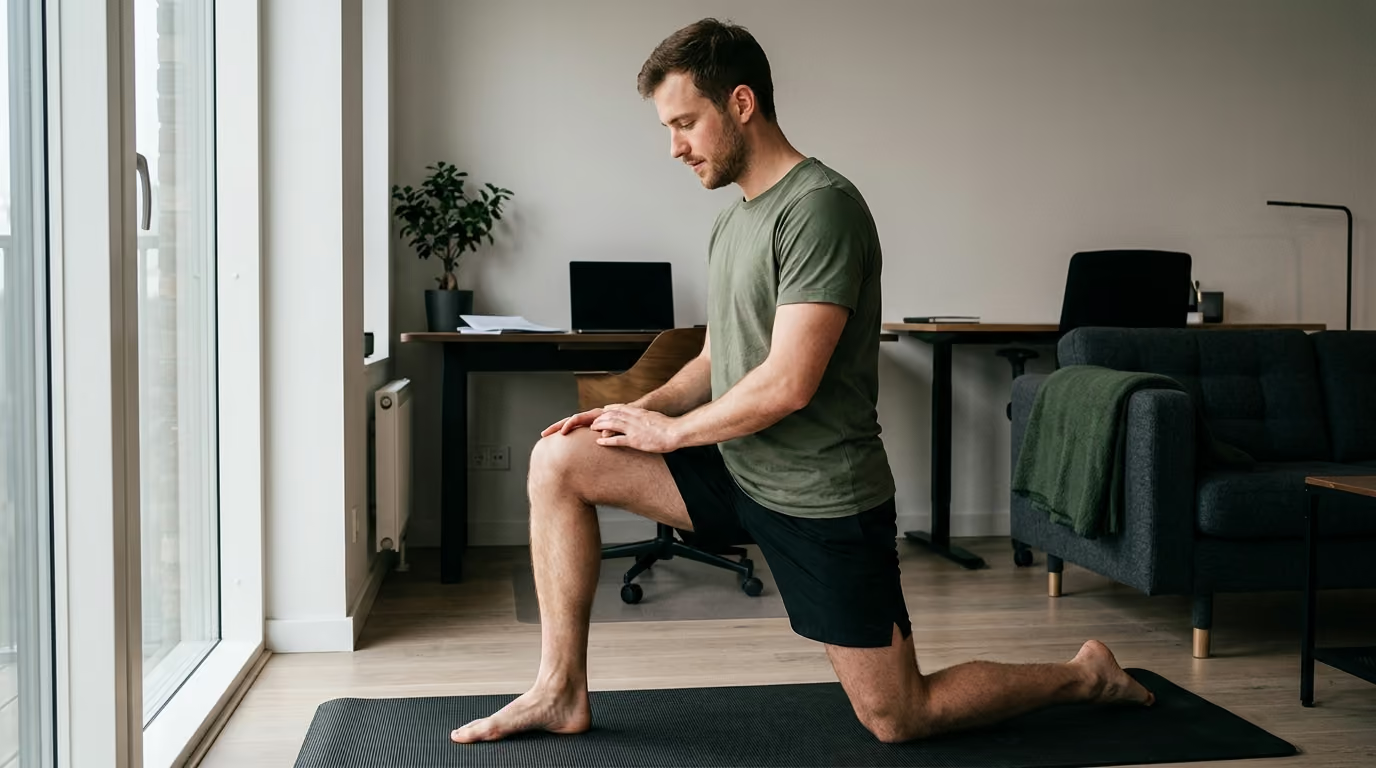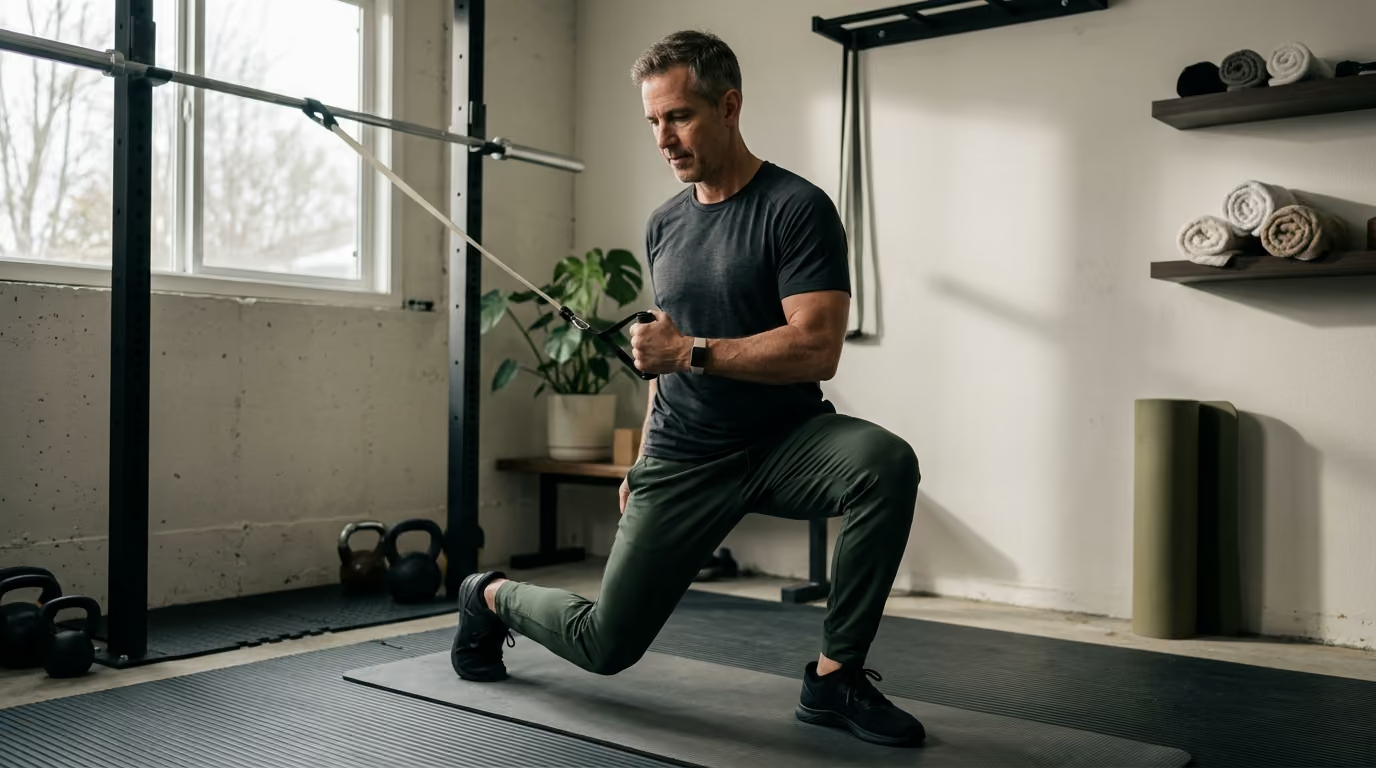

Sitting at a desk all day leaves hips locked and backs aching, making controlled range of motion exercises essential for rebuilding full movement capacity.





You step out of the truck after a six-hour convoy drive, and your hips feel cemented in place. Your lower back aches when you stand upright, and your ankles refuse to bend smoothly during your first few steps across the gravel. A week of heavy field packs, interrupted sleep, and prolonged sitting has left your joints stiff, guarded, and slow to respond. Forcing a deep squat or yanking on a tight hamstring only produces sharp discomfort and more muscular tension.
Restoring physical mobility requires gradual, controlled movement through progressively larger ranges of motion rather than aggressive stretching alone.
Mobility is the ability to actively control and coordinate your joints through the movement patterns your daily life, work, and training demand. When training spikes, long travel, field duty, or injury restrict your movement, the solution is not forcing painful positions. Effective restoration uses a structured progression: calm irritable tissues, restore active joint ranges, build motor control at the edges of those ranges, and integrate loaded movements back into functional tasks.
To restore movement effectively, you must understand what mobility actually represents. People often use flexibility and mobility interchangeably, but they describe different physical capacities. Confusing the two leads to training habits that waste time or increase joint irritation.
Flexibility describes the passive extensibility of muscles, tendons, and connective tissues. If someone can lift your leg into a high stretch while you relax completely, you possess passive flexibility. Range of motion refers to the total degrees of movement available at a specific joint structure.
Mobility represents your ability to actively control, stabilize, and use that available range of motion during a task. A person may have the passive flexibility to reach their toes while lying on their back, yet lack the mobility to perform a basic bodyweight squat without rounding their spine or losing balance.
Stability is the capacity to control joint position and resist unwanted movement when external forces are applied. Motor control is the ability of your nervous system to coordinate muscle activation, timing, and sequencing during a movement. Capacity describes the total amount of volume, load, speed, or duration your tissues can tolerate before breaking down. Readiness represents the match between your current capacity and the specific physical demands of the task you want to perform.
Achieving a massive passive range of motion is not the goal for most active adults. Having excessive range without the strength to control it can increase joint instability and reduce physical efficiency. The true goal of mobility restoration is developing sufficient, controlled movement capacity for the demands of running, lifting, rucking, climbing, manual work, and recreational sports.
Building usable mobility requires combining active range-of-motion drills, progressive strength training, coordination exercises, aerobic movement, and structured recovery. When you treat mobility as active strength across an entire movement arc, your physical capability improves and your joints stay resilient over the long term.
The science behind movement restoration reveals clear distinctions between proven training outcomes and common fitness assumptions. Understanding what the evidence supports helps you make better decisions about how to invest your training time.
Research clearly establishes that resistance training performed through full, comfortable ranges of motion improves joint mobility as effectively as dedicated stretching protocols. A systematic review and meta-analysis published in Sports Medicine demonstrated that external resistance training increases range of motion across major joints. Loaded exercises place tension on muscle fibers while they lengthen, which stimulates tissue remodeling and builds strength at elongated muscle lengths.
Guidelines from the American College of Sports Medicine recommend that adults engage in flexibility exercises at least two to three days per week. Accumulating roughly 60 seconds of total stretch time per muscle group, split into holds of 10 to 30 seconds, reliably increases joint range of motion over time. For older adults, holding static positions for 30 to 60 seconds often yields superior improvements in tissue compliance and joint tolerance. Noticeable chronic increases in range of motion typically emerge after three to four weeks of consistent, dedicated practice.
Evidence also confirms that interrupting prolonged sitting produces immediate cardiovascular and musculoskeletal benefits. A systematic review of 45 intervention studies published in the International Journal of Behavioral Nutrition and Physical Activity examined the impact of sedentary breaks. The review found that short bouts of light-intensity walking lasting from two to five minutes every 20 to 30 minutes significantly improved blood pressure, vascular function, and muscular stiffness compared to continuous sitting.
The relationship between stretching and injury prevention remains complex and often contradictory in scientific literature. A systematic review published in the British Journal of Sports Medicine found that stretching routines were associated with a 54 percent reduction in acute muscle strain injuries. However, other large-scale reviews have concluded that pre-exercise stretching alone does not reduce overall exercise-related injury rates.
These mixed findings suggest that flexibility is only one component of injury resistance. Workload management, adequate sleep, foundational strength, warm-up quality, and progressive loading play equally important roles in keeping tissues healthy. Stretching cannot compensate for sudden spikes in training volume, chronic under-recovery, or poor movement mechanics.
The mechanism behind long-term flexibility gains is also an active area of investigation. While earlier theories suggested that stretching permanently lengthened muscle fibers, current research indicates that much of the initial improvement stems from increased stretch tolerance. Your nervous system simply becomes less sensitive to the sensation of stretch, allowing you to move farther before triggering a protective guarding reflex.
Restoring movement after periods of immobilization, field duty, heavy physical training, or prolonged desk work requires a systematic process. The following seven-step framework provides a logical progression that moves from baseline assessment to long-term physical maintenance.
Before attempting any mobility drills, you need to understand the nature of your movement limitation. Identify the provoking context that caused the restriction, such as a sudden jump in mileage, hours spent in tight tactical seating, or an acute muscle strain.
Observe the exact location, intensity, and behavior of your symptoms. Determine whether the movement restriction feels like mechanical stiffness, protective muscle guarding, weakness, or sharp discomfort. Check how the limitation affects functional tasks like walking, descending stairs, squatting, and reaching overhead.
Track your recent load history, including training volume, terrain, footwear, sleep quality, and daily stress levels. Finally, monitor your physical response over a 24-hour cycle. Note how your joints feel during exercise, several hours later, and the following morning.
When tissues become irritated or overly guarded, the first step is calming the system without resorting to complete bed rest. Prolonged inactivity causes muscle atrophy, reduces tendon stiffness, and slows tissue recovery. The objective is to temporarily reduce the specific load, volume, or joint angle that provokes sharp pain while maintaining general physical activity.
Clinical practice guidelines for musculoskeletal care emphasize continuing low-stress movement to promote blood flow and maintain neuromuscular signaling. If deep squats cause sharp anterior hip pain, reduce your squat depth to a pain-free range rather than eliminating lower-body training entirely. If prolonged running irritates an Achilles tendon, switch temporarily to brisk walking or cycling while the tissue settles.
Use symptom behavior rather than a fear of all physical sensation to guide your choices. Experiencing mild, manageable discomfort during a movement is acceptable if the sensation settles quickly after the session. If your discomfort escalates during the activity or leaves you stiffer the next morning, the applied dose was too high.
Once acute sensitivity settles, begin active mobility work to restore joint range of motion. This phase uses unweighted and low-stress movements to encourage joint lubrication, relax hyperactive muscle tone, and improve tissue extensibility.
Effective mobilization methods include:
Always execute static stretches at an intensity that produces mild tension rather than sharp pain. Aggressive, forced stretching triggers protective muscle spasms that defeat the purpose of the drill. Work within your current movement boundaries and allow the nervous system to relax into the position naturally.
Gaining passive range of motion is useless if your nervous system cannot control that new space. Every newly accessed degree of movement must be reinforced with motor control and neuromuscular stability.
Progress your control training through a clear hierarchy. Begin with active unweighted movement through the expanded range, focusing on smooth, deliberate execution. Next, introduce isometric holds at the outer edge of your available range, squeezing the surrounding musculature for 5 to 10 seconds.
Follow isometric work with slow, controlled concentric and eccentric contractions through the entire movement arc. This sequence teaches your brain that the new joint position is stable, safe, and ready to produce force.
Mobility without strength is fragile. Once you demonstrate control through an unweighted range of motion, you must apply external resistance to stimulate tissue adaptation and build durable capacity.
Progress your loaded mobility by altering only one training variable at a time:
A sensible guideline when rebuilding movement capacity is increasing training volume before increasing intensity. Adding a few controlled repetitions with a moderate weight allows you to evaluate your joint response before introducing heavy loads.
Mobility restoration succeeds only when improved joint range transfers to the complex physical tasks of daily life, sports, and occupational duties. An isolated improvement in hip extension is meaningful only if it enhances your running mechanics, field movement, or lifting technique.
In this phase, transition from single-joint or controlled gym exercises to multi-planar, dynamic activities. A runner must integrate improved ankle dorsiflexion and hip extension into running drills and tempo intervals. A military service member must ensure that restored shoulder and spinal mobility holds up while carrying body armor, lifting equipment, and navigating uneven terrain.
Return-to-activity decisions should rely on clear functional criteria rather than calendar timelines alone. You are ready to resume unrestricted physical tasks when you can complete sport-specific or job-specific movement tests without compensatory patterns or delayed symptom spikes.
Maintaining restored mobility requires consistent, low-dose movement habits woven into your regular weekly routine. You do not need hours of daily stretching to maintain your physical capacity once it has been re-established.
Long-term maintenance combines regular resistance training through full ranges of motion, frequent movement breaks during sedentary working hours, and consistent weekly cardiovascular exercise. The World Health Organization recommends that adults complete 150 to 300 minutes of moderate-intensity aerobic exercise or 75 to 150 minutes of vigorous activity each week. Combining this aerobic foundation with progressive training and performance protocols keeps your joints nourished, your muscles strong, and your movement patterns clean.
Musculoskeletal restrictions rarely exist in isolation, but organizing your mobility work by specific joint complexes provides a practical, systematic starting point.
The foot and ankle complex serves as your primary contact point with the ground. Restrictions in ankle dorsiflexion often cause cascading movement compensations up the kinetic chain, creating knee irritation, hip shifting, or lower back strain during squats, lunges, and running.
Key capacities required for healthy ankle function include:
To restore ankle mobility, begin with active ankle circles and knee-to-wall dorsiflexion mobilizations. Stand facing a wall with your toes two to three inches away, then drive your knee forward over your second toe without letting your heel lift from the floor. Hold for two seconds, return, and repeat for 10 to 15 repetitions per side.
Progress into loaded calf raises performed on a raised step. Lower your heels below the step level for a three-second stretch, pause, and press up smoothly into full plantarflexion. Incorporate both straight-knee calf raises to target the gastrocnemius and bent-knee variations to load the deeper soleus muscle. As tolerance improves, progress to single-leg calf raises, pogo hops, and running drills to ensure the ankle can handle dynamic ground impact.
The knee functions primarily as a hinge joint designed to manage force between the hip and the foot. Restoring knee mobility requires rebuilding tolerance to both full flexion and full extension while improving the capacity of the quadriceps and hamstring muscle groups.
Key capacities for the knee complex include:
Start restoring knee range of motion using active heel slides while seated or lying on your back. Slide your heel toward your buttocks until you feel a gentle stretch across the front of the knee, pause briefly, and extend the leg fully, actively engaging your quadriceps at the end range.
Progress to isometric terminal knee extensions using a resistance band anchored in front of you. Once baseline control is pain-free, transition to slow tempo box squats, step-downs from a low platform, and split squats. Ensure that your knee tracks smoothly in line with your middle toes during all squatting and lunging variations. Rebuild tissue tolerance by gradually increasing the depth of your split squats before adding heavy external resistance.
The hip is a multi-axial ball-and-socket joint that requires significant mobility in all three planes of movement: flexion and extension, abduction and adduction, and internal and external rotation. Prolonged sitting and repetitive linear training often leave the hips feeling restricted and guarded.
Key capacities for the hip complex include:
Begin hip restoration with the 90/90 ground transition drill. Sit on the floor with both knees bent at 90-degree angles, one leg in front of you in external rotation and the other out to the side in internal rotation. Keeping your torso tall, gently hinge forward over your front thigh to stretch the gluteal musculature, hold for 15 seconds, and then rotate your torso toward the trail leg.
Next, rebuild active hip extension using floor glute bridges and half-kneeling hip flexor stretches. In the half-kneeling position, tuck your pelvis under by engaging your abdominal muscles and glute, then shift your weight slightly forward until you feel a stretch along the front of your rear thigh.
Progress your hip training by incorporating loaded Romanian deadlifts, goblet squats, and lateral lunges. These exercises build strength across both shortened and lengthened positions, turning passive flexibility into functional strength.
The lumbar spine is designed primarily for load transmission and stability, functioning in close coordination with the pelvis and hip joints. When hips lack mobility, the lumbar spine is often forced to move excessively to compensate, leading to localized fatigue and discomfort.
Key capacities for the lumbar-pelvic region include:
Restoring lumbar movement begins with low-load movement drills like the quadruped cat-camel. On your hands and knees, slowly round your entire spine toward the ceiling while exhaling, then smoothly transition into mild spinal extension while inhaling. Focus on distributing the movement evenly across every segment of your spine rather than hinging sharply at one painful point.
Transition to core endurance drills such as bird-dogs, dead-bugs, and side planks to establish multi-directional trunk control. Once baseline stability is solid, practice the fundamental hip hinge pattern using a light dowel along your spine to ensure movement occurs at the hip sockets rather than through the lower back. Progress to elevated barbell deadlifts, farmer carries, and suitcase carries to build heavy load tolerance and spinal resilience.
The thoracic spine is designed for rotation, flexion, and extension, while the rib cage provides vital protection for internal organs and expands to support respiration. Prolonged desk work, computer use, and driving often lead to reduced thoracic mobility and shallow chest breathing.
Key capacities for the thoracic complex include:
To restore thoracic mobility, begin with side-lying thoracic open-book rotations. Lie on your side with your hips and knees bent at 90 degrees to lock the lumbar spine in place. Reach your top arm across your body, opening your chest toward the ceiling as you follow your hand with your eyes. Exhale fully as you reach the open position, hold for two seconds, and return smoothly for 8 to 10 repetitions per side.
Pair rotational drills with foam roller thoracic extensions. Place a foam roller horizontally across your mid-back, support your head with your hands, and gently extend your upper spine backward over the roller while keeping your lower ribs drawn down. Follow these mobilizations with loaded carries, face pulls, and overhead pressing variations to solidify your active thoracic extension under load.
The shoulder complex contains the glenohumeral joint and the scapulothoracic articulation, creating the most mobile joint system in the human body. Restoring shoulder function requires balancing expansive movement with rotator cuff strength and scapular stability.
Key capacities for the shoulder and neck include:
Begin shoulder restoration with wall slides and active shoulder circles. Stand with your back against a wall, place your forearms against the surface, and slowly slide your arms upward into a "Y" position without allowing your lower back to arch away from the wall. This drill encourages proper serratus anterior activation and upward scapular rotation.
Integrate prone "Y-T-W" raises on the floor to strengthen the lower trapezius, rhomboids, and rear deltoids. For the neck, perform gentle chin tucks and slow, unforced cervical rotations within a pain-free range. Never force an aggressive stretch on the neck if you experience dizziness, visual disturbances, or radiating arm tingling. Progress your upper-body training to overhead kettlebell carries, push-ups, and pull-ups to build balanced upper-body strength and joint durability.
Organizing mobility work solely by individual joints can cause you to miss movement compensations that appear only during complex tasks. Evaluating and training the foundational human movement patterns ensures that your joint mobility functions properly during multi-joint athletic and occupational demands.
A complete squat requires coordinated ankle dorsiflexion, deep knee flexion, bilateral hip flexion, and rigid trunk control. When an active adult struggles with squat depth, the issue is rarely just tight quads.
A lack of ankle dorsiflexion will force the torso to pitch excessively forward, placing higher shear loads on the lower back. Restricted hip internal rotation can cause the knees to cave inward or produce pinching in the front of the hip socket. Restoring the squat pattern requires mobilizing the calves and hip capsules while using goblet squats to teach upright torso positioning under load.
The hip hinge is the cornerstone of safe lifting, requiring maximal hip flexion with minimal knee bend and a stable spine. This pattern demands extensibility through the hamstring and adductor magnus muscle groups alongside active posterior chain engagement.
When hip hinge mobility is restricted, lifters frequently round their lumbar spine to reach the floor, increasing the risk of back irritation. Restore the hinge by practicing wall-tap hinges, where you stand six inches from a wall and push your hips straight backward until your glutes touch the surface. Reinforce this motor pattern using Romanian deadlifts and kettlebell swings, ensuring that tension remains focused entirely in the hips and hamstrings.
Single-leg and split-stance movements expose side-to-side asymmetries that bilateral exercises easily hide. A proper lunge demands hip extension on the trailing leg, hip flexion and ankle dorsiflexion on the lead leg, and frontal-plane pelvic control.
Restricted hip flexors on the trailing leg cause the pelvis to tilt forward, creating lumbar hyperextension under load. Address this limitation with half-kneeling hip flexor stretches paired with active glute bridges. Progress into walking lunges, Bulgarian split squats, and step-ups to build balanced lower-body strength and improve pelvic stability during single-leg stance.
Upper-body pushing and pulling patterns depend heavily on coordinated movement between the rib cage, shoulder blades, and arms. Pressing a weight overhead requires full glenohumeral flexion combined with upward scapular rotation and thoracic extension.
If thoracic extension or shoulder flexion is limited, individuals consistently compensate by overarching their lower backs and flaring their rib cages to press overhead. Restore these movement patterns using lat stretches, thoracic extension mobilizations, and landmine presses. The angled trajectory of a landmine press allows you to build upper-body pressing strength while you gradually restore the mobility needed for true vertical overhead pressing.
Walking, running, rucking, and navigating rugged terrain require cyclical coordination of hip extension, ankle propulsion, trunk rotation, and shock absorption. Decelerating your body weight rapidly downhill or landing from a jump places high eccentric loads on the calves, quadriceps, and hamstrings.
Restoring locomotion capacity requires moving beyond slow, static drills. Once baseline joint mobility and strength are restored, incorporate lateral bounding, pogo hops, change-of-direction shuttle runs, and progressive rucking. This ensures that your tendons, ligaments, and nervous system develop the dynamic stiffness and reactive control required for real-world physical performance.
Mobility restoration should never be an aggressive battle against your own anatomy. Safely progressing your training requires an objective system to monitor symptoms and adapt loading based on how your body responds over a 24-hour window.
A practical framework for managing exercise progression is the traffic light monitoring system. This method categorizes your physical sensations during and after training to help you make informed decisions about whether to progress, maintain, or reduce your training dose.
Your movement feels smooth and comfortable. Discomfort levels during or after exercise remain between 0 and 2 on a 10-point scale. Any mild muscle soreness settles quickly, and your joints feel loose and pain-free the following morning. You can safely increase exercise volume, range of motion, or external load according to your planned progression.
You experience noticeable stiffness or mild discomfort rated between 3 and 5 out of 10 during the session. However, the sensation remains stable throughout training, does not cause you to limp or alter your movement mechanics, and returns completely to baseline by the following morning.
In this scenario, maintain your current exercise selection and volume without adding load or speed. Allow your tissues another week to adapt to the current demands before attempting to progress further.
Your pain reaches a 6 out of 10 or higher during the movement, or your discomfort progressively escalates with each repetition. You notice marked swelling, joint warmth, radiating nerve sensations, or a significant loss of functional strength. You wake up the following morning with increased joint stiffness and pain that persists beyond 24 hours.
A red-light response indicates that the physical dose exceeded your current tissue capacity. Immediately reduce the training volume, eliminate the provoking joint angle, or substitute a non-aggravating exercise. Return to an earlier stage in your progression and rebuild capacity more gradually.
Different tissues respond to physical stress in distinct ways. Tailoring your monitoring strategy to the specific tissue involved prevents common rehabilitation setbacks.
For muscle strains, research indicates that mild discomfort during exercise up to a 4 or 5 out of 10 is acceptable, provided symptoms return to baseline by the next morning and do not worsen from week to week. Progressing through mild discomfort helps stimulate proper collagen alignment during muscle tissue repair.
Tendons require a more conservative monitoring rule. Tendons frequently experience a delayed inflammatory response that does not peak until 12 to 24 hours after a training session. A workout that feels completely pain-free while your body is warm may trigger sharp tendon pain the following morning.
For tendon-related issues, keep training discomfort at or below a 3 out of 10. If localized tendon pain remains elevated for more than 24 hours after a workout, treat it as a clear signal that the volume, speed, or plyometric intensity was too high.
Active adults frequently fall into predictable traps when trying to improve their mobility. Recognizing these common errors will save you months of wasted effort.
Demanding occupational schedules, long vehicle transits, and desk-bound assignments impose significant static stress on the body. Implementing targeted recovery protocols counters the negative effects of prolonged sitting and physical fatigue.
Sitting for extended periods keeps the hips flexed, the thoracic spine rounded, and the calf muscles shortened. Over time, your nervous system adapts to these static postures by down-regulating gluteal activation and stiffening the anterior hip capsule.
A study on office workers published in the journal Ergonomics found that individuals who sit for more than seven continuous hours per day exhibit significantly reduced thoracic spine mobility and higher rates of neck discomfort compared to those who take regular movement breaks.
To counteract these effects, use these practical workstation habits:
Applying the principles of mobility restoration to common active-duty and civilian scenarios demonstrates how to adapt the framework to specific physical challenges.
An individual experiences stiff hip flexors, a dull lower back ache, and tight ankles after an eight-hour flight, with an upcoming training run planned for the afternoon.
Instead of jumping straight into a run or aggressively stretching cold muscles, begin with 10 minutes of brisk walking. Follow this with dynamic leg swings, half-kneeling hip flexor stretches, and unweighted bodyweight squats.
Reduce the planned run distance by 30 to 50 percent, keeping the pace relaxed and conversational. After the run, perform loaded calf raises and glute bridges to restore active strength through the lower extremities. Monitor how your hips and lower back feel the following morning before resuming normal training volume.
A lifter experiences bilateral hip and groin stiffness that prevents them from reaching parallel depth during back squats following a sudden increase in training volume.
Temporarily reduce squat loading by 20 to 30 percent and adjust the movement to a comfortable depth using a box squat. Incorporate hip 90/90 mobilizations and lateral lunges during the warm-up to improve hip capsule extensibility.
Rebuild squat depth gradually over two to three weeks by lowering the box height as movement comfort improves. This approach maintains training continuity and muscular strength without irritating the hip joints. Integrating targeted recovery and sleep habits during this phase will also accelerate connective tissue adaptation.
A service member recovering from a mild hamstring strain can walk comfortably on flat ground, but feels a pulling sensation when jogging, carrying heavy gear, or descending steep hills.
Begin by confirming that the individual can perform single-leg bridges and bodyweight Romanian deadlifts with minimal discomfort. Next, introduce straight-line jogging intervals on a predictable, flat grass surface.
Gradually progress running speed before introducing uneven terrain, heavy rucking loads, or directional agility drills. Adjusting load variables one at a time ensures that tissue healing progresses safely toward full operational readiness.
An office worker experiences persistent stiffness between the shoulder blades that worsens by mid-afternoon, but notes that moving around provides temporary relief.
Implement two-minute movement breaks every hour to perform standing arm reaches and thoracic rotations. In the gym, emphasize horizontal rowing exercises, face pulls, and loaded dumbbell farmer carries.
Strengthening the upper back musculature and improving posture endurance provides lasting relief from the postural strain of prolonged sitting. For more guidance on supporting physical longevity across your career, review our resources on healthy aging.
Maintaining joint health and mobility does not require hours of complex stretching routines. Integrating short, targeted mobility sequences into your existing training schedule provides consistent, long-term benefits.
This quick routine can be performed every morning or as a general warm-up before physical activity:
To maintain long-term physical resilience, organize your mobility and movement training into a sustainable weekly structure:
Initial improvements in joint range of motion can occur within a single session, but these early changes primarily reflect acute neurological relaxation and increased stretch tolerance. Achieving lasting structural adaptations in muscle-tendon units typically requires three to four weeks of consistent mobility and strength training performed two to three days per week. Long-term tissue remodeling continues over several months of progressive loaded exercise.
Dynamic mobility drills, active joint circles, and movement-pattern rehearsals are best performed before training to raise core temperature, lubricate joint surfaces, and prepare the nervous system for loading. Prolonged static stretching is more effective after workouts or during dedicated recovery sessions, when warm tissues can relax into deeper positions without temporarily reducing explosive power output.
Research shows that resistance training performed through a full, comfortable range of motion improves joint flexibility as effectively as static stretching. For many active adults, lifting weights through complete movement arcs provides sufficient mobility for daily life and sports. However, incorporating specific mobility drills remains valuable for addressing stubborn joint asymmetries, warming up before heavy training, or recovering from periods of prolonged immobilization.
A sharp, pinching sensation inside a joint capsule, such as the front of the hip during a squat or the top of the shoulder during an overhead press, often indicates joint impingement or protective guarding rather than muscular tightness. Never attempt to force your way through a sharp joint pinch. Immediately reduce the depth of the movement, adjust your stance or grip angle, and focus on mobilizing the surrounding soft tissues before retesting the pattern.
The information provided in this guide is intended solely for educational and informational purposes. It should not be used as a substitute for professional medical advice, diagnosis, or treatment. Always consult with a qualified healthcare provider, physical therapist, or physician before beginning any new exercise or rehabilitation program, especially if you have a history of acute injury, chronic joint pain, surgery, or underlying health conditions.
Revisit this mobility guide whenever you experience significant changes in your physical routine, such as preparing for a deployment, recovering from an intensive training cycle, returning to exercise after travel, or managing joint stiffness following prolonged desk assignments.
Building durable, usable mobility is an ongoing physical practice that supports long-term strength, joint longevity, and operational capability across every stage of your active life.
Follow BattleVet for practical guidance on military and veteran health, strength, recovery, testosterone, sleep and healthy aging. Stay connected for new articles, research backed insights and clear information to help you stay capable for the years ahead.


Build better habits around strength, recovery, sleep, hormones and healthy aging with practical guidance for active military personnel and veterans.
Explore BattleVet