
Balance recovery demands dynamic nervous system training rather than simple static poses to restore real stability and functional movement after an injury.





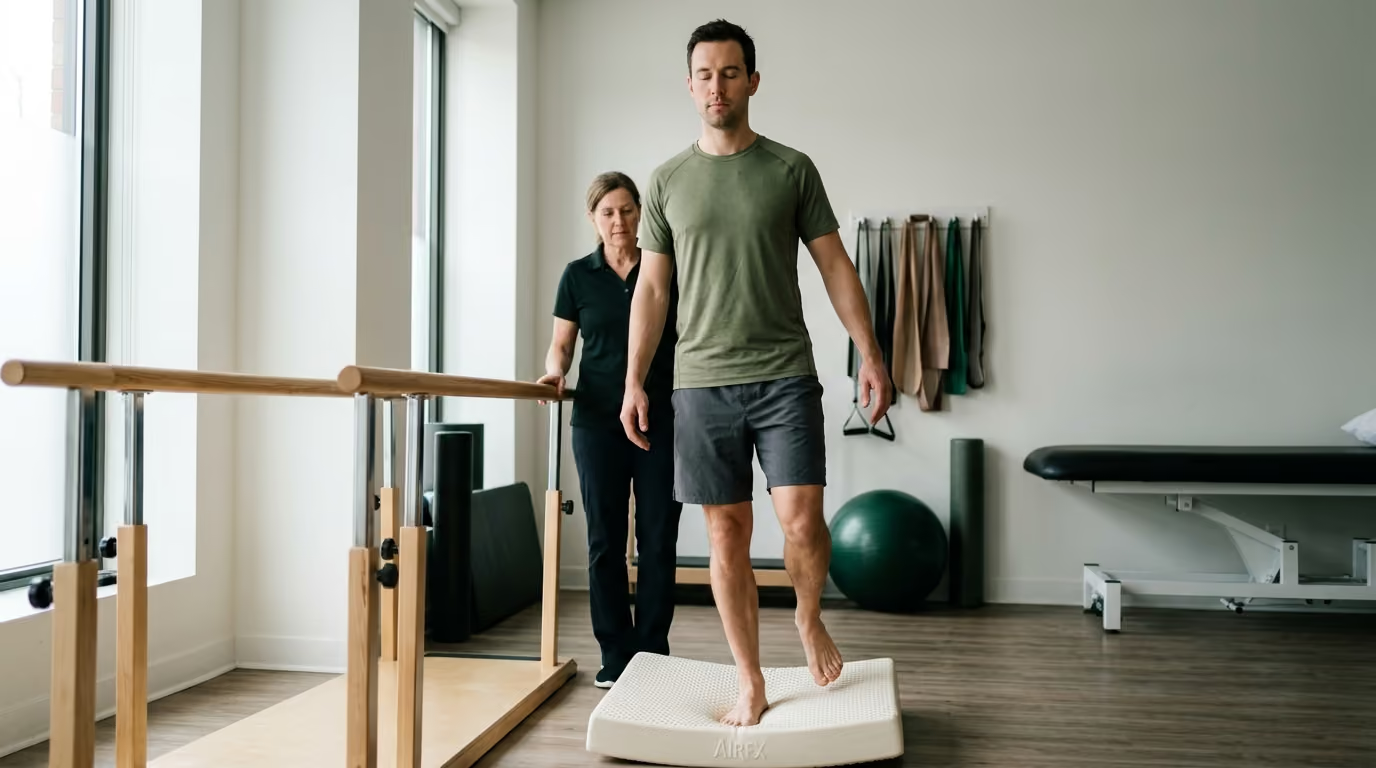
Standing on an unstable foam pad or balancing on one leg with your eyes closed is often treated as the gold standard of balance recovery. In reality, quiet standing drills on squishy mats rarely prepare someone to step off a curb in low light, navigate wet grass, or recover from a sudden stumble. True physical stability is an active conversation between your sensory organs, nervous system, and muscles. Rebuilding that capability after an injury, concussion, surgery, or prolonged inactivity requires a systematic progression rather than random balance circus tricks.
True balance recovery requires progressively integrating sensory inputs, muscle strength, and reactive stepping rather than simply balancing on unstable equipment.
Balance and proprioception recovery is the structured process of retraining your brain to gather visual, vestibular, and joint-sensing signals to produce fast, coordinated physical responses. When an injury or illness damages these pathways, your body loses its automatic spatial awareness. Restoring this system involves progressing from stable surfaces to dynamic, multidirectional movement, varying sensory conditions, and unexpected perturbations to ensure safety in everyday life.
Balance is the ability to control your center of mass relative to your base of support. It is not a single skill or an on-off switch. Postural control operates across four distinct functional domains:
A comprehensive meta-analysis examining balance training in older adults found that while exercise improved all four domains, the largest functional gains occurred in proactive and reactive balance. Being able to stand motionless for sixty seconds does not automatically transfer to stepping over an obstacle or regaining your footing on an uneven trail. Each domain places different demands on your nervous system.
Proprioception is the internal sensing mechanism that makes balance possible. Specialized receptors located in your muscles, tendons, joint capsules, and skin continuously send data to your central nervous system regarding joint angles, tissue tension, acceleration, and mechanical load. This system provides a dynamic internal map of where your limbs are positioned without needing to look at them.
When your foot strikes the ground, proprioceptive signals travel up the spinal cord to the brainstem, cerebellum, and cerebral cortex. Your brain combines this somatosensory information with two other primary systems:
Your central nervous system constantly weighs and compares these three streams. If one stream is compromised, the brain shifts reliance to the others. For example, someone with joint damage or peripheral neuropathy often relies heavily on vision to stay upright. If that person walks into a dimly lit room or closes their eyes, their stability drops rapidly.
Rehabilitation is not about isolating one sensory stream forever. It is about restoring the primary input where possible, teaching the brain to use remaining inputs effectively, and training the muscular system to produce rapid, accurate corrections. For more on building resilient movement patterns, read our training and performance articles to understand how tissue loading supports joint health.
Before starting any recovery program, you need a clear baseline of your current physical capacity. Assessment must evaluate how you function during realistic movement tasks rather than relying on a single test score.
Clinical guidelines such as the CDC STEADI initiative use a three-part model: screen, assess, and intervene. Screening identifies individuals who have fallen, feel unsteady, or worry about falling. Assessment determines the specific underlying deficits in strength, gait, sensation, vision, or vestibular function. Intervention applies targeted, evidence-based training to resolve those deficits.
An umbrella review examining functional-mobility tests found that no single assessment can predict fall risk in isolation with absolute certainty. Clinicians and active adults should use a combination of validated tools to monitor progress:
The Timed Up and Go test measures the time it takes to stand up from a standard chair, walk three meters, turn around, walk back, and sit down. It evaluates basic dynamic mobility, transitions, and turning. While a slower score indicates mobility limitations, it should be paired with broader balance assessments.
This fourteen-item test evaluates functional tasks including transfers, reaching forward, turning to look over the shoulder, standing with feet together, tandem stance, and single-leg standing. In stroke rehabilitation, research notes specific cutoff ranges around 46.5 to 50.5 points out of 56. However, scoring standards differ across health conditions and should not be treated as a universal pass-fail grade.
The Four Square Step Test measures the time required to step forward, sideways, and backward over low obstacles arranged in a cross on the floor. It tests multidirectional stepping speed, anticipatory adjustments, and foot clearance. Validation research indicates that taking fifteen seconds or longer to complete the sequence distinguishes individuals with higher fall rates. This test is not suitable for individuals who require a walker.
The Mini-BESTest is an advanced assessment tool that separates balance into four domains: anticipatory postural adjustments, reactive postural control, sensory orientation, and dynamic gait. It is widely recognized in neurological rehabilitation, particularly for Parkinson's disease, because it pinpoints whether an individual struggles with inner-ear balance, ankle strategies, or dual-task walking.
Physical capacity and subjective confidence do not always align. Some individuals have adequate strength but restrict their activities due to severe fear of falling. Others feel overly confident while demonstrating poor reactive control. Validated questionnaires like the Activities-Specific Balance Confidence Scale and the Falls Efficacy Scale International quantify subjective certainty during tasks like walking on ice, navigating stairs, or stepping onto escalators.
Professional medical evaluation is essential if your unsteadiness is accompanied by unexplained dizziness, lightheadedness, fainting, new focal weakness, numbness, severe headaches, or sudden vision changes. These red flags require immediate medical workups to rule out central neurological issues or cardiovascular complications.
Decades of clinical research demonstrate that balance and proprioception are trainable at any age and across diverse clinical conditions. However, the exact type and dose of exercise determine your outcomes.
A Cochrane systematic review analyzed 59 randomized controlled trials involving nearly 13,000 community-dwelling older adults. The authors reported that structured exercise reduced fall rates by 23 percent. Programs focusing specifically on balance and functional movement reduced fall rates by 24 percent. Most importantly, programs that combined balance, functional drills, and progressive resistance training reduced fall rates by 34 percent.
A separate meta-analysis confirmed that exercise programs challenging balance for more than three hours per week produced the greatest risk reductions. Research evaluating multimodal strength and balance programs, the Otago Exercise Program, and Tai Ji Quan reported fall reductions ranging between 20 percent and 58 percent across varied clinical cohorts.
Evidence across specific conditions reveals important nuances:
The American Physical Therapy Association issued clinical practice guidelines giving a strong recommendation for vestibular rehabilitation in adults with peripheral vestibular hypofunction. For acute or subacute unilateral hypofunction, the guidelines recommend a home gaze-stabilization program of at least three sessions daily, totaling at least 12 minutes per day.
For chronic unilateral hypofunction, the recommended dose is three to five daily sessions totaling 20 minutes daily for four to six weeks. Bilateral hypofunction requires 20 to 40 minutes daily for five to seven weeks. Gaze-stabilization exercises require moving the head while maintaining focus on a stationary target. The guidelines advise against using isolated eye movements without head motion as gaze-stability training.
In populations recovering from anterior cruciate ligament injuries or reconstruction, systematic reviews show that proprioceptive and balance training improves joint-position sense, muscle strength, perceived knee function, and single-leg hop performance. However, improved joint-position sense does not automatically guarantee improvement in every complex sports-specific task. Rehabilitation must extend beyond stationary balance into multidirectional agility and deceleration.
A critical finding in residential and community exercise studies is that the benefits of balance training decline once regular training stops. Balance is a continuous physiological adaptation. When targeted stimulation ends, neuromuscular adaptations, coordination, and reactive stepping speed gradually regress. Sustainable physical restoration requires embedding progressive balance challenges into your lifelong weekly routine. You can review our healthy aging strategies for practical methods to maintain mobility over time.
Progression should never mean making an exercise arbitrarily dangerous. Making a drill more challenging should follow systematic variables. Adjust one variable at a time so you can observe how your nervous system responds.
The challenge without chaos principle means an exercise should be difficult enough to force muscular and neurological adaptation, but controlled enough that you do not lose form, suffer severe symptom flare-ups, or risk an unrecovered fall.
Progression operates across six core dimensions:
Reduce the surface area supporting your body in a step-by-step manner:
Progress from predictable environments to compliant or uneven surfaces:
Unstable surfaces reduce the fidelity of somatosensory input from the feet. They force the body to rely more heavily on visual and vestibular inputs. Compliant surfaces should only be introduced once you demonstrate steady control on firm ground.
Systematically alter visual feedback to train sensory reweighting:
Closing your eyes is a sensory modification, not a mandatory test of fitness. It should be used carefully, especially for individuals with significant sensory loss or uncompensated vestibular hypofunction.
Advance from static postures to complex dynamic tasks:
Introduce dual-task demands to prepare for real-world environments:
Dual-task demands reflect how daily life works. Falls rarely happen in quiet rooms when someone is focusing entirely on their feet. They happen when a person turns their head to answer a question or carries a heavy box across an uneven doorway.
Transition from planned movements to reactive balance corrections:
Building lower-body strength and rate of force development provides the physical foundation for reactive balance. Explore our strength and fitness resources for programming guidance on lower-body power.
This six-phase training template guides your recovery from basic upright tolerance to reactive real-world performance. Progression between phases should occur when you complete the current drills with technical control, without excessive anxiety, and with stable symptoms.
The focus in Phase 0 is establishing safety, identifying sensory deficits, and setting baseline tolerance.
Progress to Phase 1 when you can stand and shift weight for five minutes continuously without dizziness, loss of balance, or significant pain.
Phase 1 rebuilds alignment, weight distribution, and tolerance for upright movement on predictable flooring.
Progress to Phase 2 when you can hold a narrow stance for thirty seconds comfortably and complete reaches outside your base without losing your footing.
Phase 2 challenges your ankle and hip balance strategies by narrowing your base of support and reducing arm assistance.
Progress to Phase 3 when you can maintain a tandem stance for twenty seconds per side with minimal hand support.
Phase 3 transitions from holding static positions to moving smoothly through space across multiple planes.
Progress to Phase 4 when you can perform figure-eight walks and multidirectional stepping without pausing, stumbling, or relying on external handholds.
Phase 4 forces your brain to reweight sensory information by introducing head movements and variable visual environments.
Progress to Phase 5 when you can walk with continuous head turns without veering off course or provoking symptoms. If you need strategies to support nervous system recovery after challenging sessions, check our recovery and physical restoration guidance.
Phase 5 develops movement automaticity by combining balance drills with cognitive demands and daily manual tasks.
Progress to Phase 6 when you can complete cognitive and manual dual-task walking without slowing your gait speed or losing postural control.
Phase 6 trains the rapid stepping responses and protective actions necessary to prevent falls during unexpected destabilization.
A standard drill can have completely different physiological impacts depending on your underlying health status. Balance training must be tailored to specific diagnoses.
Post-concussion balance deficits frequently involve exertion intolerance, visual-motion sensitivity, and cervical spine stiffness. Do not increase movement speed, visual complexity, and physical exertion all at once. If busy visual environments trigger dizziness or cognitive fatigue, keep the base of support stable while gradually introducing small, controlled head movements. Progress sensory exposure in short bouts, allowing symptoms to return to baseline before repeating.
Individuals with diagnosed unilateral or bilateral vestibular hypofunction require specific gaze-stabilization exercises. The American Physical Therapy Association guidelines emphasize that recovery relies on retinal slip, which occurs when you move your head while fixing your gaze on a target. Isolated eye-tracking exercises without head movement do not drive this adaptation. Dosage must be sustained daily for several weeks to produce lasting central compensation.
Rehabilitation following a stroke must address asymmetrical weight-bearing, paretic limb sensory loss, and reduced ankle dorsiflexion. Training should focus on increasing weight acceptance through the affected leg, practicing stepping in all directions, and improving clearance during the swing phase of gait. Standardized scores like the Berg Balance Scale provide helpful progress markers, but daily training must center on practical tasks such as transferring out of a chair, stepping over low sills, and turning safely.
Following an ankle sprain, knee replacement, or ACL reconstruction, mechanoreceptors in damaged ligaments and capsules are disrupted. Training must respect surgical healing timelines and tissue load tolerances. Initial work emphasizes joint position awareness and static weight-bearing on stable ground. As healing progresses, incorporate dynamic single-leg stabilization, lateral cutting, and deceleration mechanics to restore confidence and neuromuscular control.
Individuals with peripheral neuropathy or age-related vision changes have reduced somatosensory feedback from the feet. For these individuals, closing the eyes or standing on thick foam pads can create unnecessary fall hazards without providing practical functional benefits. Training should focus on maximizing remaining sensory input, building lower-body strength, improving reactive stepping speed on firm surfaces, and optimizing home lighting and footwear. Review the BattleVet research library for deeper scientific analyses on maintaining long-term physical capability.
Avoiding common training mistakes prevents injury and ensures steady functional progress.
Neuromuscular adaptations such as improved motor unit recruitment and weight-shifting confidence often appear within three to four weeks of consistent training. Significant improvements in ligament proprioception, reactive stepping, and vestibular compensation typically require eight to twelve weeks of structured practice performed three to five days per week. Long-term maintenance requires ongoing weekly movement.
No special equipment is required. A firm floor, a standard chair, a clear wall or countertop for safety, and small household items to step over are sufficient for most phases of rehabilitation. Specialized tools like foam balance pads can provide useful sensory variety later in training, but functional stepping drills and strength work on solid ground are far more important.
Single-leg balance is useful for assessing basic unilateral stability, but it is not sufficient on its own. Real-world falls usually occur during dynamic movement, direction changes, or unexpected perturbations. A complete fall-prevention program must combine single-leg control with multidirectional stepping, lower-body strength training, head-movement integration, and reactive recovery drills.
Dizziness during head movement often indicates that your visual and vestibular systems are struggling to coordinate gaze stability with dynamic motion. This can occur after a concussion, following inner-ear infections, or after prolonged periods of physical inactivity. If symptoms persist, obtain a formal evaluation from a physical therapist specializing in vestibular rehabilitation.
This article is for educational and informational purposes only and does not constitute individual medical advice, formal diagnosis, or physical therapy prescription. Balance deficits, sudden dizziness, unsteadiness, or recurrent falls can stem from serious underlying medical, cardiovascular, or neurological conditions. Always consult a qualified healthcare professional, such as a physical therapist, neurologist, or primary care physician, before beginning any balance rehabilitation program or making changes to your medical care.
Consistent, progressive practice transforms balance from a point of vulnerability into a dependable foundation for lifelong capability and physical independence.
Follow BattleVet for practical guidance on military and veteran health, strength, recovery, testosterone, sleep and healthy aging. Stay connected for new articles, research backed insights and clear information to help you stay capable for the years ahead.


Build better habits around strength, recovery, sleep, hormones and healthy aging with practical guidance for active military personnel and veterans.
Explore BattleVet