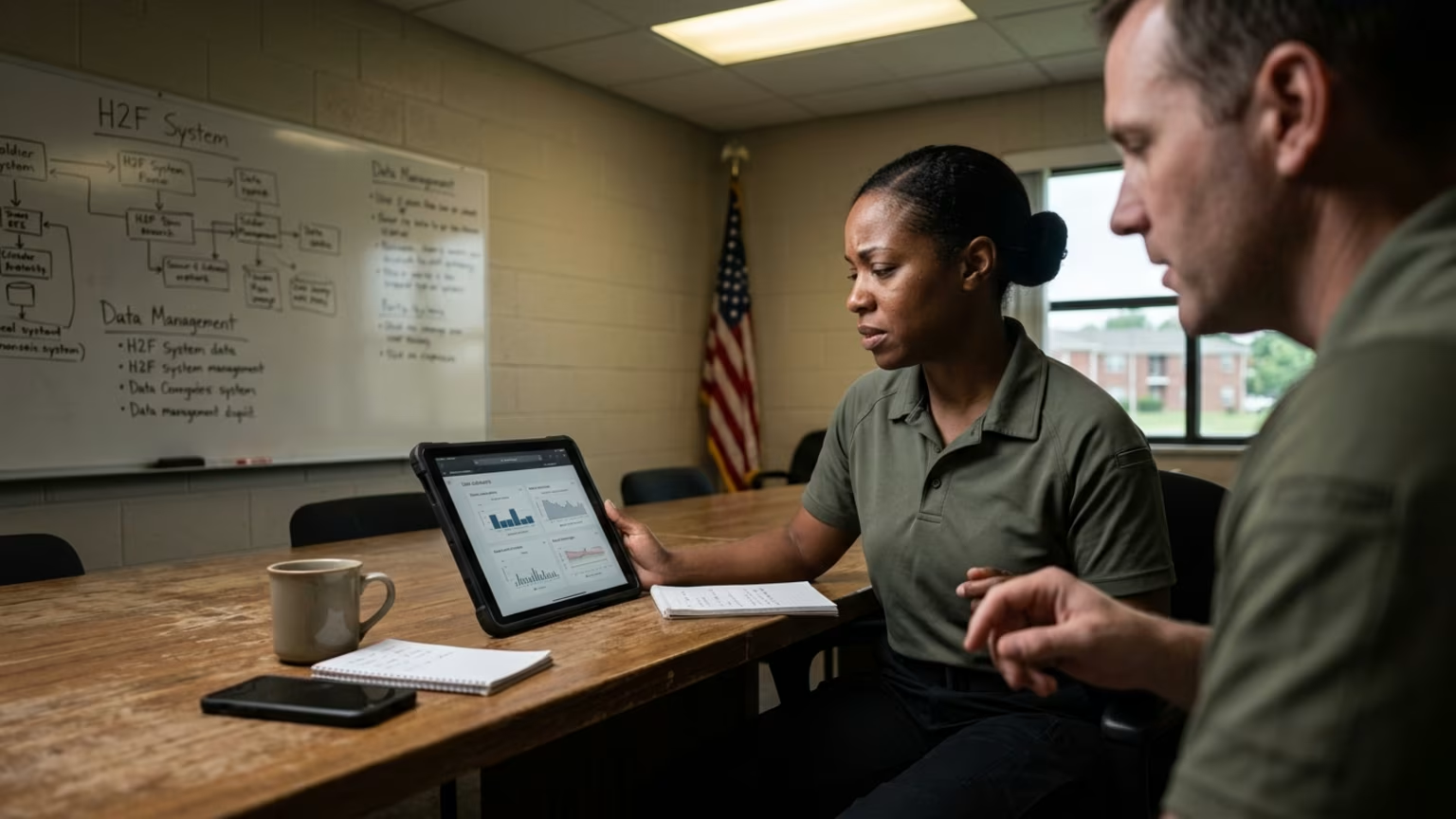

Army leaders are evaluating the new H2F Management System while raising concerns over data fatigue. Learn how this software aims to track military readiness.





The Army is currently pre-piloting apps and dashboards for the Holistic Health and Fitness Management System. This software effort provides soldiers, leaders, and human-performance staff with data-driven insights. However, top military officials are raising concerns about how much information is too much for daily use. Command Sgt. Maj. Alex Kupratty spoke at a recent Military Officers Association of America event about this issue.
The senior enlisted leader of Army Transformation and Training Command stated that he was concerned about "data fatigue." He argued that raw data alone may not be the most useful way to present information. The final configuration and fielding date for the new management system have not yet been announced.
We know from our own work at BattleVet that tracking physical metrics can quickly become overwhelming. I remember waking up after a poor night of sleep and realizing that my training recovery was taking much longer than it used to. I realized that readiness is more than just pushing through the fatigue. It requires a dedicated approach to sleep and hormonal health, which completely shifted how I view long-term capability.
Having health data is vastly different from having a clear, actionable plan. When personnel are bombarded with numbers, the information can easily become noise rather than a helpful tool. The Holistic Health and Fitness program, known as H2F, originally began as a pilot in 2018. The program relies on specialized staff and equipment intended to improve fitness, prevent injuries, and support overall warfighter health.
In 2024, the Army announced that it planned eventually to extend H2F to all soldiers. The original program description includes specialized staff such as dietitians, occupational therapists, and athletic trainers. The immediate challenge for Army leaders is deciding what performance information to display on the new software. They must find a way to share vital health metrics without overwhelming the users.
Kupratty used his own experience with wearable fitness devices to illustrate this exact risk. He noted that he looked at only about half the data provided by his Whoop and Oura Ring. He added that looking at half the data is being very generous. This highlights a common issue in military health and fitness tracking.
More information does not automatically lead to better health decisions if the user cannot process the metrics. A system designed to improve warfighter health will fail if it demands too much daily attention. Veterans and active military personnel frequently use wearables to monitor their physical habits. These devices can offer valuable insights into sleep, stress and resilience.
However, the sheer volume of physiological data can easily obscure the most critical information. When leaders discuss data fatigue, they are pointing to a real operational barrier. Health tracking must prioritize clarity over complexity to be truly effective. The Army recognizes that software alone cannot solve human performance issues.
The H2F system is framed strongly around specialized human-performance support rather than just digital tools. The inclusion of medical and fitness professionals grounds the program in credible expertise. Dietitians and athletic trainers can help soldiers interpret raw data correctly. This human element is essential for preventing injuries and supporting long-term health outcomes.
The new technology is meant to support these physical training professionals, not replace them. It is very easy to get caught up in tracking every single health metric available on the market today. Many civilian fitness applications market themselves by offering an overwhelming number of complex data points. BattleVet takes an evidence-led approach that focuses strictly on the fundamental pillars of human performance.
Clear, capable explanations of physical restoration are far more useful than a mobile screen full of raw numbers. The Army's current evaluation phase reflects this exact same priority. Health information must be practical, clear, and immediately actionable for the individual.
The development of the H2F Management System signals a practical shift in how the military approaches readiness. Kupratty described physical readiness as the leading priority for this massive data effort. This primary focus specifically includes physical resilience and the readiness to fight. Data supporting injury prevention and recovery follows closely as the second priority.
This hierarchy helps clarify what commanders and human-performance staff should focus on daily. By prioritizing physical readiness, the system aims to support the fundamental requirements of military service. General Dynamics Information Technology senior operations manager Tyler Christiansen offered a look at what this might involve. He identified heart-rate variability, sleep, workout tonnage, and diet plans as examples of lower-level data.
These metrics might be relevant for the new digital dashboards. Christiansen noted that commanders' priorities should help determine how this data is presented to units. Lower-level measures could potentially be rolled up into broader health information. This approach can communicate the return on investment to senior leaders without overwhelming them.
Tracking workout tonnage and diet plans can help service members build an effective physical foundation. By monitoring these variables, soldiers can avoid overtraining and optimize their nutritional intake. Heart-rate variability and sleep metrics provide a direct window into the nervous system. These specific data points can reveal how well a body is recovering from heavy physical stress.
Incorporating these metrics into a central system could standardize how the military manages physical fatigue. However, leaders must ensure that any new digital tools do not create unnecessary administrative burdens. If a fitness application requires a medical specialist just to read the daily summary, it may fail. The planned pilot in fiscal year 2027 will test exactly this delicate balance in a real-world environment.
It is important to remember that these specific measures are only examples at this stage. They are not confirmed features of the final H2F digital system. Soldiers should treat these specific device and metric examples as provisional for now. The Army has not yet identified exactly what the system will collect or how the information will be used.
H2F program director Jonathan Flynn recently spent two days evaluating three app styles at Fort Benning, Georgia. He noted that a pilot focused on the app and end-user experience is planned for the second quarter of fiscal year 2027. Evaluating application styles at Fort Benning gives the development team direct, unfiltered feedback from actual users. This focus on the practical user experience is a necessary step to avoid repeating past technological failures.
Flynn emphasized that soldiers must actually want to use the system on a regular basis. Without strong end-user buy-in, the Army simply cannot collect the vital data it seeks. He stated that earlier efforts at the 75th Ranger Regiment and other organizations failed because of inadequate end-user buy-in. This historical context explains why the current pre-piloting phase is proceeding so carefully.
The system must prove its daily value to the individual soldier on the ground. The projected expansion of the human-performance teams is another key element of this operational shift. Officials expected H2F performance teams to reach 129 active-duty brigades by fiscal year 2029. This projection also includes four states within the Army National Guard and two Army Reserve commands.
This timeline is purely a team-coverage projection, not a confirmed system-fielding date for the software. Reaching these numbers requires a massive financial and logistical commitment to physical readiness. Providing reserve components with dedicated performance teams could fundamentally change their long-term health outcomes. These units face unique challenges in maintaining physical fitness outside of regular active duty schedules.
The integration of modern technology with human fitness experts remains central to maintaining physical performance across the entire force. If the system is built correctly, it could set a new standard for military healthcare tracking. As service members eventually transition to civilian life, the habits formed during active duty remain vital. Understanding how to manage basic physical metrics can support healthy aging and long-term capability.
Proper data tracking helps veterans monitor changes in their body composition and daily mobility. By learning to focus on key indicators like sleep and recovery, veterans can maintain their physical strength for decades. The Army's careful, measured approach to the H2F system provides a solid lesson for personal health management.
The balance between detailed data collection and a streamlined user experience remains a difficult challenge. The upcoming digital pilot programs will test whether complex physiological metrics can be effectively simplified for daily use. Will future military tracking systems successfully integrate raw performance data with expert guidance to improve long-term veteran health?
Follow BattleVet for practical guidance on military and veteran health, strength, recovery, testosterone, sleep and healthy aging. Stay connected for new articles, research backed insights and clear information to help you stay capable for the years ahead.


A federal jury convicted a Texas clinic owner in a $26 million TRICARE fraud scheme. Learn how to verify medical providers and protect your veteran benefits.


A September 2026 update from the journal Sleep examines the effectiveness of standalone audio apps and the physiological link between sleep spindles and pain.
Updated 2026 ACSM guidance emphasizes power training for older adults. Read why adding intentional speed to workouts helps veterans maintain physical capability.
Build better habits around strength, recovery, sleep, hormones and healthy aging with practical guidance for active military personnel and veterans.
Explore BattleVet