

Fort Leonard Wood Soldiers completed the Norwegian Swim Badge assessment. Read what this event reveals about aquatic endurance and military fitness standards.





On Sept. 25, 2026, Soldiers at Fort Leonard Wood completed a specialized water-survival fitness assessment. The U.S. Army published a detailed account of the event on Oct. 6, 2026. The assessment took place at the Davidson Fitness Center pool in Missouri. The military participants tested their physical capabilities to earn the Norwegian Swimming Federation Swimmer Badge. The Army reported that all Soldiers who took the assessment successfully passed for the bronze grade.
This assessment highlights the critical intersection of aquatic endurance and water confidence. The award is formally known as the Store Havhesten. This title translates to "The Great Sea Horse" in English. The Army article says the badge recognizes established competence in swimming, physical endurance, and applied lifesaving tasks.
For active personnel and veterans, this event demonstrates the practical value of comprehensive aquatic conditioning. Maintaining capability across multiple domains remains a core focus when evaluating military health standards. Earning this badge requires demonstrating survival skills under fatiguing conditions. The event provides a clear example of combining physical endurance with critical water survival skills.
Capt. Nicolas Tures connected this type of fitness directly with operational readiness. Tures noted that fitness ensures service members are ready to perform with little or no warning. True capability requires preparation for unpredictable physical demands across varied environments. A strong foundation allows personnel to adapt quickly to new challenges.
Maj. Jonathan Chang also described fitness as a critical component of personal readiness. Chang highlighted that maintaining physical capability is essential for effective leadership. Aquatic survival events force participants to manage fatigue while executing precise movements. These demanding requirements test both mental resilience and physical preparation.
Sgt. 1st Class Jeremy Calvin framed the swimming assessment as a highly controlled opportunity. Calvin stated that the event tested both mental and physical capabilities. He noted that such testing builds valuable confidence when new challenges arise in the future. Facing difficult tasks in a structured environment prepares service members for unexpected operational hurdles. Incorporating these varied physical demands supports long-term strength and physical capacity planning.
The Army account describes an assessment spanning multiple aquatic disciplines. The evaluation covered distance swimming, backstroke, underwater swimming, and diving. It also required a timed freestyle event and a structured lifesaving assessment. The badge program utilizes bronze, silver, and gold grades to measure success. These grades feature progressively higher performance requirements, according to the Army report.
The published event parameters identify two specific distance requirements. Participants completed a 1,000-meter freestyle swim to test baseline aquatic endurance. Swimming this distance requires significant cardiovascular capacity and technical efficiency.
The assessment also featured a grueling 500-meter clothed swim. This event introduces severe mechanical resistance into the endurance test. Calvin stated that the clothed swim was the most challenging event of the assessment. He explained that the clothing created significant extra drag in the water. This added drag forces a swimmer to exert considerably more energy to maintain forward momentum.
All Soldiers at the Fort Leonard Wood event passed for the bronze grade. Calvin explained that bronze was the highest grade available to a Soldier in their first year. The Army report does not publish the exact time limits or specific bronze cut scores. It also omits the full task-by-task distance requirements for the more advanced silver and gold tiers. The missing standards mean readers cannot fully replicate the grading system.
The lifesaving portion of the assessment tested several practical rescue capabilities. The event included sculling and a comprehensive lifesaving assessment. The report describes precision rescue techniques and CPR as part of that evaluation. Tures mentioned that the backward-sculling technique was difficult because it was new to him. Mastering new physical movements under fatigue adds significant difficulty to any fitness test.
Chang described lifesaving as a fundamental skill for swimmers of differing experience levels. He noted that the CPR portion was easiest for him because he already held a basic life support qualification. Readers should recognize this as an individual account. It is not evidence that the CPR assessment is easy for all participants.
This information reinforces current approaches to tactical athletic programming for service members. The Norwegian badge assessment clearly separates raw swimming capacity from applied rescue skills. This functional distinction is highly useful for individuals evaluating their own conditioning routines. Building endurance in a pool does not automatically translate to effective rescue capabilities. A complete physical readiness plan must address both raw stamina and technical survival skills.
Service members and veterans considering aquatic conditioning must prioritize safety above all else. The Army article does not state the medical screening requirements used for the assessment. It also omits the specific safety protocols and supervision standards maintained at the facility. Readers should never use this report as a stand-alone template for unsupervised water training. Earning the badge demonstrates practical capabilities, but the report does not establish that it predicts combat survival outcomes.
The clothing configuration for the 500-meter swim was also unspecified. Readers should not assume that the test replicates a particular operational uniform. It does not perfectly simulate a specific field condition. Practical water training requires careful progression and professional supervision to mitigate inherent risks.
The Army report also clarifies important regulations regarding the wear of foreign awards. Calvin confirmed that the swim badge itself is not authorized for Soldiers to wear. This distinction matters for service members managing their uniform records and planning their civilian transition. Personnel must not treat the swim badge as an authorized U.S. Army uniform decoration.
However, the Norwegian Armed Forces Medal for Field Sports is authorized for wear. Earning this medal requires completing three field-sport skill badge assessments. At least one of those three assessments must be a military-skill event. The Army report lists several qualifying events for this medal requirement.
The qualifying badges include the Norwegian Foot March, Norwegian Ski, and Norwegian Infantry badges. The Norwegian Military Field Sports and Norwegian Pentathlon badges also count as qualifying events. The report does not state that the swim badge counts toward the three required assessments. Service members should verify their specific award eligibility through official channels.
The Army report announces another physically demanding Norwegian badge event. A separate Norwegian Foot March is scheduled at Fort Leonard Wood for Nov. 10, 2026. The Army describes this march as an 18.6-mile event. It includes a 24.25-pound rucksack requirement for military participants. This march offers a second example of a demanding physical assessment. It is a completely different event and should not be presented as part of the swim assessment requirements.
As physical conditioning programs continue to adapt to new operational demands, how will future military training standards integrate specialized aquatic survival skills with traditional combat readiness metrics?
Follow BattleVet for practical guidance on military and veteran health, strength, recovery, testosterone, sleep and healthy aging. Stay connected for new articles, research backed insights and clear information to help you stay capable for the years ahead.



The VA reports veteran trust remained above 80 percent for a fourth consecutive quarter. Learn how this data impacts health planning and community care.


Recent 2026 data from the Royal British Legion and the UK Ministry of Defence highlights the co-occurrence of fatigue and musculoskeletal symptoms in veterans.
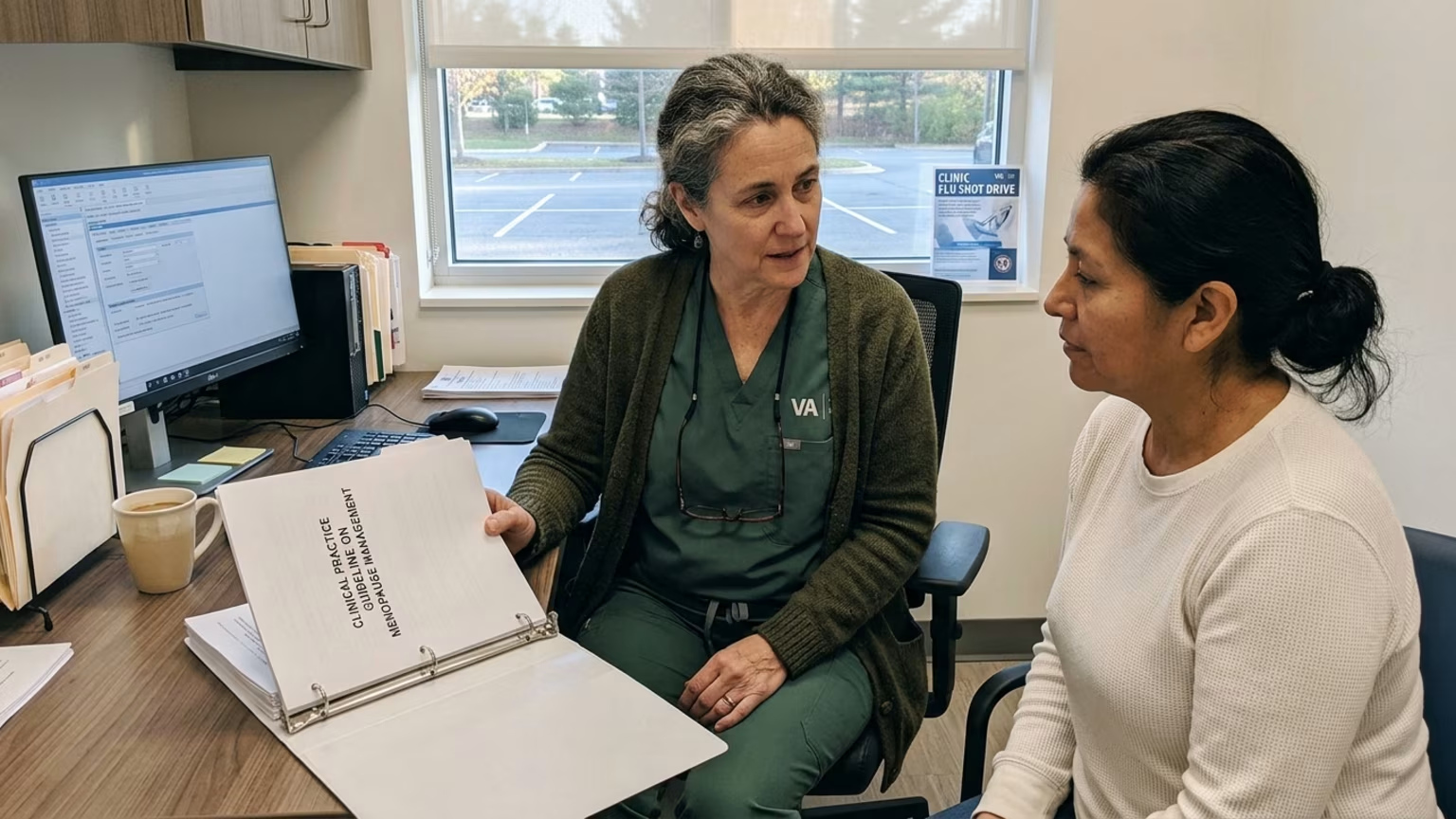
The VA and DoD released the 2026 Clinical Practice Guideline on Menopause. Learn how the 43 evidence-based recommendations impact military and veteran care.
Build better habits around strength, recovery, sleep, hormones and healthy aging with practical guidance for active military personnel and veterans.
Explore BattleVet