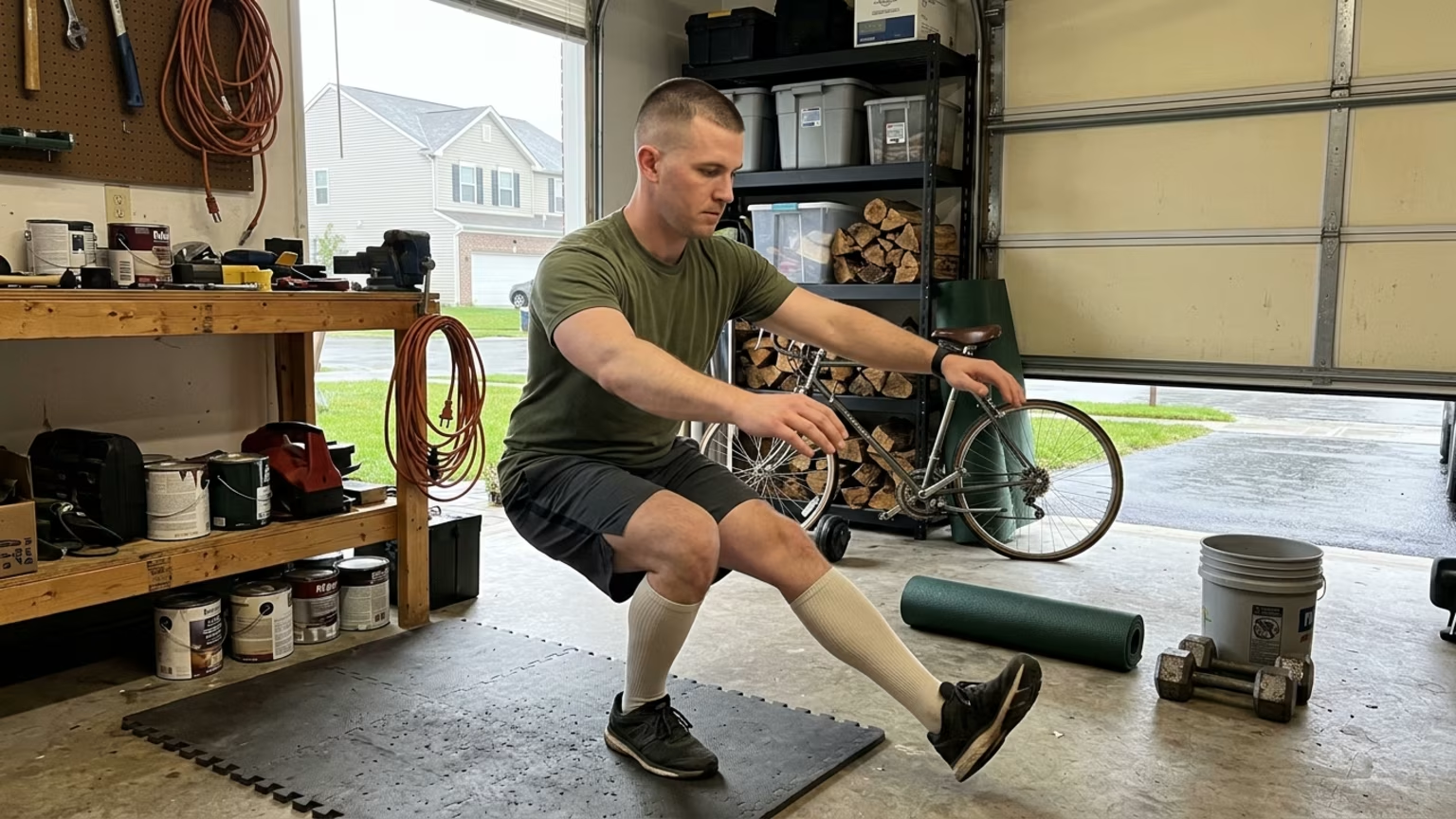

Improve military readiness by prioritizing active mobility over passive flexibility. Learn to build usable range of motion and control for field tasks.





A 2026 meta-analysis of 23 studies reported significant reductions in trunk strength, lower-body power, and postural stability following military foot marches. This data highlights a fundamental truth about military health and physical preparation. Mobility is not just about reaching a position, but having the capacity to maintain force and control when fatigued. A service member drops a heavily loaded rucksack after a long movement, only to find their hips and ankles stiffen completely as they kneel to inspect their gear.
Historically, physical readiness relied heavily on passive stretching to improve flexibility. The goal was simply to lengthen tissues and increase the maximum angle a joint could reach. A person might sit on the floor and hold a hamstring stretch or pull an arm across their chest. This method succeeds at increasing passive range of motion when performed consistently over time.
However, military performance requires more than just reaching an isolated angle. Running, heavy load carriage, lifting, and working in asymmetric positions place complex demands on the body. A person might possess excellent passive range of motion in their ankles or hips. That same person may still lack the active control needed to use that range during a sprint start or a casualty lift.
Passive stretching may still have a place when a specific mobility limitation is identified. It can be useful for separate recovery sessions or when an individual simply responds well to it. Yet, the available evidence suggests it is not a complete solution for occupational readiness. Passive range gained on a clinic table does not automatically transfer to a loaded squat or a ruck march.
While stretching might temporarily relieve a feeling of tightness, it does not prepare the nervous system to handle weight in that new range. Joint stability requires muscular engagement to protect ligaments and tendons during dynamic movement. A muscle that has been passively stretched for an hour is not necessarily prepared to rapidly absorb the shock of a sprint. The available military sources support a broader human-performance approach that goes beyond basic stretching.
Furthermore, excessive range without stability or strength may actually be unhelpful. Tasks that require bracing, rapid force production, or joint control depend on tension as much as flexibility. For many service members and veterans, simply stretching a sore muscle rarely resolves the underlying performance limitation. The focus must eventually shift from passive flexibility to active, usable motion.
The alternative approach treats mobility as a task-specific capacity built through controlled movement. Active mobility requires the person to control and produce force in a required position under load and fatigue. The U.S. Army describes its Holistic Health and Fitness system as a way to optimize Soldier health, readiness, and performance. This modern doctrine establishes unified training standards across the force to improve combat effectiveness.
Recent evidence supports the idea that strength training and mobility are closely connected. A 2026 systematic review of 11 randomized studies involving 452 participants analyzed strength training versus stretching. It reported no significant difference between strength training and stretching for improving range of motion. The authors did note substantial heterogeneity between the studies and called for higher-quality research.
Performance in demanding tasks requires strength through the entire range of motion. A 2024 study examined 65 ROTC cadets completing a 12-mile foot march with a 35-pound rucksack. The researchers measured performance against a strict three-hour completion standard. This required participants to sustain force, balance, and posture under a continuous external load.
The same study provided further insights into body composition and physical capacity. Each additional kilogram of fat-free mass was associated with a 24% increase in the odds of meeting the ruck standard. Furthermore, a one-point increase on the two-mile run was associated with a 9% increase in those odds. Additionally, each one-point increase in a cadet's Army Combat Fitness Test score was associated with a 6.1% increase in the odds of finishing on time.
These statistics highlight that pure flexibility alone is not enough to guarantee task completion. The body requires adequate muscle mass to generate force and aerobic capacity to clear fatigue byproducts. When a person focuses only on stretching, they miss the opportunity to build the resilient muscle tissue needed for real world performance. A balanced program integrating both mobility and resistance training offers a much higher likelihood of success.
The demands placed on the body during occupational tasks eventually degrade movement quality. As the 2026 meta-analysis of 23 studies demonstrated, military-style foot marches significantly impair postural stability and lower-body strength. When fatigue sets in, the body struggles to access the same ranges of motion it had when rested. This is why strength, fitness, and body composition are foundational to maintaining mobility in the field.
A separate systematic review of military occupational training included 14 studies from an initial 7,220 records. It found significant muscle damage and temporary reductions in strength and power lasting as long as 96 hours after some military-specific activities. If a service member is dealing with this level of tissue damage, their mobility will naturally be restricted. Adding more intense stretching to damaged muscle is rarely the appropriate intervention.
Mobility routines cannot cancel out excessive workloads or poor recovery practices. Programming must account for cumulative load, sleep quality, heat, and footwear before attempting to force more flexibility. Active personnel must balance their conditioning so that mobility supports their primary tasks rather than competing for recovery resources. This requires a systematic approach rather than a random collection of stretches.
Choosing between passive flexibility and active mobility depends entirely on the physical task at hand. The most defensible framework begins by identifying the exact positions required by your daily occupational demands. Ask whether a physical restriction affects your running stride, overhead lifting, front-loaded carries, or kneeling while wearing equipment. Once the specific task is identified, test your usable range rather than just your passive flexibility.
Observe the required position under light load to see if range disappears when balance or breathing changes. Compare your left and right sides to identify asymmetries that might alter your mechanics under fatigue. Next, pair mobility drills with immediate movement control by using a brief range-of-motion drill. Follow that drill immediately with an isometric hold or slow-strength exercise in the newly available position.
Timing also dictates how these methods are applied around other physical work. Dynamic drills and controlled resistance are best used before lifting, running, or field training. This prepares the tissues to absorb and produce force safely. Longer relaxed stretching can be reserved for the end of the day or separate recovery and physical restoration sessions if it helps manage stress.
Furthermore, recognize that mobility is not a form of medical care. Persistent pain, joint instability, numbness, or recurrent sprains warrant assessment by a qualified healthcare professional. This is especially true for active-duty personnel or veterans dealing with prior injuries. Pushing through neurological symptoms in an attempt to improve mobility will only cause further damage.
Rather than assuming everyone needs the same program, select drills that address genuine restrictions. Start with the ankles by performing knee-to-wall ankle rocks for eight to ten controlled repetitions per side. Follow this with a split-stance calf raise, keeping the front knee slightly bent for eight to twelve repetitions. Progress this by holding a light load or pausing at the top and bottom while maintaining foot control.
For the hips, utilize a half-kneeling hip-shift drill for five to eight slow repetitions per side. You can then transition into a supported deep squat hold for twenty to thirty seconds. Make sure to sink only as deep as your control safely allows. Progress this into a goblet squat to a box, emphasizing trunk control and even foot pressure.
Thoracic spine and shoulder restrictions frequently impact lifting and carrying heavy loads. Address the upper back with quadruped reach-throughs for six to eight repetitions per side. Follow up with wall slides or controlled overhead reaches for six to ten repetitions. Finally, a band external-rotation isometric can be held for fifteen to twenty seconds per side to secure the shoulders.
Always finish a mobility routine by practicing the specific task you are preparing to execute. For rucking, perform short and easy loaded-walking intervals before increasing your distance or pace. If preparing for field tasks, practice kneeling, crawling, and rising with a light load. This progression ensures the nervous system knows how to use the ranges you just established before performing them under fatigue.
The bottom line is that usable mobility changes based on your career phase and physical demands. Active-duty personnel need the active control to carry heavy loads, sprint, and change levels over unpredictable terrain. Their mobility work should prioritize strength through specific occupational ranges rather than isolated flexibility. A soldier who cannot access a stable kneeling position cannot effectively operate in the field, no matter how far they can stretch on a mat.
For veterans navigating post-service healthy aging and longevity, the priorities shift slightly but the principles remain identical. Maintaining the capacity to get off the ground, reach overhead, and carry daily loads dictates long-term independence. Whether managing the physical toll of past deployments or building resilience for the future, the goal is usable control. Flexibility is just an angle, but mobility is the freedom to move without hesitation.
This returns us to the physical reality of the field. The service member kneeling by their rucksack does not need the flexibility of a gymnast to do their job. They need the strength, stability, and control to access a basic human position despite carrying a heavy load for miles. By training the ranges you actually use, you ensure your body remains capable, resilient, and ready for whatever the task requires.
Follow BattleVet for practical guidance on military and veteran health, strength, recovery, testosterone, sleep and healthy aging. Stay connected for new articles, research backed insights and clear information to help you stay capable for the years ahead.


Combat Stress’s workplace guidance emphasizes listening over diagnosis. Recent U.S. veteran insomnia research adds context for sleep and recovery concerns.


ErythroMer's reported storage design could matter for military care. An academic review still lists it as preclinical, with human evidence ahead.
A large veteran study links PTSD and documented social needs to later cognitive impairment, reinforcing the value of connected care planning.
Build better habits around strength, recovery, sleep, hormones and healthy aging with practical guidance for active military personnel and veterans.
Explore BattleVet