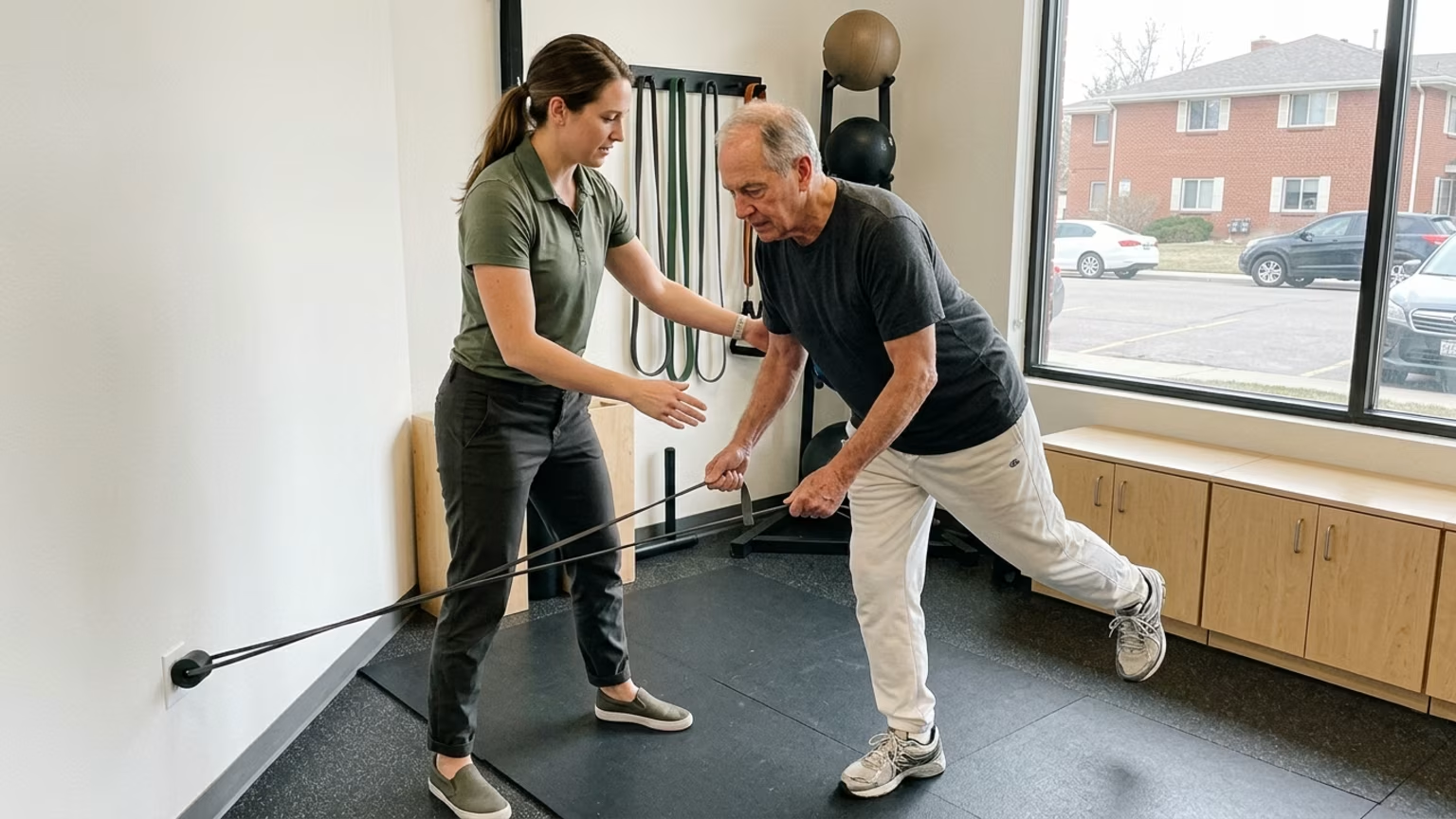

How older veterans can preserve strength, power, and mobility without causing injury. Learn evidence-based training adjustments for lifelong physical health.





You wake up, swing your legs over the edge of the bed, and feel a familiar stiffness in your knees before standing up. Years of heavy packs and repetitive physical stress often change how your joints handle daily movement. This physical reality leads to a very specific question for many former service members. How can I actually maintain my strength, power, and mobility as I get older without causing further injury?
Aging changes your physical demands, but it does not mean you stop preparing entirely. Trying to maintain fitness years after leaving service required a completely new mindset. The goal changed from immediate tactical readiness to healthy aging and longevity. I learned that connecting short term performance with long term health, focusing on mobility and cardiovascular function, was the real key to staying capable. Training must shift toward individualized and multicomponent exercise.
Many veterans measure fitness success strictly by how their bodies look or the number on the scale. The evidence shows that physical size and physical capability do not always change at the same rate. A systematic review of 16 studies involving 801 adults aged 60 and older found that resistance training improved muscle mass, muscle strength, and functional performance. The reported standardized effects were g = 0.16 for muscle mass, g = 0.55 for strength, and g = 0.76 for functional performance.
This data indicates that older adults often gain functional ability and strength faster than they add visible muscle tissue. The type of resistance training you choose directly influences these specific results. The review noted that lower-intensity and higher-frequency training was more favorable for muscle-mass gains. Moderate-intensity and moderate-frequency training was more favorable for strength. Meanwhile, faster movement execution was more favorable for functional performance.
Focusing solely on muscle size can lead to frustration when physical changes slow down with age. Functional adaptations often occur even when the mirror shows minimal physical change. A review of 25 randomized trials involving 2,267 frail or sarcopenic older adults highlighted this reality perfectly. The review found improvements in grip strength, lower-limb strength, and agility.
It also noted positive changes in walking speed, postural stability, and overall functional performance. Importantly, the changes in muscle mass were smaller than the improvements in several strength and performance measures. For older service members, this means progress should not be judged only by body weight or circumference measurements. Your ability to perform daily tasks is a far more accurate metric of health and independence.
Power is the ability to produce force quickly, and it matters immensely outside the gym environment. It becomes critical during a stumble recovery, a rapid step, a hill ascent, or an obstacle negotiation. The resistance-training review found that faster movement execution was especially useful for functional performance. This supports incorporating carefully dosed power work into your routine after a proper warm-up.
Examples of safe power work include fast chair rises, controlled step-ups performed with intent, or light kettlebell deadlifts lifted briskly. The primary goal is movement speed with strict control, not reckless heavy loading. Veterans with joint replacements, significant neuropathy, or osteoporosis must exercise caution. Those experiencing dizziness or a history of falls should also be careful before attempting impact work. You should always obtain individualized clinical guidance before attempting ballistic movements.
Balance and mobility are highly trainable targets, not merely passive consequences of aging. Balance depends on strength, sensory input, coordination, and the ability to generate corrective force quickly. The VA Gerofit model explicitly includes balance exercises and individualized modification for functional limitations. You can practice balance progressively through supported single-leg stances, multidirectional stepping, and controlled turns.
Mobility involves usable range of motion, steady gait, smooth transitions, and the ability to move under load. The VA age-friendly care materials emphasize daily safe movement as a way to maintain function and continue doing meaningful activities. You can include regular joint-range work, loaded carries, step-downs, and task-specific movement in your weekly plan. A veteran with pain or neurological limitations might simply need shorter sessions or more stable surfaces rather than complete inactivity.
Cardiovascular health is critical for recovering between physical efforts and sustaining daily energy levels. The VA Gerofit model combines aerobic training with whole-body strength and balance exercises. It also includes flexibility work, dedicated warm-ups, and cool-down routines. These group-based exercise sessions were originally conducted three times per week.
The program structure proves that cardiovascular fitness should never be treated as a substitute for resistance training. Instead, aerobic conditioning works alongside strength training to support sustained movement and better training and performance outcomes. You can maintain a sustainable aerobic base through walking, cycling, or swimming. Rowing and seated exercise modalities are also excellent low-impact options.
Testing a one-repetition maximum on the squat or bench press is often unnecessary and risky for an aging body. Progress should be measured through practical tasks that reflect daily living requirements and physical independence. In 2025, a VA report on the Gerofit to Home program demonstrated this concept using targeted functional testing. VA researchers analyzed results from 600 Veteran participants whose average age was 75.
These older Veterans improved on the two-minute step test, 30-second chair-to-stand test, five-times sit-to-stand test, and 30-second arm-curl test. The improvements continued at three, six, and 12 months in the VA report. These tests are incredibly relevant because they measure usable capacity like stepping, standing, and upper-body endurance. Tracking these specific functional tasks creates a more complete picture of your health than a single heavy lift.
Standard fitness advice often assumes a completely healthy body with no history of serious physical trauma. Former service members frequently carry chronic pain, joint replacements, traumatic brain injuries, or cardiopulmonary conditions. In these situations, progress requires a highly individualized approach that respects your unique medical history. The Department of Defense Warfighter Performance Optimization resources include guidance for recovering from bone, joint, and muscle injuries.
This institutional focus supports a continuum between rehabilitation, health maintenance, and performance training. Additionally, physical readiness is deeply connected to body composition and overall metabolic health. A recent review in Military Medicine reported that lower total and visceral adiposity, together with greater total and segmental lean mass, were generally associated with better strength. They were also associated with better cardiorespiratory endurance, power, and task-specific operational outcomes in military populations.
However, changing body composition is only one piece of the performance puzzle. At a 2026 military health symposium, a senior military health official discussed physical fitness. They stated that fitness cannot be separated from nutrition, sleep, medical readiness, or psychological well-being. A poor training week might actually stem from disrupted sleep, pain flare-ups, or medication effects rather than a lack of motivation. Recovery capacity must be treated as a crucial training variable for aging adults.
Navigating physical limitations requires clear communication with your healthcare team before starting any new fitness routine. When you meet with a VA clinician or physical therapist, describe your specific functional struggles clearly. Tell them if you have trouble getting out of a low chair, carrying groceries, or walking up a steep driveway. The VA describes Gerofit as a program intended to improve strength, balance, and flexibility. It is also designed to support cardiovascular fitness and reduce overall fall risk.
Ask your clinical team for a customized plan that accounts for your specific service-connected injuries and overall healthy aging goals. A qualified exercise professional can help you find safe alternatives to painful movements and establish a baseline. If a specific joint cannot handle heavy loads, ask about low-impact variations or remote exercise delivery options. The 2025 VA report showed that remote delivery can produce sustained improvements in multiple physical tests without requiring daily travel.
Your body adapts to the specific demands you place on it every single week. If your current routine avoids balance work and ignores functional movement, your capability in those areas will naturally decline. Look at your weekly schedule and ask yourself if your exercises support the life you want to live ten years from now. Prioritizing smart veteran lifestyle and healthcare decisions today will directly determine your physical independence tomorrow. Train for the specific functions that matter most, and adjust your intensity to match your current reality.
Follow BattleVet for practical guidance on military and veteran health, strength, recovery, testosterone, sleep and healthy aging. Stay connected for new articles, research backed insights and clear information to help you stay capable for the years ahead.


Combat Stress’s workplace guidance emphasizes listening over diagnosis. Recent U.S. veteran insomnia research adds context for sleep and recovery concerns.


ErythroMer's reported storage design could matter for military care. An academic review still lists it as preclinical, with human evidence ahead.
A large veteran study links PTSD and documented social needs to later cognitive impairment, reinforcing the value of connected care planning.
Build better habits around strength, recovery, sleep, hormones and healthy aging with practical guidance for active military personnel and veterans.
Explore BattleVet