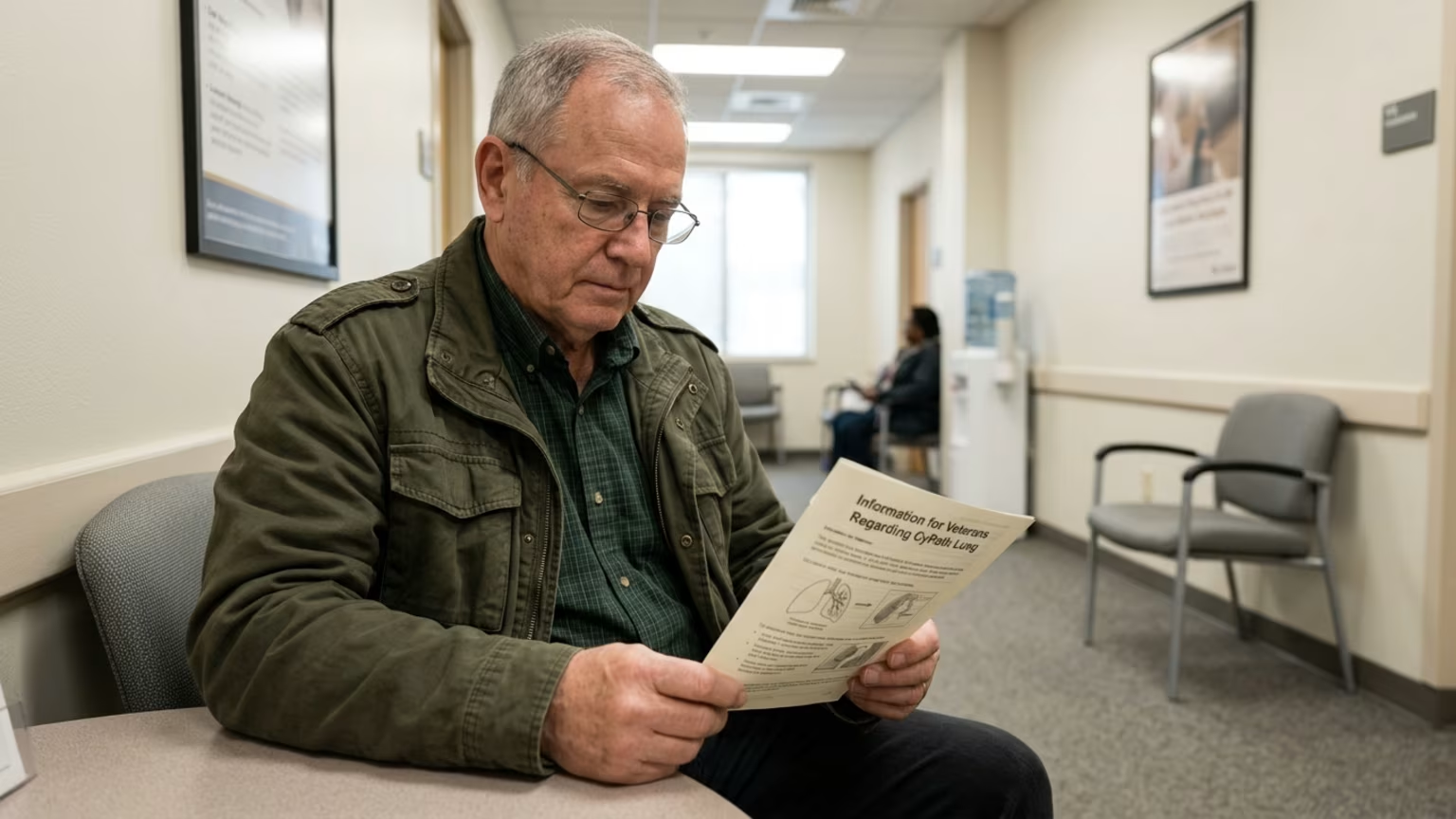

Understand what the new federal distribution agreement for CyPath Lung means for veterans, how the test works, and why standard CT screening remains vital.





Sitting in a sterile clinic room after a routine chest scan reveals an unknown shadow. A physician explains that a small nodule requires more testing to determine if it is dangerous. The waiting period brings stress and an immediate search for the best available screening tools.
On August 18, 2026, bioAffinity Technologies announced a nationwide federal healthcare distribution agreement with AvMEDICAL for CyPath Lung. Headlines about new cancer tests can create immediate hope for patients navigating uncertain diagnoses. However, understanding exactly what these announcements mean is critical for making informed medical decisions.
It is a common misconception that a new distribution agreement means a medical test is instantly available at every clinic to replace traditional scans. The factual correction is that a federal distribution deal creates a commercial pathway for clinics to order a tool. It does not replace standard diagnostic imaging or mandate nationwide clinical adoption. CyPath Lung is designed to work alongside existing clinical information rather than acting as a standalone cure.
"Reviewing my blood work for the first time felt overwhelming. There was so much confusing information out there about testosterone and hormones. I wanted clear facts and evidence based guidance, not a sales pitch. That experience showed me how critical it is to separate established science from marketing hype."
This same critical thinking applies when we read headlines about new diagnostic tests. We must separate commercial announcements from actual clinical guidance. Patients need to know what tools are actually available in their local treatment facilities today.
This misunderstanding usually comes from corporate press releases and simplified health news. When companies announce major agreements, they highlight market reach and sales potential. For example, the companies describe AvMEDICAL as a Service-Disabled Veteran-Owned Small Business. They highly value its government contracting and procurement experience.
The company notes that its federal contracting capabilities include access to indefinite-delivery, indefinite-quantity contracts. According to the announcement, bioAffinity Technologies says this could simplify procurement for government healthcare systems. People read these announcements and assume the technology is already standard protocol for military health.
A distribution deal is a commercial arrangement for laboratory equipment. The companies plan to develop co-branded marketing materials. AvMEDICAL will use its national sales force to market CyPath Lung through its existing federal procurement channels and customer relationships. The public announcement contains company level statements about the commercial rationale for this agreement.
The announcement highlights bioAffinity's expectation that AvMEDICAL's procurement expertise will expand the product reach in the federal healthcare market. These are management claims about potential sales, not independent clinical mandates. The agreement provides a route into federal procurement. However, it does not disclose which facilities have ordered the test or how many patients will receive it.
Furthermore, bioAffinity reported that CyPath Lung test volume increased 216% in the second quarter of 2026 compared with the second quarter of 2025. That figure is a company reported commercial metric. It does not establish the clinical impact or the rate of adoption across federal healthcare facilities. Test volume increases do not automatically equal widespread clinical integration.
CyPath Lung is a noninvasive sputum test. It uses a fluorescent porphyrin that the company says is preferentially taken up by cancer cells. The process then uses flow cytometry and automated analysis to evaluate cell populations associated with malignancy.
In a published clinical trial, bioAffinity Technologies tested high-risk patients. These patients had small, indeterminate pulmonary nodules measuring less than 20 millimeters. In this specific trial population, the test demonstrated 92% sensitivity and 87% specificity. The results also showed 88% accuracy and a 99% negative predictive value.
A high negative predictive value is clinically attractive. A negative result might help inform decisions about further evaluation and reduce unnecessary invasive procedures. However, the manufacturer explicitly states that the test is a Laboratory Developed Test. It should not be used as a stand-alone diagnostic tool.
These performance figures come from a specific study population. They do not represent guaranteed performance for every veteran, active duty member, or clinical setting. The test performance could differ in patients with larger nodules or different disease prevalence. It could also vary in patients with non-smoking related risk factors.
Additionally, bioAffinity Chief Medical Officer Gordon H. Downie authored a clinical review and white paper. This document describes a framework for incorporating CyPath Lung into pulmonary nodule evaluation and cancer surveillance. The publication supports the existence of a proposed clinical framework. It should not be treated as independent consensus guidance or as proof that the framework has been adopted across VA medicine.
Shedding the myth of an instant diagnostic cure changes how veterans must approach their respiratory health. Patients should not wait for this specific test before seeking a lung evaluation. Current screening guidance continues to center on annual low-dose CT scans. This applies to adults aged 50 to 80 who have at least a 20 pack-year smoking history.
A pack-year is calculated from the average number of cigarette packs smoked per day multiplied by the number of years smoked. This guidance also applies to those who currently smoke or who quit within the previous 15 years. Veterans who meet these criteria should discuss standard screening protocols with their providers. Access to a new sputum test does not eliminate the need for routine imaging to support healthy aging.
If a physician finds an indeterminate pulmonary nodule, veterans can ask targeted questions. You should ask if a sputum based adjunct test is available at your specific clinic. You must also ask how the result would change your treatment plan. The test is meant to help clinicians risk-stratify patients who already have an uncertain nodule.
Veterans must actively report their full history to their primary care teams. This includes smoking history, occupational hazards, and deployment related exposures. VA materials state that some veterans face health risks from certain radiation related occupational exposures. Open communication helps doctors choose the right combination of imaging and tests.
The broader context of VA care shows progress in respiratory health management. VA research reported that a centralized screening approach increased screening rates by 75% at VA Greater Los Angeles. This highlights how system improvements drive better patient access.
Furthermore, the VA reported that three-year survival among veterans using VA care for lung cancer increased from 24% in 2007 to 51% in 2019. The comparable increase among veterans using community care was from 24% to 41%. Navigating standard care pathways remains the most effective strategy for managing your long term veteran life.
The clinical evidence for this new tool is still developing. A separate longitudinal clinical performance study had begun enrolling patients by August 2026. This trial involves 11 clinical sites. Nine of these locations are VA and military medical centers.
Financial support for this study came from the John P. Murtha Cancer Center Research Program. This program operates within the Department of Surgery at the Uniformed Services University of the Health Sciences. The enrollment milestone simply means the study was underway. It does not mean the trial was completed or that its final results had been reported.
Future results from this trial could provide more evidence about how the test performs over time. The presence of VA sites does not mean the test is independently validated for the entire active duty population. We will continue monitoring these longitudinal outcomes to provide reliable updates. Evaluating new science with patience ensures we rely on proven medical facts rather than early stage promise.
Clear evidence and proactive conversations with your doctor are your best defense against health uncertainty. Stay informed, ask the right questions, and prioritize your long term capability.
Follow BattleVet for practical guidance on military and veteran health, strength, recovery, testosterone, sleep and healthy aging. Stay connected for new articles, research backed insights and clear information to help you stay capable for the years ahead.


Combat Stress’s workplace guidance emphasizes listening over diagnosis. Recent U.S. veteran insomnia research adds context for sleep and recovery concerns.


ErythroMer's reported storage design could matter for military care. An academic review still lists it as preclinical, with human evidence ahead.

A large veteran study links PTSD and documented social needs to later cognitive impairment, reinforcing the value of connected care planning.
Build better habits around strength, recovery, sleep, hormones and healthy aging with practical guidance for active military personnel and veterans.
Explore BattleVet