

An overview of the U.S. Army's guidance on foundational readiness, explaining how daily habits and basic standards drive measurable physical performance.





On September 23, 2026, the U.S. Army published a leadership article titled "Master the Intangibles: Building Readiness Through the Basics." Written by Command Sgt. Maj. Jacinto Garza of U.S. Army Materiel Command, the piece examines how daily habits drive measurable performance. This publication serves as institutional guidance rather than a newly reported scientific study or a force-wide policy change.
The article argues that visible metrics like fitness scores, vehicle readiness rates, and weapon system readiness rates are downstream results. These outcomes rely on intangibles such as good order and discipline. They also depend heavily on cohesion, pride, and trust. Garza states that data and reports are necessary but incomplete, noting that numbers alone never tell the full story.
This update matters because it shifts the focus from merely passing physical tests to maintaining a system of reliable behaviors. For active personnel, it reinforces that physical training must connect to daily standards, recovery practices, and equipment maintenance. It reminds leaders that operational capability relies on addressing small deficiencies before they grow into larger readiness problems. For veterans, it provides a realistic framework for sustaining long term health without relying on rigid military structures.
I remember waking up after a poor night of sleep and realizing that my training recovery was taking much longer than it used to. I realized that readiness is more than just pushing through the fatigue. It requires a dedicated approach to sleep and hormonal health, which completely shifted how I view long term capability. Garza's article points to a similar conclusion about daily habits across military formations.
It shows that overall performance depends on a complete system of behaviors rather than sheer physical effort. Those who prioritize recovery and sleep understand that health is an integrated daily process. Building a resilient foundation involves structured recovery, consistent routines, and maintaining personal accountability over time.
Garza identifies five foundational qualities that translate intangible behaviors into tangible readiness. Good order provides a predictable structure that gives formations rhythm and clarity. Discipline requires the consistent application and enforcement of known standards, including maintenance and administrative readiness. Cohesion is built on the relationships, communication, and shared purpose that allow people to work together under pressure.
Pride involves taking ownership of meaningful work and service, which is distinct from self-centered status seeking. Finally, trust is confidence built through competence, character, and consistency across leaders and formations. These five elements work together to ensure that units can function effectively during stressful operations. Without these intangible traits, measurable performance scores often fail to reflect actual operational capability.
The article uses Basic Combat Training to illustrate how repeatable routines create necessary habits for incoming recruits. Training days in that environment are divided into 10-minute segments to establish a predictable operational rhythm. These scheduled activities include preparation, formation, and warmup drills. The schedule also covers physical training, recovery routines, and movement to breakfast.
This schedule demonstrates the value of strict structure and repetition for building a lasting baseline of readiness. It removes guesswork and ensures that foundational health and administrative tasks are completed daily. Setting a predictable rhythm allows service members to focus their energy on executing complex tasks rather than managing chaos.
Skipping basic procedures can severely compromise operational capability and personal safety in hostile environments. The article connects individual maintenance standards with operational reliability by citing a tragic historical event from 2003. It references the Army's official account of the attack on the 507th Maintenance Company in An Nasiriyah, Iraq.
That report stated many Soldiers experienced weapon malfunctions during the engagement. The report concluded that these malfunctions may have resulted from inadequate individual maintenance in a desert environment. This severe example illustrates why daily equipment checks and routine discipline must remain non-negotiable standards.
Leadership and accountability are essential components of maintaining basic standards over time. Sergeant Major of the Army Michael Weimer is quoted as saying, "In every case, brilliance at the basics sets the foundation to tackle complex problems." The article emphasizes that trust is the currency of mission command, requiring leaders to be competent and reliable.
It quotes Colin Powell saying, "Leadership is solving problems. The day Soldiers stop bringing you their problems is the day you have stopped leading them." This highlights that effective leadership involves actively addressing deficiencies rather than simply issuing directives. Open communication ensures that small physical or logistical issues are resolved before they cause mission failure.
Shared confidence and teamwork often matter just as much as individual physical talent. The cohesion discussion in the article quotes former professional basketball player Thurl Bailey. He noted, "We weren't the biggest or the fastest, but we were the closest." For service members and veterans, maintaining healthy aging and longevity requires relying on a supportive network of peers and professionals.
For active duty personnel, the article supports treating physical training as one element of a daily readiness system. It cautions against viewing physical readiness as an isolated test preparation activity. The practical emphasis is placed heavily on consistency and personal accountability. Service members must maintain standards, recover equipment correctly, and follow through on administrative tasks to sustain operational capability.
Leaders can translate this leadership framework into highly observable daily behaviors. Formations that start on time demonstrate a commitment to good order and discipline. Equipment returned to the correct location reflects individual responsibility and organizational pride. Ensuring maintenance is performed to standard proves that troops respect the tools required for their mission.
Veterans and former service members should extract the underlying principles without recreating basic training environments. The safest interpretation is to build a repeatable personal routine rooted in realistic standards. This involves scheduling progressive training sessions, prioritizing recovery, and maintaining organized personal equipment. Veterans who focus on strength, fitness and body composition can benefit from establishing accountability to a coach or health professional.
Readers must also distinguish true readiness from superficial appearance or personal ego. The article's discussion of pride heavily favors ownership, steady service, humility, and quality work. It warns that status seeking behavior can actively undermine necessary correction and unit discipline. True pride involves doing the job correctly when no one is watching.
The mechanisms for tracking physical readiness are currently being updated across the military. According to a September 2026 Army publication update, the Army has replaced the Army Combat Fitness Test with the Army Fitness Test. This official change took effect on June 1, 2025, under Army Directive 2025-06. This transition provides important context for readers tracking their current performance metrics against standard institutional benchmarks.
The military is also digitizing how it records and manages these physical readiness results to reduce administrative burdens. The Army tested a new system called AFT Go at Fort Belvoir on July 20, 2026. This system is designed to let units upload Army Fitness Test scores directly into the Army Training Information System, which reduces duplicate data entry. The Army noted that an Army-wide release for AFT Go was planned for fall 2026.
As military doctrine continues to treat physical performance as the result of consistent foundational habits, will future veteran healthcare systems fully integrate behavioral discipline, structured recovery, and holistic conditioning into their standard clinical protocols?
Follow BattleVet for practical guidance on military and veteran health, strength, recovery, testosterone, sleep and healthy aging. Stay connected for new articles, research backed insights and clear information to help you stay capable for the years ahead.



A 2026 University of Oklahoma study demonstrates how unusually heavy training loads impact next-day recovery, wellness, and speed in elite soccer athletes.

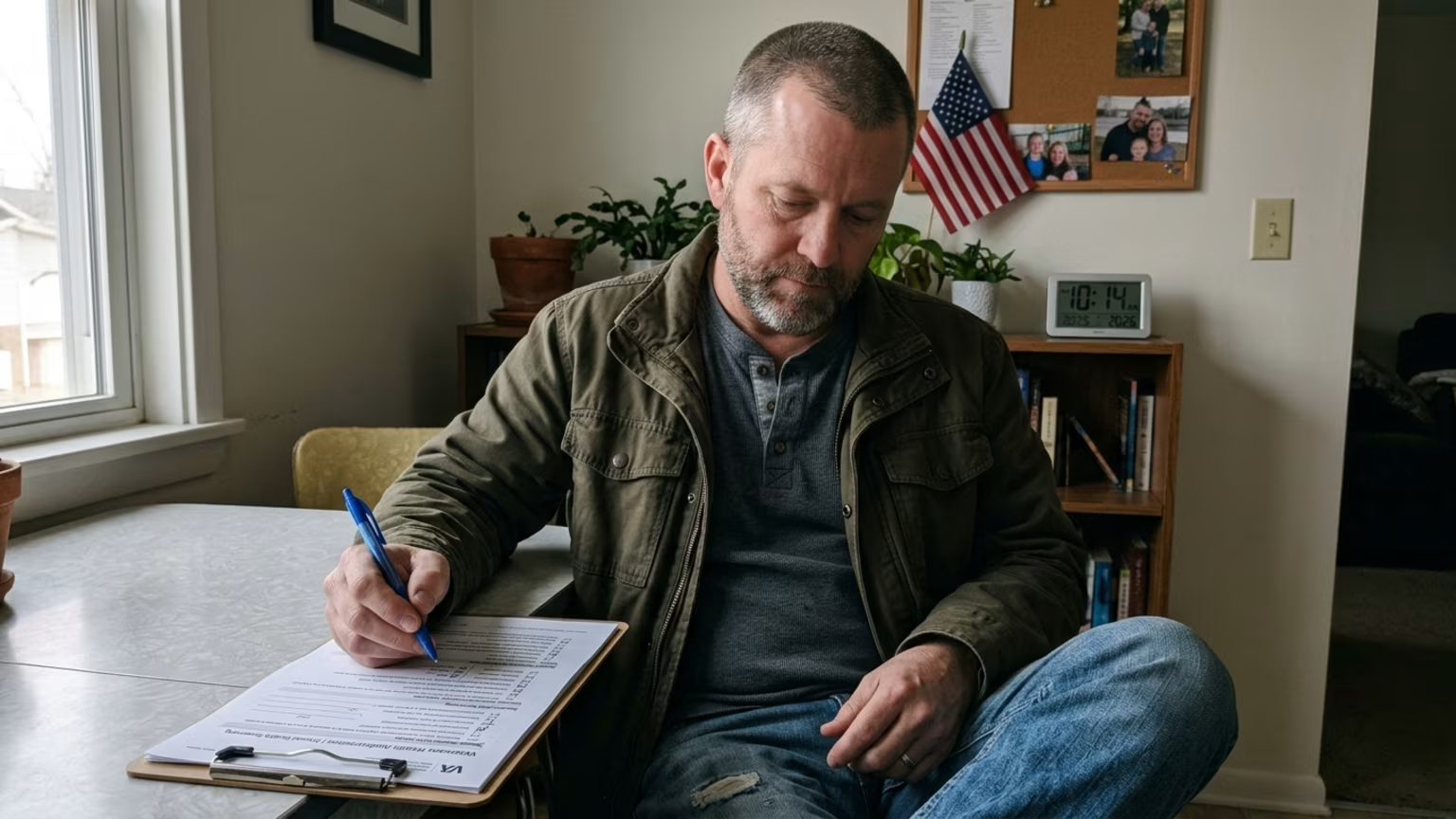
The VA reported record high annual suicide screening and 24-hour follow-up rates for VHA patients in early 2026. Learn how this impacts routine veteran care.

Stanford Medicine cautions against using biological age tests as definitive health markers. Learn why veterans should focus on functional capability instead.
Build better habits around strength, recovery, sleep, hormones and healthy aging with practical guidance for active military personnel and veterans.
Explore BattleVet