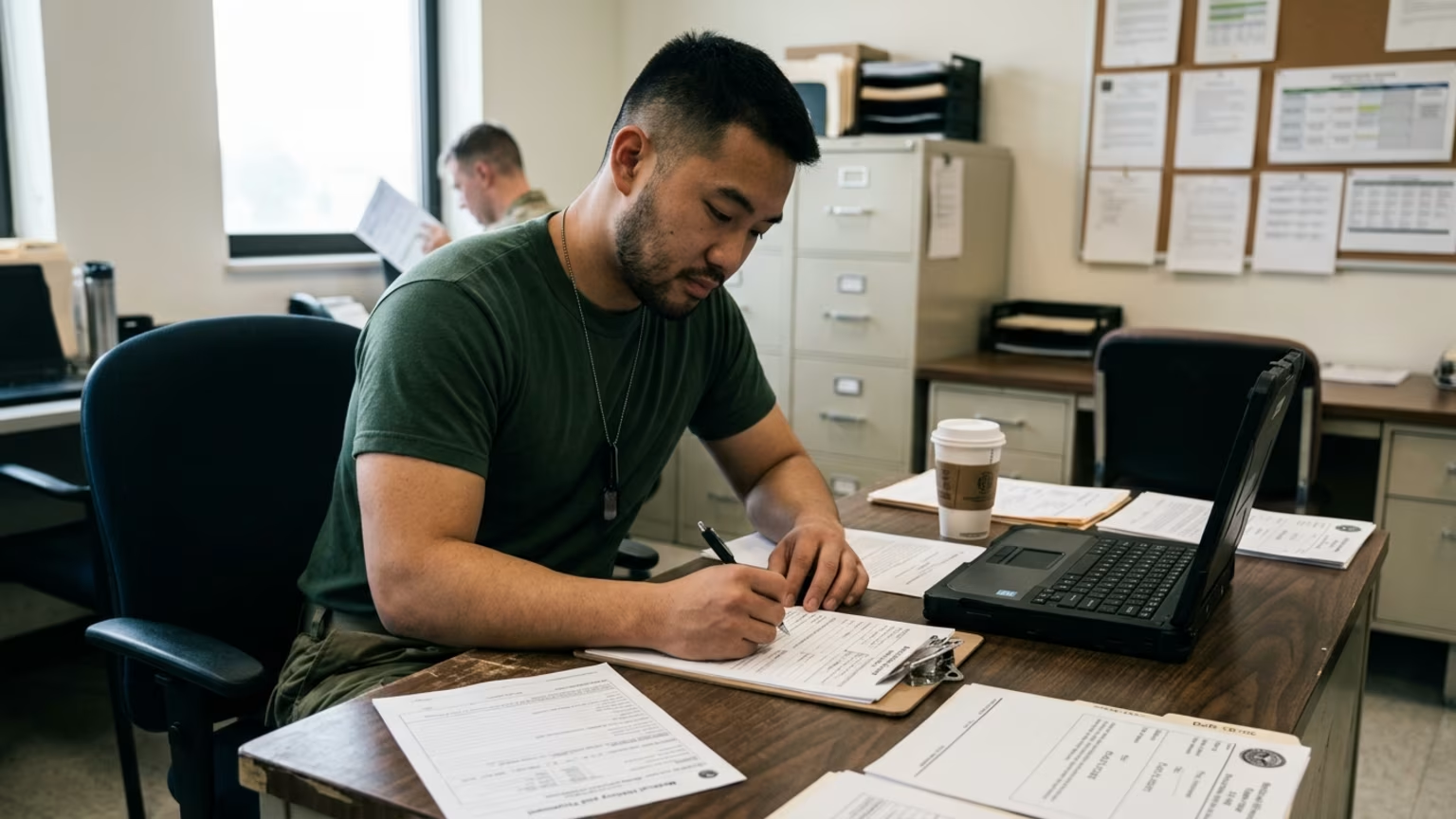

A new GAO report reveals Pentagon resource gaps in tracking troop blast exposure. Learn why maintaining personal medical records protects long term capability.





The assumption that military medical infrastructure automatically catches and records every significant blast exposure is simply incorrect. A new review from the Government Accountability Office reveals that the Defense Department lacks the resources to consistently track brain health. While policies for monitoring blast overpressure exist on paper, their physical execution relies on an underfunded system. This creates a severe gap that often leaves service members without necessary documentation.
For decades, the standard assumption was that military administrative systems would meticulously monitor occupational environmental hazards. The administrative reality on the ground is far more complicated, especially when tracking chronic issues instead of immediate acute injuries. Medical tracking programs are only as effective as the trained personnel specifically assigned to manage them. Without enough clinical specialists to log data accurately, large scale safety policies often fail to translate into individual protection.
This discrepancy between written policy and actual execution directly impacts the long term health of thousands of individuals. Service members routinely assume that their medical files contain a perfect history of their occupational hazards. In reality, the systems designed to protect troops are struggling to maintain basic tracking metrics. Understanding this vulnerability is the first step toward taking control of personal medical documentation.
Traditional military culture treats blast exposure as an event to shake off unless immediate physical symptoms occur. The Pentagon attempted to correct this oversight by issuing a series of blast overpressure policies in 2024. These guidelines established firing range standoff distances, increased the use of training simulators and mandated exposure monitoring. However, recognizing the problem is entirely different from executing a massive monitoring program across a global force.
The Defense Health Agency reported that it did not have enough specialists to conduct required recurring monitoring after initial assessments. Furthermore, officials in the Office of the Under Secretary of Defense for Personnel and Readiness identified insufficient industrial hygienists as the primary barrier to meeting the tracking targets. Having a protective policy is a positive step, but a lack of qualified staff makes consistent implementation impossible. Service officials admitted to the Government Accountability Office that compressed implementation timelines and limited technology made it difficult to evaluate personnel consistently.
This resource gap reveals a fundamental flaw in relying solely on institutional systems for long term health security. The department is attempting to shift from treating brain injuries as acute battlefield problems to managing exposure as an occupational health issue. That shift requires a massive logistical network to record details accurately over the span of a long military career. When the required health specialists are missing, the best written policies fail to protect the troops on the ground.
The burden of maintaining accurate health documentation often falls silently on the individual rather than the medical institution. The military is distributing educational material on blast exposure, encouraging troops to seek treatment and instructing leaders to schedule training breaks. These are positive developments, but general education cannot replace necessary clinical screening equipment or qualified staff. When an infrastructure lacks the capacity to track hazards accurately, the responsibility to monitor symptoms shifts entirely to the service member.
Baseline cognitive testing is not a diagnosis for a traumatic brain injury or any specific neurological condition. These computer based assessments measure attention, memory, thinking speed and accuracy to establish a personal baseline. By the end of fiscal year 2025, nearly 200,000 new service members had completed cognitive assessments. During that same period, more than 119,000 active-duty personnel in high-risk occupations had also been assessed.
A recorded baseline is essential for identifying subtle cognitive changes. This is especially true following exposure to howitzers, mortars, M107 and Mk 15 sniper rifles or breaching charges. The Government Accountability Office noted that overall, 86% of personnel in occupations classified as having increased blast risk received assessments. However, the reported completion rates varied significantly by service branch.
The Army reached 87%, the Air Force hit 81% and the Navy lagged behind at a concerning 59%. These uneven screening rates prove that military health protocols are not yet applied uniformly across the armed forces. A single cognitive test does not prove that a specific blast caused a particular symptom. The central biological reality is that these early metrics are crucial for accurate future medical comparisons.
Documenting early cognitive function gives specialists a clear reference point if memory issues or concentration problems develop later. The science behind cognitive monitoring relies heavily on consistent, repeatable data collection over several decades. A single baseline test is only valuable if medical professionals can access it easily during future medical examinations. The current reporting indicates that the Defense Department is updating a centralized data system to record these critical exposures accurately.
This system is intended to capture the specific weapons involved and the exact circumstances of how individuals were exposed. The military set deadlines requiring new recruits to receive assessments by the end of 2024. High-risk active-duty personnel were required to be assessed by the end of fiscal year 2025. When administrative processes break down, the biological reality of a cognitive injury becomes much harder to prove.
Because institutional tracking systems are still catching up, service members must actively manage their own medical files. The Pentagon announced a one-year pilot program in April to test an app-based cognitive assessment tool. Officials hope this application will require fewer resources and streamline the complex exposure monitoring process for all branches. The Government Accountability Office recommended that the department complete a thorough resource assessment and secure adequate industrial hygiene staffing.
Under Secretary of Defense for Personnel and Readiness Keith Bass estimated that these actions would be completed by December 2026. While the department works to improve its technology, personnel in high-risk roles must take immediate action to protect themselves. Troops should explicitly ask if their baseline cognitive assessment has been completed and formally recorded. Service members must also ensure that specific weapons, training activities and protective measures are thoroughly documented after significant training events.
Proper veteran lifestyle and healthcare planning starts long before an individual actually leaves active duty service. After a significant exposure event, personnel should report symptoms promptly rather than waiting for them to resolve on their own. Symptoms like changes in concentration, memory problems or balance issues should be discussed directly with a medical professional. A practical request to a medical team is to ask for exposure documentation, a baseline review and a follow up evaluation.
Veterans with a history of repeated weapons training can bring their previous exposure details to a civilian clinician. However, the current government findings focus specifically on active Defense Department implementation rather than separate veteran screening entitlements. This means that documentation gathered during active service is the primary tool available for post military medical care. Ensuring that these records are spotless before transition is an absolute necessity for protecting future physical capability.
Managing this documentation directly ensures that BattleVet readers maintain accurate records for any future medical evaluations. The most important action a service member can take is treating administrative health tracking with the same seriousness as physical fitness. Accurate records empower specialists to make informed decisions when health priorities inevitably shift with age. Taking personal responsibility for these files bridges the administrative gap between official policy and true readiness.
A clear medical record may not prevent an exposure, but it remains the most reliable anchor for navigating long term health when circumstances eventually change.
Follow BattleVet for practical guidance on military and veteran health, strength, recovery, testosterone, sleep and healthy aging. Stay connected for new articles, research backed insights and clear information to help you stay capable for the years ahead.


Combat Stress’s workplace guidance emphasizes listening over diagnosis. Recent U.S. veteran insomnia research adds context for sleep and recovery concerns.


ErythroMer's reported storage design could matter for military care. An academic review still lists it as preclinical, with human evidence ahead.
A large veteran study links PTSD and documented social needs to later cognitive impairment, reinforcing the value of connected care planning.
Build better habits around strength, recovery, sleep, hormones and healthy aging with practical guidance for active military personnel and veterans.
Explore BattleVet