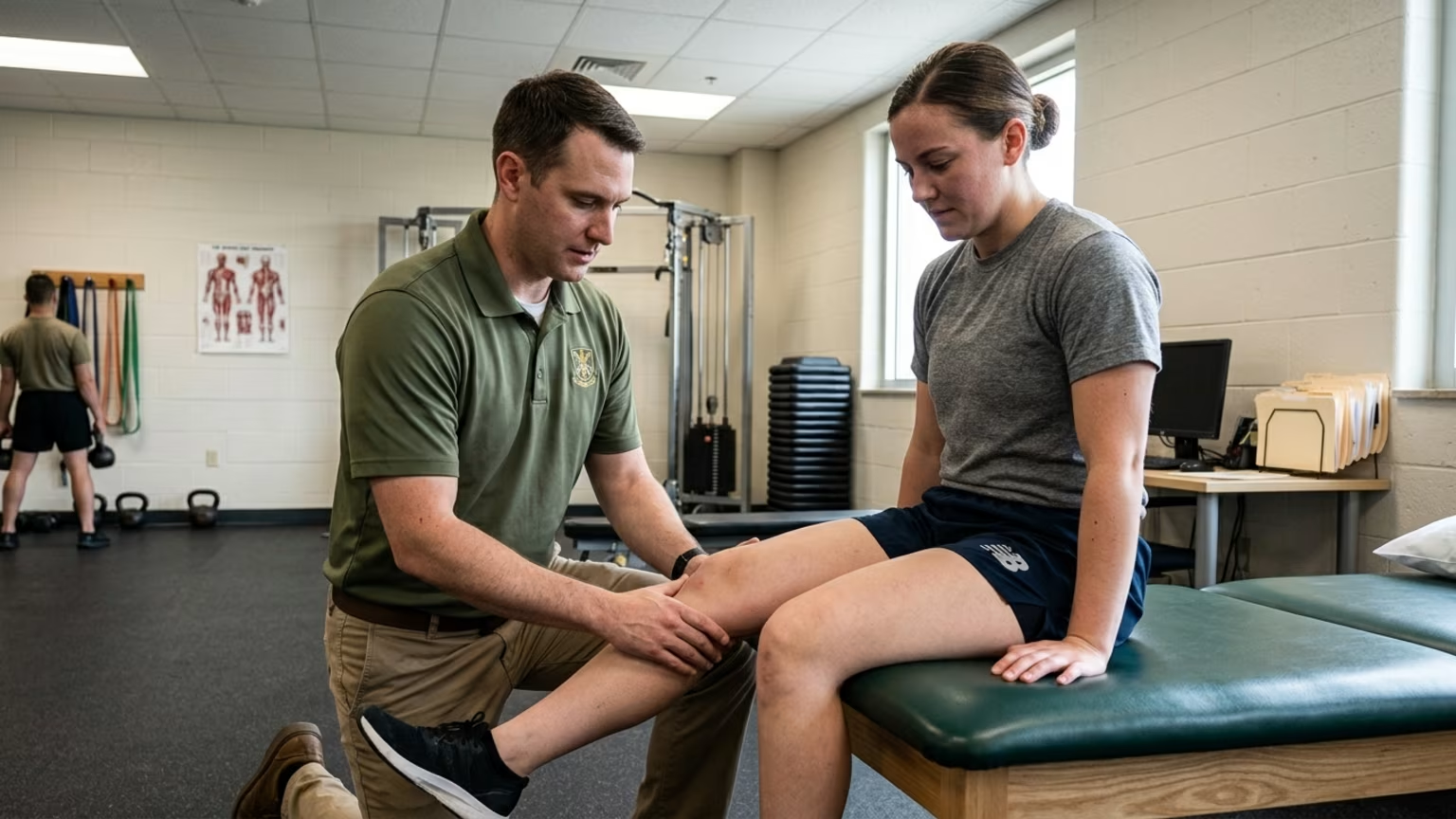

Build a year-round strength and conditioning plan that balances military duty, deployments, and civilian life while preventing overtraining and injury.





Jeremy McGowan oversees the Holistic Health and Fitness program at Fort Rucker to solve a persistent military problem. Service members constantly face a tension between demanding physical training schedules and exhausting operational duties. He recognized that keeping Soldiers healthy and ready to deploy requires an all-encompassing system rather than rigid gym routines.
Treating military duty and physical fitness as entirely separate activities ignores basic human physiology. A demanding field exercise or a long casualty drill imposes significant physical stress on the body. A 2026 systematic review and meta-analysis evaluated acute fatigue following occupational military training. The review found significant muscle damage and significant reductions in strength and power lasting as long as 96 hours after military-specific activities.
If you stack heavy lifting directly on top of occupational stress, you severely exceed your recovery capacity. U.S. military research identifies noncombat musculoskeletal injuries as a leading cause of disability. These injuries affect more than 800,000 service members annually and produce millions of limited duty days.
One report estimates approximately $3.7 billion in direct and indirect Department of Defense costs associated with these injuries. A review cited in military health literature estimates that roughly 50% of service members experience a musculoskeletal injury severe enough to restrict work for as long as 120 days during their careers. In an Army dataset covering 2011 to 2021, 138,649 incident fractures were recorded among 1,289,953 Army service members. This is equivalent to 10.8% of the observed population over the study period.
The U.S. Army addresses this biological reality through its Holistic Health and Fitness system. The Army describes H2F as a readiness system intended to improve physical and mental stamina for performance, survival, and deployment. Its model targets physical, nutritional, and mental readiness alongside sleep and spiritual health. Recent Army reporting shows H2F being applied to specific installations where coaches synchronize programs with operational demands.
H2F's physical performance component combines strength and conditioning with physical therapy, rehabilitation, injury prevention, and functional power development. The Army is embedding H2F Performance Teams within brigades to provide direct support. These multidisciplinary teams include physical therapists, strength coaches, and cognitive performance specialists working alongside occupational therapists and athletic trainers. This structure aligns training and health support closely with unit level operational demands.
Sleep plays an equally critical physiological role in physical readiness. Military health researchers report that sleep deprivation can reduce muscular performance and impair aerobic and anaerobic capacity. Poor sleep degrades the body's ability to repair muscle tissue after heavy exertion. You can read more about these mechanisms in our articles on recovery and sleep.
Building a sustainable training calendar requires flexibility and proactive planning. The Army's H2F doctrine update states that the system is intended to establish common training standards and integrate performance teams directly into units from the beginning. This prevents the military from responding only after an injury or a readiness degradation occurs. You can apply a similar preventative mindset to your own programming to ensure sustainable progress.
Start by putting your military and civilian obligations onto a single calendar. Mark upcoming deployments, field exercises, and shift changes before adding your civilian work deadlines and family commitments. You cannot follow a rigid progression program if you spend two weeks sleeping on the ground every quarter. Group your year into build blocks, operational blocks, maintenance blocks, and recovery blocks based on these dates.
When operational load is high, switch to a maintenance block immediately. You only need a fraction of your normal volume to maintain muscle mass and aerobic capacity. A practical template includes two brief full body resistance sessions per week when circumstances permit. You can also add one or two short aerobic sessions, adjusted for occupational walking, heat exposure, and load carriage.
A field exercise or a long ruck is a major physical stressor that requires recovery. If your occupational load is high, use short technical sessions and mobility work instead of heavy lifting. If your occupational load is moderate, maintain your baseline strength while limiting any additional fatigue. You should only push for personal records in the gym when your occupational stress is low and your sleep is consistent.
A military body composition review linked greater lean mass with better strength, power, load carriage, and task-specific performance. The same review found that higher body fat percentage and visceral fat were generally associated with poorer functional performance. Maintaining lean mass requires consistent resistance training and adequate protein intake. Adjust your maintenance blocks to preserve this lean mass without piling on unnecessary cardiovascular fatigue.
You must taper your training volume before important fitness tests or selection events. A taper reduces physical fatigue without eliminating your exposure to the specific qualities needed for the event. You might cut your total accessory lifting volume in half while retaining brief, controlled exposures to test-specific movements. For further guidance on specific events, view our training and performance articles.
Implement a simple daily readiness check to manage fatigue and prevent serious injury. If your sleep is normal and your soreness is manageable, proceed with your planned session. If you have poor sleep, unusual fatigue, or a heavy occupational load, reduce your workout volume. If you experience acute injury symptoms, severe exhaustion, or illness, stop training completely and seek appropriate medical evaluation.
One frequent error is ignoring the biological cost of military duty. Many service members and veterans try to complete high volume civilian gym routines regardless of what happened at work that day. Remembering that military occupational training can reduce strength and power for up to 96 hours is crucial. Forcing a heavy leg workout two days into an exhausting field exercise dramatically increases your injury risk.
Another major mistake is treating sleep as a luxury rather than a primary training variable. You cannot adapt to physical training if you do not sleep enough to facilitate tissue repair. Trying to compensate for missed sleep by pushing through a brutal workout often backfires. This habit leads to overtraining, suppressed immune function, and stalled physical progress over the long term.
Failing to adapt programming for extreme environments is also a severe error. U.S. Army heat illness guidance warns that intense activity, dehydration, and inadequate recovery can raise core temperature rapidly. This dangerous risk exists even when the ambient temperature is relatively moderate. Multi-day exercises can produce cumulative internal heat when sleep and cooling are inadequate.
Finally, many people ignore early warning signs of joint pain or reduced mobility. Relying on sheer willpower to get through a training cycle often turns minor joint irritation into a chronic issue. A U.S. military study of patellofemoral pain identified 85,023 initial diagnoses among 2,477,394 active-duty service members, an incidence rate of 0.94 per 100 person-years. Ignoring early warning signs from your body will eventually force you to take a mandatory pause.
The most effective training plan is one that survives contact with your actual schedule. Maintaining physical capability year round requires you to accept that your training volume will fluctuate constantly. You will make consistent progress if you capitalize on low stress periods and intelligently scale back during demanding operational blocks. Adapting your training volume based on occupational demands ensures that you stay capable, strong, and healthy.
Your baseline consistency matters far more than an occasional perfectly executed workout. Treat your sleep, nutrition, and daily recovery routines with the exact same respect that you give your gym sessions. Adjusting your effort based on operational stress is not a sign of weakness. Proper planning is the hallmark of a capable individual who understands how to sustain peak performance over a lifespan. For more insights, explore our military health guidance.
Audit your upcoming 90 days of work and life obligations tonight to map out your necessary maintenance weeks.
Follow BattleVet for practical guidance on military and veteran health, strength, recovery, testosterone, sleep and healthy aging. Stay connected for new articles, research backed insights and clear information to help you stay capable for the years ahead.


The Army’s HVAC task force targets hot barracks. Here is what its project figures mean and how to assess future housing and sleep-related claims.


The BRIDGE Act proposes a whole-family military transition pilot. Read who it would serve, what support it includes, and what remains unresolved.

Combat Stress’s workplace guidance emphasizes listening over diagnosis. Recent U.S. veteran insomnia research adds context for sleep and recovery concerns.
Build better habits around strength, recovery, sleep, hormones and healthy aging with practical guidance for active military personnel and veterans.
Explore BattleVet