

Recent discussions on women's hormone research highlight clinical gaps. Learn how changing evidence impacts veteran healthcare and military screening policies.





On August 24, 2026, Forbes published a discussion arguing that testosterone is an under-recognized component of women’s health research and clinical practice. The article highlights that women produce testosterone throughout life. The hormone acts on androgen receptors throughout the body. Despite this physiological reality, the United States currently has no FDA-approved testosterone product specifically indicated for women.
Forbes presents this regulatory absence as part of a broader systemic problem. The publication notes that limited research funding and inconsistent clinical education create medical barriers. Fragmented care and the lack of a standardized clinical pathway further complicate the issue. These systemic gaps often leave patients without clear medical guidance.
Dr. Komal Bajaj, identified by Forbes as a board-certified OB/GYN and clinical geneticist, argues that the central challenge is closing the gap between medical evidence and clinical practice. Bajaj emphasizes that hormone therapy should not be treated as one uniform intervention across all patients. According to Forbes, the risk and benefit profile can vary significantly. Factors include the specific hormone and formulation.
The route of administration, patient age, menopause timing, and individual risk profile also matter. This nuance remains critical because past medical consensus has often shifted rapidly based on single studies. For example, the 2002 Women’s Health Initiative findings were widely interpreted as showing that menopausal hormone therapy broadly increased health risks. Prescribing dropped sharply after that study, though Forbes says subsequent research produced a more differentiated understanding of hormone therapy.
This evolving conversation holds material importance for active-duty personnel and veterans navigating their health priorities. The military context makes the Forbes discussion particularly relevant right now. The Department of Defense reportedly added mandatory testosterone screening to the Periodic Health Assessment for active-duty and reserve personnel aged 30 and older. Screening remains optional for younger personnel.
Importantly, the policy applies to both male and female service members. This makes it clear that testosterone screening is not solely a men’s health issue. Reports indicate that treatment for those found to have low testosterone is voluntary. Because treatment is voluntary, service members are left to navigate the results themselves.
This DoD policy has drawn notable criticism from endocrinology and medical policy experts. The core tension is that routine screening of asymptomatic people is not supported by several major clinical positions. A Military Times opinion analysis cautioned that no single symptom or biomarker should be used to define a complex condition like cumulative operational injury. Laboratory findings must be interpreted in an appropriate clinical context rather than treated as a definitive answer.
For military personnel managing sleep issues or recovery barriers, understanding this distinction is crucial. Broader testing might successfully identify individuals who need further medical evaluation. However, a single test result by itself does not establish an automatic treatment indication. Active personnel must balance the requirements of mandatory screening programs with established medical guidelines that prioritize symptom-directed care.
Finding reliable military health guidance ensures that service members can advocate for accurate diagnoses. Medical readiness should not override the need for comprehensive evaluation and clear patient consent. Service members need to know what follow-up is recommended before they accept any medical interventions. They should also ask their providers what alternative treatments exist.
The Forbes article uses specific data to quantify the widespread impacts of systemic clinical gaps. Forbes cites research from the World Economic Forum and McKinsey Health Institute regarding global health disparities. These organizations estimate that women spend approximately 25 percent more of their lives in poor health than men. The global women’s health gap represents about 75 million disability-adjusted life years annually.
Furthermore, closing this gap could add at least $1 trillion to the global economy annually by 2040. These numbers underscore the heavy systemic cost of fragmented care and delayed diagnoses. The data reveals a pressing need for more focused clinical funding.
Within the veteran population, hormone-related care involves far more than tracking a single biomarker. VA research followed nearly 700 Gulf War-era women veterans over a 17-year period to study early menopause. The research summary reported that Gulf War-era women veterans with traumatic experiences or environmental exposures during service were more likely to experience early menopause. Early menopause is described by the VA as beginning before age 45.
The condition is linked with poorer bone health, premature mortality, cardiovascular disease, and depression. The exact numerical findings from this VA study highlight severe risk associations for female service members. The VA reported that women veterans with PTSD had nearly two-and-a-half times the risk of early menopause. Additionally, those with hazardous environmental exposure had 83 percent higher odds of early menopause.
These data points demonstrate why veteran hormone care must be highly sensitive to operational history. It is highly appropriate to raise reproductive aging, bone health, and menopause symptoms during primary care visits. Veterans seeking further information on these topics can reference comprehensive healthy aging and longevity resources to help guide their medical conversations.
The VA’s Center for Women Veterans directs women veterans with questions to the Women Veterans Call Center. This resource can be reached at 1-855-829-6636. VA facilities have also been providing menopause-focused education addressing symptoms and treatment options. These educational programs cover mental health effects and emerging research.
The latest clinical discussions reinforce a shift away from universal screening and toward symptom-directed evaluation. The American Association of Clinical Endocrinology takes a firm position against routine population screening for testosterone deficiency in asymptomatic men. AACE says current evidence does not support routine population screening. The Endocrine Society likewise states that there is insufficient evidence to recommend population-level testosterone screening for asymptomatic men.
Instead, AACE says testosterone deficiency should be evaluated using compatible symptoms or signs. It also requires confirmed low morning testosterone measurements and investigations of possible underlying causes. A single laboratory result is never sufficient for a diagnosis. The testing must always include an evaluation for alternative conditions.
For women, the clinical guidelines remain highly specific and narrower than general marketing claims might suggest. Current evidence supports considering testosterone therapy for appropriately selected postmenopausal women with clinically diagnosed hypoactive sexual desire disorder. Forbes identifies muscle, bone, and sleep as systems that may interact with hormonal health. Inflammation, metabolism, and immune function are also listed as interacting systems.
However, the publication describes evidence involving bone-density improvement and cardiovascular-risk reduction as emerging rather than established indications. The international consensus position does not establish testosterone as a general treatment for energy or mood. It also remains unproven for cognition, muscle goals, or broad well-being in women.
The available clinical summaries state that no blood testosterone level can independently diagnose a female androgen-deficiency syndrome. There is no universal female low-testosterone threshold established by the international consensus position. This lack of a clear threshold makes the diagnostic process much more reliant on a complete clinical picture. Clinicians cannot simply look at a lab value and prescribe a standardized dose.
These guidance shifts require service members and veterans to take a careful approach to any hormone testing. Testing should be treated as a starting point rather than an immediate answer. If a hormone is measured, patients should ask their clinician what symptoms the test is intended to investigate. They should also determine whether repeat or confirmatory testing is needed before any clinical decisions are made.
Patients must bring their full symptom picture to these appointments. This includes recording sleep patterns, mood changes, training tolerance, and any medication use. Forbes stresses that hormonal evaluation should be guided by a patient’s age and specific symptoms. A clinician must also consider medical history, menopausal status, and medications.
Depending on the clinical context, a clinician may consider estrogen, progesterone, thyroid function, or testosterone evaluations rather than assuming one hormone explains every symptom. Understanding how testosterone and hormones interact with overall health helps patients avoid the trap of self-medicating with over-the-counter products. A responsible treatment plan should always explain the intended benefit and the monitoring schedule. It must outline the specific circumstances under which therapy would be stopped.
Fatigue, sleep problems, and mood changes can have multiple potential causes. Low libido, changes in physical strength, and concentration difficulties are also highly nonspecific symptoms. Forbes recommends discussing medical conditions and other possible contributors rather than immediately assuming a hormonal cause. If a patient rushes into therapy based on a single blood test, they risk missing the true underlying issue.
Relying on thorough diagnostics helps protect patients from potential side effects associated with unnecessary hormone treatments. Accessing veteran lifestyle and healthcare resources can help patients form better questions for their medical providers. Taking a systematic approach ensures that any prescribed treatment actually addresses the root cause of the patient's symptoms.
As the Department of Defense implements its screening protocols and civilian research attempts to close the gaps in female hormone care, the medical community faces a significant transition period. How will future clinical guidelines adapt to ensure that the complex operational exposures and unique health histories of veterans are accurately addressed without relying on oversimplified laboratory results?
Follow BattleVet for practical guidance on military and veteran health, strength, recovery, testosterone, sleep and healthy aging. Stay connected for new articles, research backed insights and clear information to help you stay capable for the years ahead.


The Fort McClellan veterans health study is planning its analysis. Learn who is covered, how the research will work, and what it means for care.

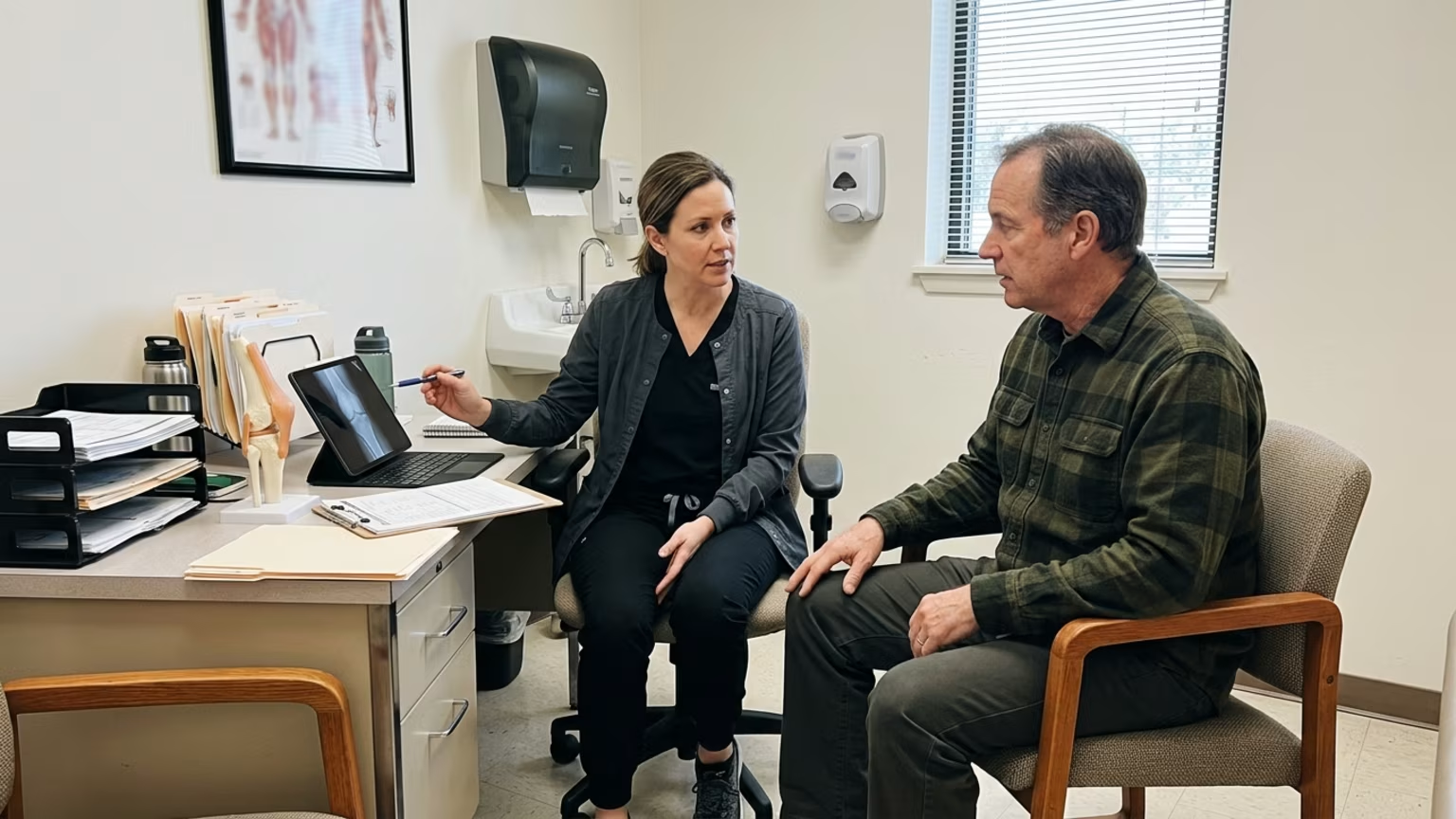
A Cureus review links preoperative TRT with selected knee replacement complications. Learn what the findings mean for veterans' surgical discussions.

VA research raises questions about suicide-screening answer accuracy and supports clearer conversations, trust, and broader clinical assessment.
Build better habits around strength, recovery, sleep, hormones and healthy aging with practical guidance for active military personnel and veterans.
Explore BattleVet