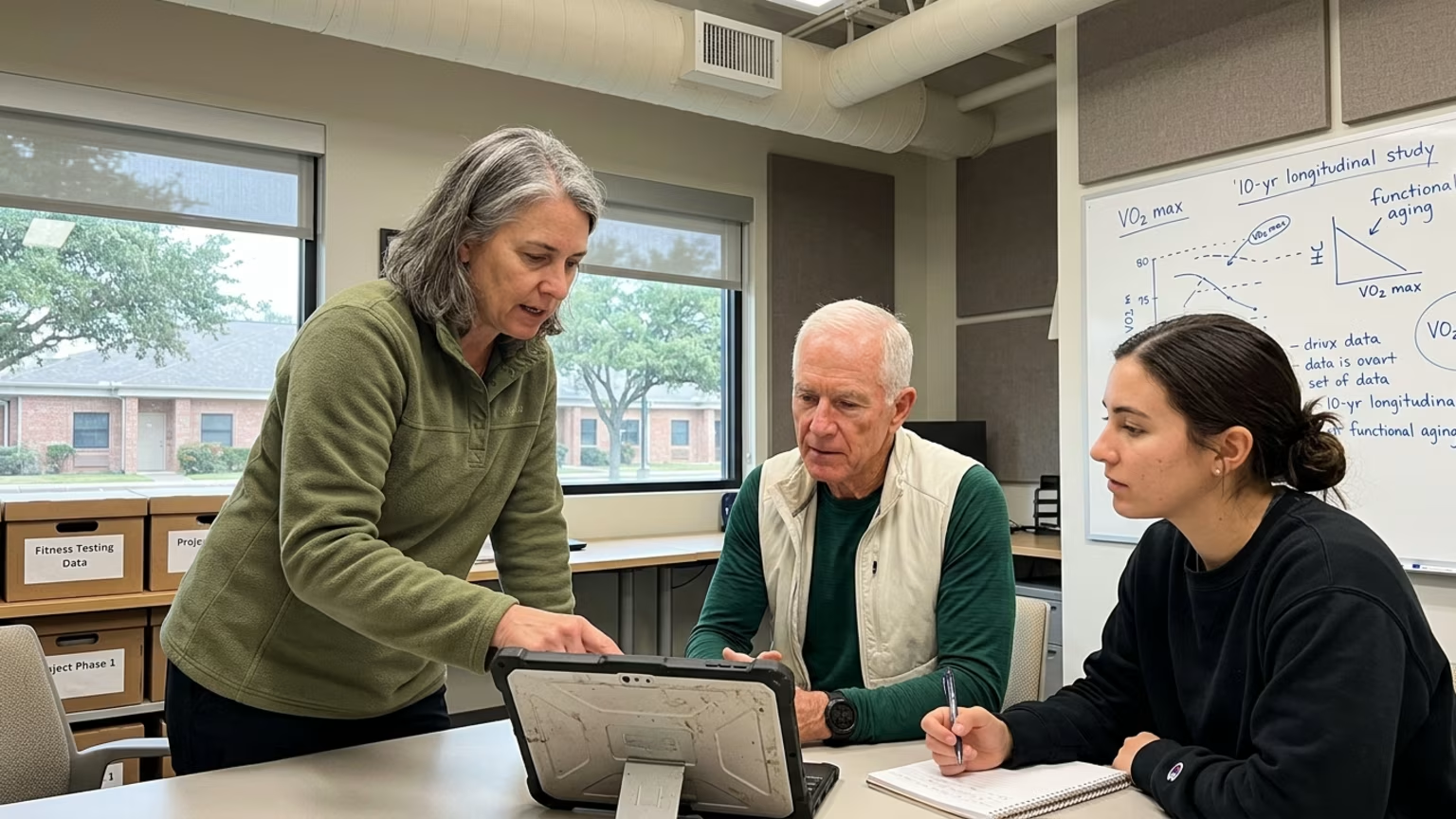

The German Aerospace Center launched a 10-year study on competitive masters athletes. Learn how this research influences veteran physical training and health.





In 2026, the German Aerospace Center launched the Track and Field Masters Athletic Cohort. This project is a 10-year international field study examining fitness, training, and health in competitive masters athletes. Researchers collected their latest fieldwork data during the 2026 World Masters Athletics Championships. This major athletic event took place in Daegu, South Korea. The study is led by the Department of Metabolism and Human Performance. This department operates within the Institute of Aerospace Medicine. It also features collaboration from the institute's Department of Cardiovascular Aerospace Medicine.
The German Aerospace Center refers to its organization as DLR. Professor Dominik Pesta is the head of the human performance department. He serves as a lead figure in this decade-long initiative. He presented the initial research at a symposium held during the Daegu championships. Professor Hiro Tanaka of The University of Texas at Austin presented alongside him. The project involves multiple international academic partners. These include the University of Saskatchewan and Brandon University. The team also includes California State University in Bakersfield.
DLR also reported several 2026 collaborations with prominent Asian institutions. These partners include Juntendo University in Japan. Further partnerships exist with Yonsei University, Yeungnam University, and Keimyung University in South Korea. The testing battery utilized in Daegu assessed aerobic capacity and general muscle strength. It also measured cardiovascular function, vascular health, and total lung capacity. The symposium in Daegu brought the study directly into contact with older competitive athletes. DLR intends to make the research symposium a recurring feature of future championships.
DLR describes masters athletes as competitors who continue training beyond the normal athletic prime. These individuals compete well past the age considered mature for their specific sport. They may preserve unusually high levels of physical function despite growing older. This preservation happens despite normal age-related declines in aerobic fitness and muscle strength. It also occurs alongside standard reductions in flexibility, balance, and vascular function. The longitudinal design of the study will track changes in this cohort. It aims to show how fitness, training behavior, and overall health shift over time.
This new initiative provides essential context for active personnel and veterans. Military readiness and long-term health both rely on sustained physical capability. The project is notable because it avoids simple metrics. It does not reduce healthy ageing to a single number like a race time. Instead, it measures how multiple physiological systems interact in older high-performing adults. This comprehensive evaluation creates better benchmarks for maintaining real-world performance. Veterans can use this research model to understand their own functional requirements.
Operational capability depends on significantly more than just cardiovascular endurance. Carrying heavy equipment, climbing steep terrain, and recovering from intense exertion require systemic fitness. Maintaining balance and tolerating heat or altitude also demand highly coordinated physical systems. Muscular, respiratory, and neuromotor capacities all play a role in long-term independence. The aerospace connection to this study provides a unique scientific angle. Spaceflight causes rapid physical deterioration that closely mimics the human ageing process. DLR researchers are comparing the slow biological decline on Earth to the rapid decline in space.
This comparison could reveal fundamental truths about how human muscles and bones maintain their density. It also highlights how critical physical conditioning is for survival in extreme environments. The central message of the study remains deliberately qualified by the researchers. DLR states clearly that masters athletes do not demonstrate how to stop ageing entirely. Rather, these individuals show exactly how much physical function humans can preserve. This distinction is vital for a military and veteran audience managing physical expectations. It frames physical training as a reliable method for maintaining practical functional capacity.
Service members can rely on solid healthy aging strategies to support their longevity. The 10-year structure of the project adds crucial weight to this concept. A single assessment only describes a current physical condition at one specific moment. It cannot fully separate lifelong training effects from basic genetics or injury history. It also cannot isolate the impact of prior athletic selection, nutrition, or current medical status. Repeated measurements over a decade will clarify which physical traits decline inevitably. They will also highlight which characteristics remain most responsive to continued physical training.
The study reinforces a necessary shift toward multidomain fitness models rather than single-metric tracking. A 2026 scoping review of older athletes provides important scientific context for this shift. This review examined competitive masters athletes, lifelong exercisers, and former Olympians aged 40 or older. It found that athlete-focused studies reported a lower prevalence of confirmed sarcopenia. Sarcopenia is the natural, age-related loss of muscle mass and physical strength. The athlete studies were compared directly to research on standard, community-dwelling older populations.
However, the physical benefits varied significantly depending on the specific type of sport. This reality requires a balanced approach to strength, fitness and body composition. The review noted that strength and sprint athletes generally showed better muscular outcomes. They outperformed endurance athletes in several key physiological categories. These power-focused athletes demonstrated greater appendicular lean mass, which means more muscle in the arms and legs. They also showed better rates of force development and excellent preservation of type II muscle fibers.
Lifelong endurance training provided an entirely different set of physical benefits for the body. It was strongly associated with lower overall adiposity, meaning less body fat. Endurance athletes also maintained superior aerobic capacity and favorable muscle-oxidative characteristics compared to sedentary peers. Yet, neither training style offered complete biological protection against all aging factors. The scoping review cautioned that lifelong endurance training does not completely stop the ageing process. Even consistent endurance work did not fully prevent lower muscle mass or motor-unit loss.
It also failed to prevent standard age-related reductions in muscular power. This confirms DLR's conclusion about preserving function rather than completely stopping biological time. The review clearly concluded that continued training after elite retirement appeared highly important. Historical athletic status alone did not provide sufficient long-term physical protection for older adults. This is a critical point for former military personnel adjusting to civilian life. Past fitness test scores simply do not protect against the physical decay of current inactivity.
Veterans should build routines that include progressive resistance work alongside their aerobic conditioning. The evidence supports maintaining power and balance rather than relying solely on distance running. Many previously fit service members unfortunately become inactive after their discharge. They must treat their current physical conditioning level as their true starting point. Past military performance cannot act as a substitute for present-day training habits. A balanced approach helps preserve essential type II muscle fibers and joint mobility over time.
This active strategy directly supports comprehensive veteran lifestyle and healthcare goals. The broader institutional context includes current programs specifically designed for older veterans. The U.S. Department of Veterans Affairs describes programs that combine strength, balance, flexibility, and cardiovascular exercise. The VA has also detailed a telerehabilitation study specifically designed for veterans aged 60 and older. This remote study targeted physical strength, mobility, and social engagement for patients with physical therapy needs. Programs like this help veterans maintain their independence without requiring daily visits to a clinic.
These VA initiatives highlight the immense practical relevance of multidomain exercise programming today. They demonstrate why tracking endurance and strength together is necessary for preserving long-term independence. Gradual progression remains absolutely essential after any extended period of inactivity, injury, or illness. Veterans should note that these VA programs are not part of the TaFMAC project. They do not validate the DLR study directly or share data with the researchers. They simply illustrate the real-world application of preserving strength and mobility in veteran healthcare.
Veterans should always seek clinical assessment when symptoms or physical limitations arise. The DLR announcement does not provide a medical safety protocol for the general public. It should never be used to justify unsupervised maximal testing for individuals with cardiac or orthopedic concerns. Safe and structured physical activity remains the standard recommendation for the veteran population. Tracking cardiovascular and vascular function alongside muscular strength provides a superior model for long-term resilience.
The early stages of this 10-year study offer a powerful reminder about physical maintenance. Athletics and rigorous training can clearly shift the trajectory of biological decline. The true value of this research will emerge as the longitudinal data develops over the coming decade. Future results will reveal exactly how much capacity humans can retain through dedicated, decades-long effort. As this international study progresses, how will its upcoming data on preserved muscle and lung function eventually reshape the physical rehabilitation standards used in veteran healthcare?
Follow BattleVet for practical guidance on military and veteran health, strength, recovery, testosterone, sleep and healthy aging. Stay connected for new articles, research backed insights and clear information to help you stay capable for the years ahead.


A Cureus review links preoperative TRT with selected knee replacement complications. Learn what the findings mean for veterans' surgical discussions.


VA research raises questions about suicide-screening answer accuracy and supports clearer conversations, trust, and broader clinical assessment.
JAMA estimates low testosterone readings in active-duty Army men. See the threshold data, study limits, and implications for clinical follow-up.
Build better habits around strength, recovery, sleep, hormones and healthy aging with practical guidance for active military personnel and veterans.
Explore BattleVet