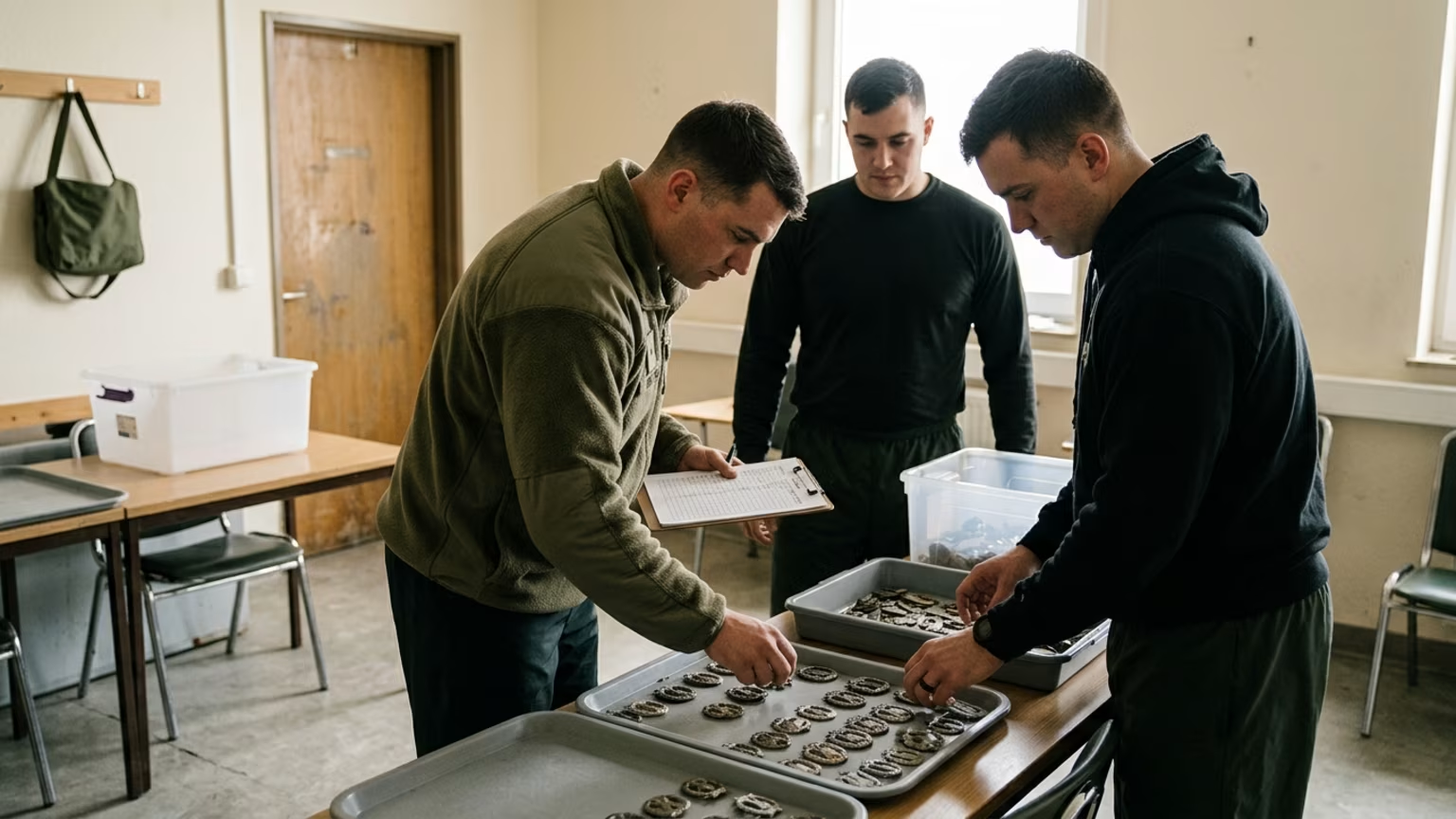

U.S. service members tested speed, strength, and endurance in a German basic fitness competition, highlighting broad multinational readiness standards.





On August 16, 2026, the U.S. Army Reserve’s 99th Readiness Division reported a multi-day physical and tactical competition at Joint Base McGuire-Dix-Lakehurst in New Jersey. U.S. Soldiers, Army Cadets, Airmen, and a Marine competed for two highly recognized German military awards. Competitors pursued the German Armed Forces Proficiency Badge and the German Armed Forces Badge of Marksmanship. The marksmanship award is officially known as the Schützenschnur.
The event tested participants across multiple domains of physical and technical readiness. The multi-day competition demanded proficiency in swimming, sprinting, upper-body endurance, and middle-distance running. Competitors also had to demonstrate tactical skills through live-fire exercises and loaded marching. After the initial physical assessments, competitors moved to a live-fire range to shoot from standing, kneeling, and prone positions.
The 99th Readiness Division reported 230 total awards across the two demanding German qualifications. The division reported 110 total awards for the German Armed Forces Proficiency Badge. The marksmanship qualification resulted in 120 separate awards for the participating personnel. These figures demonstrate a significant effort by U.S. forces to meet rigorous allied standards.
The German Armed Forces Proficiency Badge provides a clear benchmark for active personnel and veterans who want to maintain balanced physical capabilities. The event requires competitors to complete a Basic Fitness Test, a uniform swim, marksmanship testing, and military first-aid qualification. Participants must also complete ABC-defense training and receive a positive disciplinary-supervisor assessment. This broad structure rewards comprehensive readiness rather than specialization in a single athletic discipline.
The Bundeswehr states that the lowest individual result determines the final badge level. A competitor cannot offset a bronze-level performance in one component with a gold-level score in another event. This strict scoring format aligns with practical strength, fitness and body composition goals for modern military personnel. Preparing for this standard forces athletes to address their weakest physical links well before testing day.
Recent U.S. military coverage shows that this German standard is being used in multiple operational settings. Soldiers from the 21st Military Police Company conducted the qualification at Fort Bragg in July 2026. A U.S. Army video also documented 52nd Air Defense Artillery Brigade soldiers completing qualification events in Germany in August 2026. The 21st Military Police Company described their participation as a way to demonstrate soldier skills and build unit esprit de corps.
The U.S. Department of Defense supports a similar multidimensional approach to service member capability. The Health.mil Total Force Fitness resources include physical fitness, nutrition, and sleep. The framework also emphasizes mental health, cognitive performance, and medical readiness. This framework suggests that preparation for an event like the German badge should not be reduced to just running harder or lifting more.
Research indexed in Military Medicine has reported that lower total and visceral adiposity is generally associated with better operational outcomes. Greater total and segmental lean mass also correlated with better strength, cardiorespiratory endurance, and power in military populations. This finding supports the value of developing a highly balanced physical base. However, changing one body composition measure alone does not guarantee better field performance.
The physical assessments began with a demanding aquatic event requiring water confidence and fatigue management. Competitors had to swim 100 meters in military uniform in less than four minutes. They then had to remove their uniform while treading water. This aquatic test immediately preceded the Basic Fitness Test and evaluated the capacity to work under fatigue.
The Basic Fitness Test itself included an 11-by-10-meter shuttle sprint, a flexed-arm hang, and a timed 1,000-meter run. These three events emphasize different physical qualities required for occupational readiness. The shuttle sprint primarily challenges acceleration, deceleration, and repeated short-burst speed. The flexed-arm hang assesses upper-body muscular endurance, while the 1,000-meter run provides a test of cardiovascular capacity.
The competition also required a 15-kilogram ruck march with specific distance and time standards. The ruck march required six kilometers in 60 minutes for bronze, nine kilometers in 90 minutes for silver, and 12 kilometers in 120 minutes for gold. The final badge is awarded in bronze, silver, or gold based entirely on the weakest individual result. This reinforces the Bundeswehr's goal of encouraging broad performance and troop readiness over specialized fitness.
The 99th Readiness Division provided a specific breakdown of the 230 reported awards. For the German Armed Forces Proficiency Badge, the breakdown was 13 gold, 73 silver, and 24 bronze awards. For the Schützenschnur, the division reported 33 gold, 56 silver, and 31 bronze awards. The event successfully combined traditional endurance testing with short-burst movement and load carriage requirements.
The structure of the German Basic Fitness Test changes how service members should approach their own physical preparation. Athletes should treat speed, upper-body muscular endurance, and cardiovascular capacity as distinct but connected challenges. Practice short shuttle efforts and controlled turns instead of relying only on long distance running volume. Incorporate isometric holds, grip training, and pull-ups to specifically prepare for the flexed-arm hang requirement.
Because the badge includes a weighted march and a uniform swim, athletes must gradually condition themselves for load carriage. Ruck progression should be conservative and carefully managed to prevent injury. Athletes must pay strict attention to footwear, foot care, and load distribution. Uniform water practice should only occur in an appropriately supervised environment due to the inherent risks.
Athletes should use their weakest event as the primary planning priority when designing a training block. A runner who performs well over 1,000 meters but struggles with the flexed-arm hang needs specific adjustments. They may gain more from structured upper-body work than from adding more running volume. This balanced approach supports long term capability over specialized short term performance.
The competition moves aggressively between aquatic work, sprinting, and upper-body isometrics. Athletes then transition into running, marksmanship, and loaded marching. A highly useful preparation strategy is to include occasional sessions that rehearse these physical transitions. Athletes might perform a moderate aerobic run immediately after upper-body endurance work.
Training for multiple disciplines simultaneously requires careful attention to daily fatigue management. A systematic review and meta-analysis of occupational military training reported significant muscle damage following certain training activities. This review found impairments in strength and power lasting up to 96 hours after some demanding sessions. This evidence reinforces the need to prioritize recovery and sleep alongside intense physical effort.
Service members and veterans must treat sleep, adequate food, hydration, and rest days as non-negotiable components of preparation. The Health.mil Total Force Fitness page identifies the Consortium for Health and Military Performance as a valuable readiness resource. This program addresses nutrition, sleep, and injury recovery. It also provides guidance on physical fitness and cognitive performance.
The German Armed Forces Proficiency Badge offers a valuable multinational performance benchmark. The event successfully combines speed, muscular endurance, and cardiovascular fitness. It also tests water confidence, marksmanship, medical skills, and load carriage. However, this assessment should not replace service-specific physical readiness requirements or individualized occupational standards.
Former service members should always adapt these physical sessions to their current health status. Veterans looking to maintain capability should consult qualified professionals when dealing with persistent pain or prior injuries. The German benchmark provides a framework for training and performance goals, but individual safety must remain the priority. Preparing for this specific test allows personnel to build a balanced foundation of strength and endurance.
Maj. Gen. Scott Linton, commanding general of the U.S. Army Reserve’s 99th Readiness Division, praised the competitors for working hard outside their normal comfort zones. He noted the awards represented the recipients’ identity as warriors and their connection to allied forces. Oberst i.G. Stephan Lissinna, the German Army senior liaison officer, noted the event helped participants prepare for an ever-changing future battlefield. As multinational standards continue to influence how physical readiness is evaluated, how will U.S. military fitness protocols integrate these broad readiness models into future health assessments?
Follow BattleVet for practical guidance on military and veteran health, strength, recovery, testosterone, sleep and healthy aging. Stay connected for new articles, research backed insights and clear information to help you stay capable for the years ahead.


JAMA estimates low testosterone readings in active-duty Army men. See the threshold data, study limits, and implications for clinical follow-up.

The Army’s HVAC task force targets hot barracks. Here is what its project figures mean and how to assess future housing and sleep-related claims.

The BRIDGE Act proposes a whole-family military transition pilot. Read who it would serve, what support it includes, and what remains unresolved.
Build better habits around strength, recovery, sleep, hormones and healthy aging with practical guidance for active military personnel and veterans.
Explore BattleVet