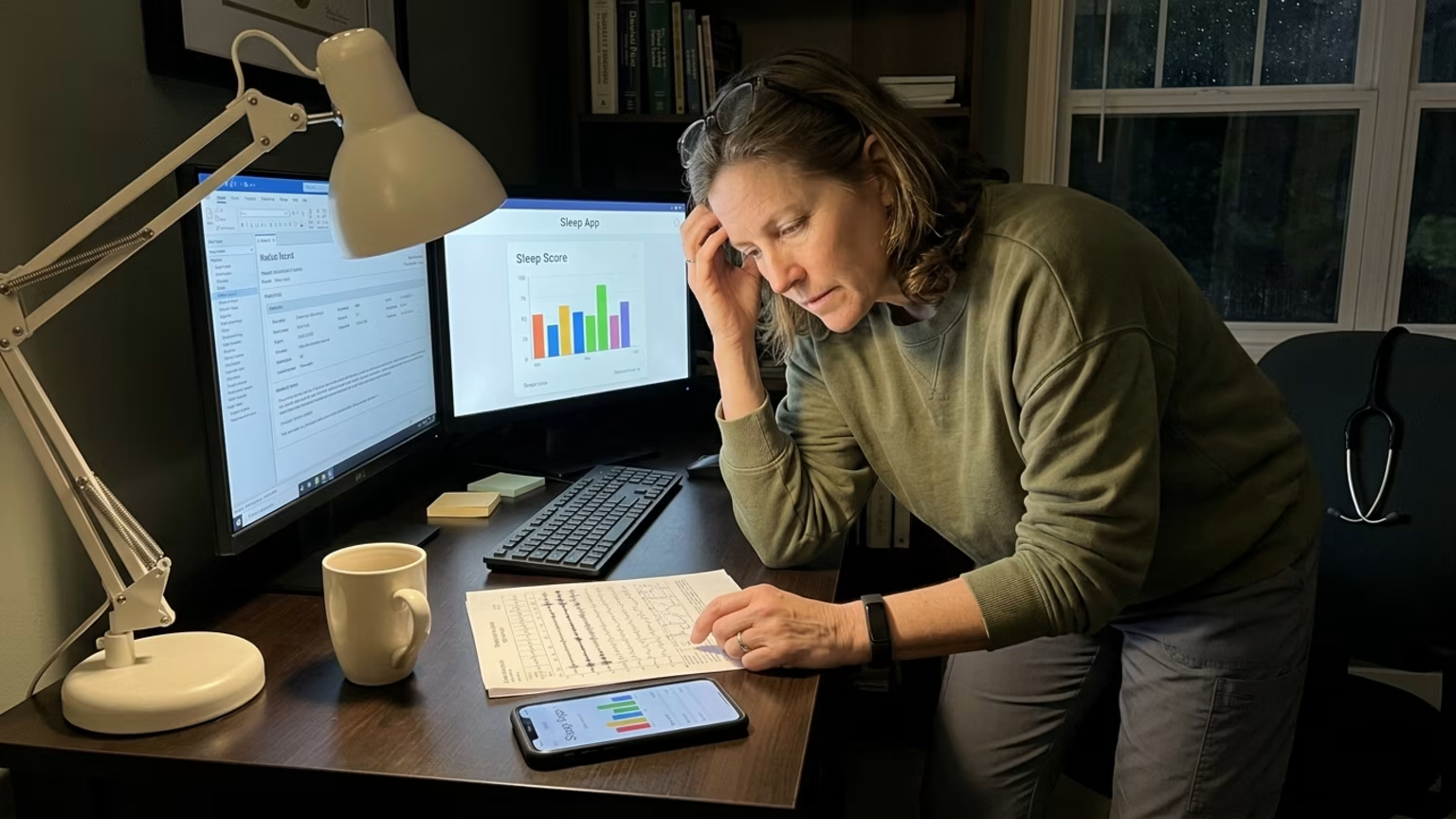

Cleveland Clinic doctors warn that consumer sleep trackers can miss clinical disorders. Learn why veterans should seek formal testing for sleep apnea.





On September 4, 2026, a WALA/Fox10 report from Mobile, Alabama, stated that Cleveland Clinic clinicians warned against treating consumer sleep trackers as definitive health tools. The clinicians explained that while these consumer wearables can successfully raise awareness of daily sleep habits, they should not be viewed as accurate measurements of sleep quality or specific sleep stages. The public reporting highlighted a growing medical concern regarding digital health tools. Medical professionals are increasingly observing patients who place too much trust in unvalidated algorithms, which can delay necessary clinical testing for genuine physical disorders.
For active duty personnel and veterans, understanding the limits of consumer technology is necessary for maintaining long term capability. The Military Health System identifies sleep as a core part of its warfighter performance and readiness resources. This classification makes sleep health directly relevant to operational readiness and general physical maintenance. Relying entirely on a smartwatch to validate recovery can lead to poor health decisions if the device provides a falsely reassuring score.
Military personnel often push through fatigue as part of their job requirements. This operational reality makes accurate health data incredibly important for long term physical restoration. When a wearable app incorrectly logs deep sleep, a service member might assume their fatigue is just normal soreness. They might continue training heavily instead of seeking necessary medical attention for a hidden sleep disorder.
Most consumer sleep trackers use an accelerometer or other basic motion sensor to estimate whether a person is asleep or awake. Movement alone is not a reliable substitute for the brain activity and vital sign measurements used in clinical sleep testing. Cleveland Clinic clinicians warn that quiet wakefulness can closely resemble sleep to a simple motion sensor. This means a person might lie awake in bed for hours, and the tracker will falsely record that time as light sleep.
A review of digital sleep biomarkers indicates that trackers generally perform better at estimating total sleep time in healthy sleepers. However, they are far less accurate at detecting wakefulness during the night or classifying specific sleep stages. The same review notes that accuracy can decline significantly among older adults and people with disturbed sleep. These are the exact groups where clinical evaluation and precise data are especially important for long term health.
When service members base their physical recovery plans on inaccurate metrics, they risk overlooking serious medical conditions. You can read more in our military health articles to understand how proper rest impacts operational performance. A poor score on an app is not automatic proof of a disorder. Similarly, a good score does not guarantee healthy sleep.
Stress and shift work can easily alter a sleep metric. Factors like alcohol consumption and minor illnesses also distort the data. Furthermore, travel and environmental disruptions can cause sensor errors that ruin the accuracy of a nightly score. Fox10 emphasized that apps can simply be wrong, and users should never let digital scores override their actual physical symptoms.
The differences between consumer screening and clinical diagnostics become clear when looking at specific statistical outcomes. A recent smartwatch study evaluated the detection of moderate to severe or high risk obstructive sleep apnea. At one estimated apnea hypopnea index threshold, the study reported a sensitivity of 94.1 percent and a specificity of 66.7 percent. When researchers applied a cohort optimized threshold, the sensitivity dropped to 82.4 percent, while specificity increased to 94.9 percent.
Veterans face a documented increase in sleep related breathing disorders compared to the civilian population. A U.S. Department of Veterans Affairs research report based on a survey of nearly 20,000 people highlighted this disparity. The survey found sleep apnea in 21 percent of Veterans, compared with just 9 percent of non Veterans. Furthermore, the data showed that Veterans were diagnosed five years earlier on average than their civilian counterparts.
The way researchers define sleep disorders also impacts the accuracy numbers reported in scientific literature. Published sensitivity and specificity figures are entirely study specific. These numbers depend heavily on the specific device used and the demographic population of the study group. They also rely on the exact medical definition of the disease being tested.
The technical capabilities of consumer trackers vary wildly across the commercial market. Devices differ widely in their built in sensors and algorithms. They also use different software versions and validation studies. This means accuracy claims for one model should not automatically apply to another device.
A University College Dublin researcher described consumer watches as moderately good for measuring total sleep time, but cautioned that this does not necessarily make the data clinically useful. Sleep stage labels such as deep or REM are algorithmic estimates in most consumer products rather than direct measurements of brain waves.
The technology landscape surrounding wearable devices and mobile applications continues to shift rapidly alongside consumer entertainment. For instance, the same Fox10 report described recent social media updates from TikTok. The platform recently rolled out voice comments of up to 60 seconds, comment polls with up to five choices, and photo carousels of up to nine images. These consumer software updates are presented alongside clinical discussions about mobile hardware, highlighting how health tools often share the same digital environment as entertainment features.
These technical limitations are shifting how medical professionals advise patients to use wearable data. The American Academy of Sleep Medicine states that consumer generated sleep data may support a patient clinician discussion. However, the organization maintains that this data should not replace validated diagnostic instruments. Regulatory authorization for a specific screening feature also does not apply to every metric on a device. FDA records identify Samsung's Sleep Apnea Feature as a specific De Novo authorized product, while standard consumer sleep stage scores remain a separate category of measurement.
VA guidance clearly lists excessive daytime sleepiness and loud snoring as primary warning signs. Other symptoms of sleep apnea include irregular breathing and nighttime gasping or choking. If you experience these symptoms, a reassuring tracker score should never override your physical reality. You can browse our Veteran lifestyle and healthcare Resources for more context on navigating military health systems.
The distinction between screening and diagnosis is important for service members. A positive alert may justify follow up care, while a normal score cannot reliably exclude a disorder. First, users should treat the score as a prompt rather than a medical verdict. Trackers can help identify recurring changes in your schedule, but they cannot rule out a sleep disorder.
Second, always prioritize physical symptoms and daytime performance over digital feedback. Persistent daytime sleepiness and poor concentration deserve immediate clinical attention. Third, bring multi night trends to a clinician instead of single night data points. A several week record of sleep timing and awakenings can help structure a medical conversation.
The broader evidence supports using wearable data longitudinally to notice changes in sleep timing. You should not treat isolated scores as precise measurements. Fourth, never self clear for duty or training based on an app. A normal consumer score is not a medical clearance and should never be used to ignore fatigue.
Read our recovery and sleep articles for more information on managing physical readiness. Finally, treat any alert from a device as follow up information. A device's ability to screen for a breathing abnormality does not mean it can diagnose obstructive sleep apnea. The Fox10 report recommends a formal sleep study when an accurate assessment is needed.
Formal sleep studies measure actual brain activity and other vital signs to properly evaluate conditions like insomnia. VA sleep medicine services are equipped to diagnose conditions like insomnia and narcolepsy, and they also treat restless legs syndrome and sleep apnea. Fox10’s quoted guidance advises users to avoid becoming overly focused on nightly scores, and individuals should instead consider daytime functioning while discussing persistent problems with a doctor.
Sleep tracking technology is moving beyond simple movement estimates toward features that use additional signals to identify possible breathing disturbances. As wearable sensors become more integrated into daily life, patients will have access to massive amounts of unstructured health data. How will military and veteran healthcare systems adapt their diagnostic protocols to manage this influx of consumer sleep data while ensuring those with clinical disorders receive timely, validated testing?
Follow BattleVet for practical guidance on military and veteran health, strength, recovery, testosterone, sleep and healthy aging. Stay connected for new articles, research backed insights and clear information to help you stay capable for the years ahead.


An Air Force veteran’s Apple Watch alert prompted medical evaluation. Learn what the reported case means for sleep testing and clinical care.


The Fort McClellan veterans health study is planning its analysis. Learn who is covered, how the research will work, and what it means for care.
A Cureus review links preoperative TRT with selected knee replacement complications. Learn what the findings mean for veterans' surgical discussions.
Build better habits around strength, recovery, sleep, hormones and healthy aging with practical guidance for active military personnel and veterans.
Explore BattleVet