

The RAF’s first functional fitness championships highlight a broader shift toward task-specific military training, emphasising capability and injury prevention.





On September 4, 2026, Forces News reported on the first functional fitness championships held by the Royal Air Force. The competition took place at RAF Cosford. It brought together approximately 30 male and female athletes competing for the title of the fittest athlete in the RAF. The event was updated in reporting on September 7, 2026, and highlighted a shift in physical training priorities.
Competitors faced five distinct events during the championship. These stages covered endurance, strength, metabolic conditioning, movement skill and sprint capacity. The organisers deliberately withheld the exact workouts until athletes reached the competition floor. This decision added an element of mental pressure and required adaptability to the physical challenge.
The opening event was called Cardio and Military Resilience. It required competitors to run 800 metres while carrying wooden rifles. Athletes then completed 30 metres of overhead walking lunges and dragged a 50-kilogram casualty dummy for 15 metres. The sequence finished with 25 burpees over the dummy before competitors repeated the entire circuit in reverse.
This championship reflects a broader shift toward combining strength, conditioning and task-specific challenges in military environments. Traditional runs and standard gym routines remain common, but fitness programmes are increasingly testing practical capability. Squadron Leader Abi Bagshaw organised the RAF event and serves as the chair of the RAF’s Functional Fitness Association. She is actively campaigning for functional fitness to become a recognised military sport.
Bagshaw hopes to eventually expand this recognition across all three services. She argued that formal recognition could allow functional fitness to receive support comparable to established service sports like football. Bagshaw stated that functional training is highly applicable to life in the military. She associated higher fitness with coping more easily with late nights, early mornings, long operational days and testing situations.
Bagshaw suggested that the organisers view functional fitness as an inclusive environment for all personnel. The events are designed for both experienced CrossFit participants and relative newcomers to the sport. The ultimate goal is for athletes to identify their personal strengths, weaknesses and future training priorities. This structured feedback loop helps personnel refine their physical preparation over time.
Functional fitness incorporates strength, mobility, balance and coordination to support everyday physical activity. Corporal Moulam-Jones is a physical training instructor at RAF Cosford. He linked fundamental patterns like lunging, squatting, hinging and pulling directly to everyday physical tasks. He suggested that functional fitness can help with injuries and longevity within reasonable limits.
A related Forces News report detailed a similar approach within the British Army. The British Army Warrior Fitness programme tests strength, stamina and aerobic capacity through functional movements. This includes weightlifting, gymnastics and cardiovascular exercise. Warrant Officer Class 2 Aaron Hatt described this strength and conditioning work as a connection from the gym floor to the battlespace, a concept we examine when discussing military strength and conditioning strategies.
The observations from Army personnel using Warrior Fitness highlight a focus on strengthening joints and major muscle groups. Practitioners noted this focus was a response to lower-back injuries, knee problems and rolled ankles. These observations represent practitioner commentary rather than a controlled medical evaluation. Anecdotal reports of fewer injuries should not be generalised to all military personnel without independent scientific backing.
The emphasis on injury prevention is highly relevant to current military readiness data. Ministry of Defence data cited by Forces News showed that approximately 10% of serving personnel were not medically deployable in 2025. Nearly half of that non-deployable group experienced some form of injury. This figure places the non-deployable serving population at roughly one in ten personnel.
Specific injuries sustained early in a military career can have lasting consequences. A 2026 prospective cohort study of infantry trainees examined the long-term impact of ankle sprains. Researchers found that an ankle sprain early in training was associated with persistent functional deficits. These functional deficits remained relevant to operational readiness over a period of 5.5 months.
This data supports the importance of targeted injury prevention and proper rehabilitation for service members, reinforcing the need for evidence-based health guidance. Military readiness assessment is also moving toward more objective physical performance measures. A 2026 paper published in Frontiers in Sports and Active Living reviewed potential assessment tools for military personnel.
The researchers recommended multi-joint isometric testing, countermovement jumps and drop jumps as effective force-plate measures. They suggested these specific tests could complement physical readiness assessment before arduous military selection courses. Moving beyond basic fitness tests allows evaluators to better understand a candidate's actual physical capability.
The RAF championship format provides a useful template for assessing multiple physical qualities. Service members can evaluate their own strength, aerobic capacity, movement skill and agility rather than tracking only a single run. The RAF strength event clearly demonstrated the importance of pacing and intelligent load selection. It consisted of the bench press, strict press, back squat and deadlift.
Competitors worked on two-minute timers and received one minute of rest between each exercise. They selected their own weights, forcing them to balance load, repetitions and scoring strategy. Corporal Abbott noted that using lighter weights could remove some ego from the challenge. He pointed out that lighter weights still produced rapid fatigue during sustained repetitions.
The metabolic conditioning event used an AMRAP format, where athletes completed as many repetitions as possible. The skill event then assessed different pull-up variations to test movement competency. Athletes received one point for a jumping pull-up and up to four points for a difficult chest-to-bar variation. The final sprint finish combined SkiErg and rowing-machine bursts with box jumps, shuttle runs and a gymnasium sprint.
While the RAF event featured military equipment, functional fitness remains a broad label rather than a single validated training method. The use of rifles and casualty dummies makes the event visibly relevant to military operations. However, a strong resemblance to operational tasks is not the same as definitive proof of operational transfer. The event remains a sport-format assessment rather than a complete model of battlefield readiness.
The public report on the championship does not state whether the events were validated against specific RAF job roles. It also does not establish how competition scores correspond to occupational standards or actual deployment outcomes. Furthermore, the report did not publish an overall scoring table, winner identities or event-by-event rankings. Claims about the absolute fittest athlete cannot be presented with unsupported numerical precision.
Integrating these task-relevant patterns requires careful progression and adequate recovery. Military-style circuits involving loaded movement, drags and sprints can create substantial fatigue. Higher fitness is not automatically safer without considering training load, technique, previous injury and medical limitations. Personnel should build movement quality before increasing their training intensity.
RAF reservist medical officer Squadron Leader Sophie Foxen offered clear advice regarding exercise programming. She cautioned service personnel to distinguish credible exercise advice from unsupported social media content. Foxen recommended following qualified sources that provide proper references. Veterans should seek qualified medical or strength-and-conditioning guidance after an injury.
Veterans can preserve the principle of training for capability without copying extreme workouts. A combat-themed workout is not automatically appropriate or necessary for long-term health and performance. The safest approach involves a balanced programme combining strength, conditioning, mobility and injury management. This mindset supports durable readiness for both active duty and civilian life, providing a reliable foundation for long-term physical capability after service.
As military fitness programmes increasingly incorporate task-specific movements and force-plate testing, the definition of physical readiness is expanding. How will these evolving standards shape the future of injury rehabilitation and long-term health monitoring for service members transitioning into civilian life?
Follow BattleVet for practical guidance on military and veteran health, strength, recovery, testosterone, sleep and healthy aging. Stay connected for new articles, research backed insights and clear information to help you stay capable for the years ahead.


The Fort McClellan veterans health study is planning its analysis. Learn who is covered, how the research will work, and what it means for care.

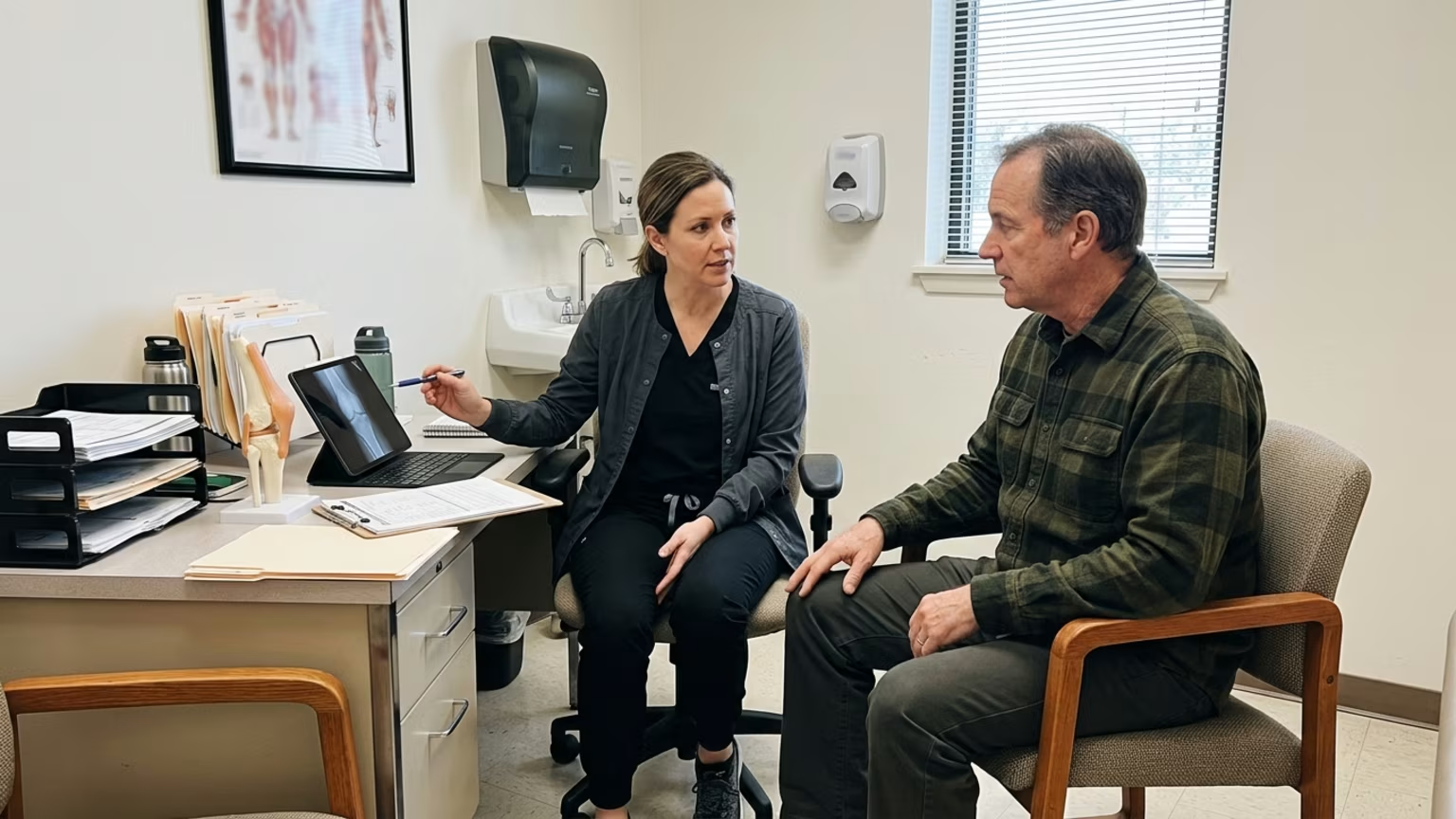
A Cureus review links preoperative TRT with selected knee replacement complications. Learn what the findings mean for veterans' surgical discussions.

VA research raises questions about suicide-screening answer accuracy and supports clearer conversations, trust, and broader clinical assessment.
Build better habits around strength, recovery, sleep, hormones and healthy aging with practical guidance for active military personnel and veterans.
Explore BattleVet