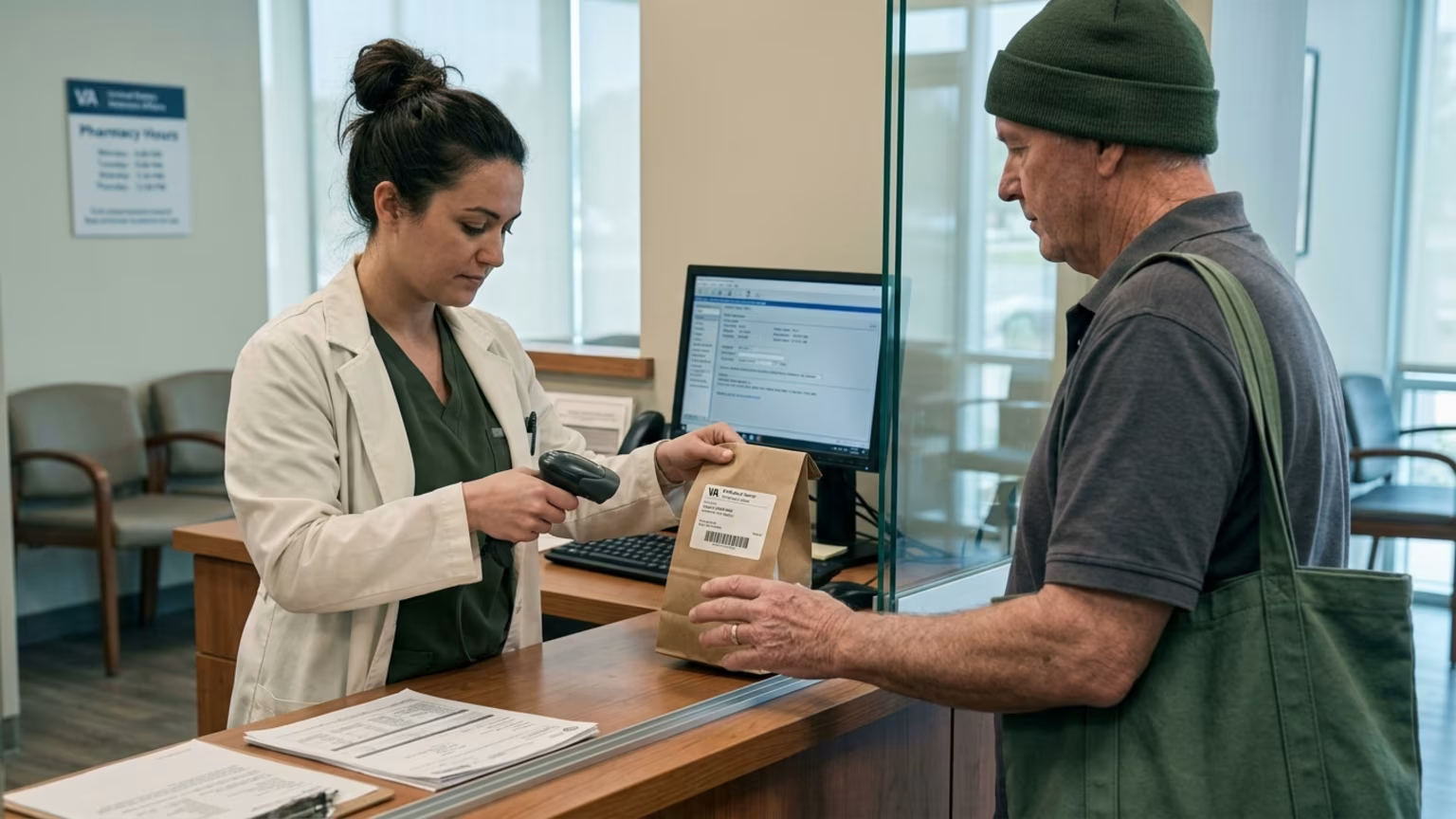

A new policy analysis outlines how the Department of Defense and VA could reduce their reliance on Chinese pharmaceutical ingredients to secure medication access.





The Information Technology and Innovation Foundation published a detailed policy analysis on August 31, 2026. The report was written by Sandra Barbosu and Stephen Ezell. It outlines how United States agencies could reduce their reliance on Chinese active pharmaceutical ingredients. The proposed strategy highlights the Department of Defense and the Department of Veterans Affairs as key organizations that could use their procurement budgets to support domestically produced drugs.
To understand the current medication supply chain, we must separate a finished drug from its foundational components. An active pharmaceutical ingredient is the chemically active component that produces the therapeutic effect of a medicine. A key starting material is a component used even earlier in the manufacturing process. The new analysis argues that dependence on foreign inputs creates significant national security and drug supply risks.
I remember waking up after a poor night of sleep and realizing that my training recovery was taking much longer than it used to. That experience taught our team that physical readiness requires addressing the foundational systems that keep us capable. In much the same way, the military health system relies on foundational supply chains that must remain secure. If a primary ingredient is unavailable, the finished medication cannot reach the active personnel or veterans who need it.
The report cites data compiled by the U.S. Pharmacopeia from FDA active API Drug Master Files. China accounted for 45 percent of active API filings in 2024. India accounted for 43 percent, Europe for 6 percent, and the United States for 3 percent. These figures demonstrate a heavy reliance on overseas production for finished active ingredients.
The concentration is notably severe early in the manufacturing process. The analysis says China was the sole producer of nearly 41 percent of the key starting materials used in U.S. approved active pharmaceutical ingredients. The report identifies an especially high concentration in upstream materials for several common drug categories. For example, China supplies 94 percent of amoxicillin raw materials, 74 percent of heparin inputs, and 70 percent of acetaminophen inputs.
Other critical drug categories show similar patterns of supply chain concentration. Chinese sourced materials were used in 100 percent of active ingredients for angiotensin II receptor blockers. They were also used in 94 percent of active ingredients for non insulin blood glucose lowering drugs. The data shows they appeared in 83 percent of direct acting antivirals, 71 percent of antineoplastics, and 66 percent of antibacterials.
For selected products in 2024, China supplied 90 percent of U.S. ibuprofen imports and 82 percent of tetracycline imports. The country also supplied 74 percent of vitamin C imports and 72 percent of acetaminophen imports. A separate Senate announcement stated that experts estimate nearly 700 essential medicines depend on at least one active ingredient produced solely in China.
Moving production away from these sources involves substantial financial challenges. The report says manufacturing costs are approximately 30 to 35 percent lower in India than in the United States. Costs in China are estimated to be 35 to 40 percent lower than domestic production. The authors note that some Chinese producers have reduced prices for key starting materials by 40 to 50 percent.
This aggressive price reduction can easily squeeze competing producers out of the market. Relying on allied nations like India does not completely resolve the underlying risk. The analysis estimates that roughly 87 percent of India's imported antibiotic ingredients by value originate in China. This illustrates that shifting final stage production does not always eliminate the original supply vulnerability.
The report points to the Strategic Active Pharmaceutical Ingredients Reserve as a potential solution. This model would combine domestic production capacity, distributed storage, and centralized inventory management. The analysis highlights earlier federal support of up to $800 million for related efforts led by the Department of Health and Human Services.
The analysis also discusses advanced production methods to close the cost gap. It describes prototype results from the CONTINUUS continuous manufacturing platform, which involves the company Phlow. The prototype demonstrated 30 to 50 percent lower costs, more than 60 percent lower solvent use, and 50 to 60 percent lower energy costs. It also achieved a 90 percent smaller facility footprint and shortened lead times from months to less than 48 hours.
The authors also suggest using allied and nearshore production in countries like South Korea and Mexico. Puerto Rico is presented as a domestic manufacturing location because it operates within U.S. jurisdiction. The territory generated $48.3 billion in pharmaceutical exports in 2024. Its pharmaceutical industry accounted for 30 percent of the territory's gross state product and included 60 facilities employing 13,917 people.
However, the report notes that Puerto Rico's potential is limited by exposure to natural disasters. It is unlikely to replace Chinese production at full scale. A geographically diverse approach is necessary to prevent creating a different kind of concentration risk.
The report recommends stronger FDA oversight of foreign facilities to improve supply chain visibility. This includes unannounced inspections and a rule barring imports from facilities that have not passed an inspection within the previous three years. Foreign inspections have historically been constrained by staffing, visa requirements, and advance scheduling.
The central legislative recommendation in the analysis is the proposed Pharmaceutical Supply Chain Defense and Enhancement Act. This proposal would provide $1 billion annually for five years to the Biomedical Advanced Research and Development Authority. The funding would aim to improve domestic capacity to manufacture critical drugs and starting materials. It would also provide an additional $1 billion above existing procurement budgets for covered federal agencies.
These agencies include the Department of Defense, the Department of Veterans Affairs, and the Bureau of Prisons. The funds would be used to purchase American made drugs whose ingredients are produced exclusively in the United States. The bill would require the FDA and the Secretary of Defense to create a confidential list of drugs critical to public health. It would also require drugmakers to report the sources of active ingredients used in medicines consumed domestically.
The proposed legislation would enforce stricter reporting requirements for drug manufacturers supplying the government. Companies supplying federal agencies would have to identify foreign manufacturers involved in producing the drugs and their components. The proposal directs the FDA to issue public and classified reports to Congress on pharmaceutical supply chain strength. It also requires the Federal Trade Commission and the Treasury Department to study foreign investment in the pharmaceutical industry within one year of enactment.
For active duty personnel and veterans, this represents a strategy for future resilience rather than an immediate change to current prescriptions. The proposed act is a policy proposal, and it does not guarantee that the VA will instantly change its formulary. A domestic preference rule could improve supply security, but it could also raise acquisition costs if U.S. made drugs remain more expensive.
Veterans should understand the difference between an ingredient supply problem and a finished drug shortage. Dependence on an upstream ingredient can create risk even when the final tablet or injectable medicine is manufactured elsewhere. If you experience a medication substitution or delayed refill, ask your VA pharmacy team for specific details.
Your care team can clarify whether the issue involves a temporary inventory disruption, a manufacturer change, or a formulary decision. Veterans relying on veteran lifestyle and healthcare resources should base their treatment plans on direct communication with their providers. The policy analysis does not establish that any particular current shortage is caused by international dependencies.
The VA National Acquisition Center manages Federal Supply Schedule programs covering pharmaceuticals and other medical products. The VA also uses strategically sourced contracts within its Medical/Surgical Prime Vendor program. These existing systems feature centralized supply chain management, bulk purchasing, and mandatory contract vehicles. This infrastructure could help implement future domestic content preferences if the legislation passes.
Government Contracts Navigator reported that a recent Court of Federal Claims decision affirmed the importance of ingredient origins. The court upheld the VA conclusion that the country where an active ingredient is synthesized can determine a drug's country of origin. This legal precedent supports the idea that federal purchasing rules can enforce stricter supply chain requirements.
As federal agencies evaluate their purchasing power, the conversation around secure medical care will continue to evolve. The Department of Defense and the VA purchase medicines at a massive federal scale. Their contracts could create predictable demand for resilient suppliers, which might encourage greater domestic manufacturing investments.
A broader shift toward domestic production will require careful evaluation of costs, supplier competition, and product availability. How will military and veteran health systems balance the financial challenges of domestic manufacturing against the critical need for uninterrupted access to essential medications in the years to come?
Follow BattleVet for practical guidance on military and veteran health, strength, recovery, testosterone, sleep and healthy aging. Stay connected for new articles, research backed insights and clear information to help you stay capable for the years ahead.



A 2026 review shows structured aerobic exercise is linked to longer survival for cancer patients. Learn how VA rehabilitation integrates these clinical findings.


The Army deployed a sleep director to the Himalayas in 2026 to manage jet lag and altitude. Here is how formal sleep protocols support veteran recovery.

The VA is launching its new Electronic Health Record system in Anchorage amid congressional scrutiny over costs. Learn what this means for veteran care.
Build better habits around strength, recovery, sleep, hormones and healthy aging with practical guidance for active military personnel and veterans.
Explore BattleVet