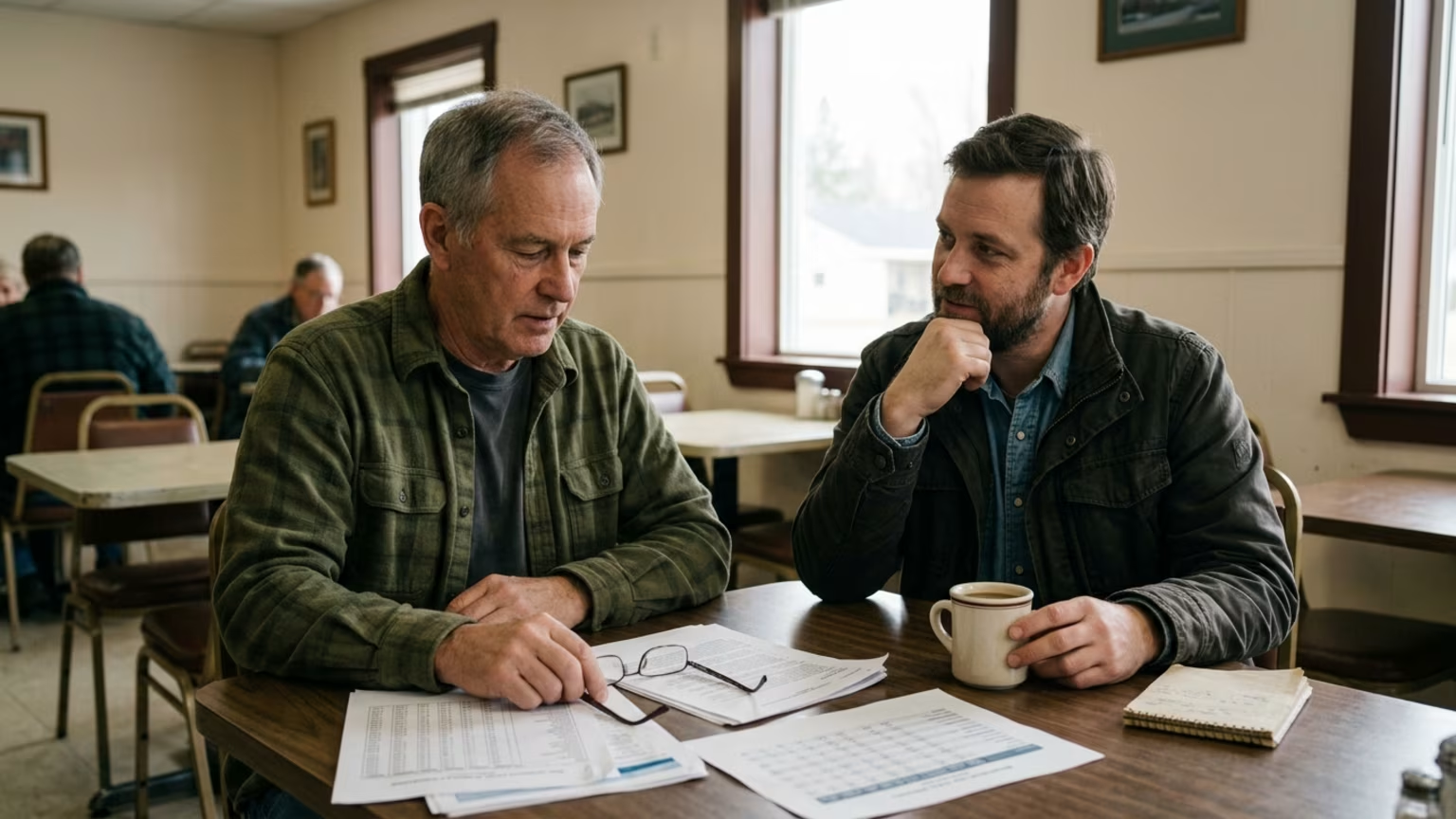

A Lancet meta-analysis shows leisure exercise lowers dementia risk while occupational exertion may raise it. Learn to structure off-duty physical activity.





A logistics chief finishes a twelve-hour shift of loading pallets and walking the warehouse floor. They log miles on their feet by the end of the long workday. The physical exhaustion feels identical to a heavy workout in the gym. The vital question is whether that daily labor protects their brain health the same way dedicated exercise would.
A systematic review and meta-analysis published in The Lancet Public Health examined physical activity and dementia risk. The researchers wanted to know if this relationship varies based on where the activity occurs. They identified 6,270 records in their updated search for relevant scientific literature. The team then added eligible studies from an earlier review to complete their robust data set.
The final analysis included 74 cohort or case-control studies involving 4,227,297 participants. The group was 52.8% female and 47.2% male with a median age of 67.3 years. Participants were adults aged at least 20 years who had cognitive function assessed at baseline. They also needed a validated measure of physical activity and at least one year of follow-up.
The median follow-up was 10.0 years with an interquartile range of 5.1 to 21.3 years. Higher overall physical activity was associated with a lower risk of all-cause dementia. The researchers found 146 effect sizes producing a relative risk of 0.80. This result included a 95% confidence interval of 0.75 to 0.86.
The analysis also found associations with lower risks of Alzheimer's disease and vascular dementia. The relative risk was 0.79 for Alzheimer's disease among participants with higher overall activity. The relative risk was 0.71 for vascular dementia in that same higher activity group. Leisure-time physical activity showed the clearest favorable domain-specific association in the comprehensive research.
High leisure-time activity was associated with a relative risk of 0.76 for all-cause dementia. This specific metric included a 95% confidence interval of 0.65 to 0.88. Household physical activity was also associated with lower all-cause dementia risk. This category showed a relative risk of 0.85 and a 95% confidence interval of 0.74 to 0.98.
The household estimate came from only one study. Readers should interpret the household finding with appropriate caution compared to the leisure data. Service members often seek clear protocols for their physical training routines. The healthy aging resources at BattleVet emphasize building sustainable movement habits that last a lifetime.
The pattern reversed for occupational physical activity in the published analysis. High occupational activity was associated with a relative risk of 1.20 for all-cause dementia. This calculation included a 95% confidence interval of 1.01 to 1.42. The finding suggests an approximate 20% higher relative risk compared to lower activity groups.
Commuting-related physical activity was also associated with a higher dementia risk. That specific category showed a relative risk of 1.10 and a 95% confidence interval of 1.03 to 1.18. The commuting analysis only included two studies and had no observed statistical heterogeneity. Its extremely small evidence base still limits confidence in drawing broad public health conclusions.
This data should not be interpreted as evidence that physically demanding work directly causes dementia. The meta-analysis was observational in design because it combined cohort and case-control studies. It did not rely on randomized trials to establish direct biological causation. The authors rated the certainty of evidence from very low to low across all activity domains.
Statistical heterogeneity was substantial for several major estimates in the published report. The all-cause dementia analysis had an I² of 97.4% and the leisure-time analysis had an I² of 96.6%. The occupational analysis showed an I² of 85.6%. The overall sample was largely drawn from high-income countries rather than a global distribution.
Specifically, 69 of 74 studies were conducted in high-income countries. This geographic distribution represents 93% of the total research pool analyzed by the team. The published article is listed in volume 11 of The Lancet Public Health on pages e650 to e664. The study officially carries the DOI 10.1016/S2468-2667(26)00142-8.
The researchers reported nonlinear dose-response associations for both leisure-time and occupational physical activity. The relationship was not adequately described as a simple progressive pattern across all activity domains. More physical activity is not universally better in every single occupational context. You can read our military health articles to better understand these nuanced general population findings.
The primary source concluded that physical activity associations might be domain-specific. The authors called for public-health strategies involving safe exercise spaces and adequate leisure time. They also recommended mitigation strategies in highly demanding occupational settings. These practical suggestions apply directly to the veteran transition and lifestyle planning process.
Service members must separate occupational fitness from dedicated health-promoting exercise. A day involving field work or prolonged standing may satisfy a strict military job requirement. It does not provide the same benefits as chosen, varied, and appropriately dosed leisure activity. The Department of Defense Total Force Fitness framework explicitly includes brain health alongside physical fitness.
A VA Million Veteran Program analysis surveyed more than 7,000 veterans screened for traumatic brain injury. That analysis found higher physical activity was associated with better overall health outcomes. The positive relationship was more pronounced among veterans with a traumatic brain injury. However, veterans should never use the Lancet study to dismiss their own cognitive symptoms.
Persistent memory problems or changes in executive function always warrant professional medical evaluation. Veterans with injuries or reduced mobility should begin with an adaptable and safe exercise plan. VA guidance advises people to start with short bouts of activity when necessary. They specifically recommend beginning with three to five minutes and building duration gradually.
VA also advises veterans to consult a health-care provider before beginning a new exercise program. One VA telerehabilitation study announced in August 2026 planned to recruit 126 veterans. These participants were aged at least 60 and had existing physical-therapy needs. The specific program intended to improve strength, mobility, social engagement, and sustained physical function.
Our training and performance articles outline how to progress safely after a period of physical restriction. Walking serves as a highly practical entry point for older veterans rebuilding their fitness. VA programs include supervised walking designed to support safe ambulation and recovery. They also prioritize patient education about daily movement and joint health.
Physically demanding service builds immediate operational capability for the military mission. It should not be treated as a complete long-term brain health strategy for the future. Occupational exertion often lacks adequate recovery, varied movement patterns, and individual pace control. Off-duty exercise allows you to control the intensity and prioritize your crucial rest periods.
The Lancet meta-analysis reinforces the value of intentional movement outside of strict work hours. High leisure-time physical activity clearly showed a favorable association with reduced dementia risk. The study successfully registered with PROSPERO under CRD420251010899. It reported official funding from the U.S. National Institutes of Health and Brazilian research agencies.
You can build a sustainable off-duty movement habit around enjoyable and accessible activities. Walking, cycling, and structured gym sessions all count toward this valuable health goal. Keep your unavoidable occupational demands separate from your dedicated physical conditioning schedule. Proper daily recovery remains an essential part of veteran lifestyle and healthcare.
BattleVet provides research backed guidance on complex military and veteran health topics. We focus on connecting immediate physical performance with long term biological capability. Read our About BattleVet page to learn more about our rigorous editorial standards. Stay capable, stay informed, and always prioritize your off-duty physical recovery.
Follow BattleVet for practical guidance on military and veteran health, strength, recovery, testosterone, sleep and healthy aging. Stay connected for new articles, research backed insights and clear information to help you stay capable for the years ahead.


JAMA estimates low testosterone readings in active-duty Army men. See the threshold data, study limits, and implications for clinical follow-up.

The Army’s HVAC task force targets hot barracks. Here is what its project figures mean and how to assess future housing and sleep-related claims.

The BRIDGE Act proposes a whole-family military transition pilot. Read who it would serve, what support it includes, and what remains unresolved.
Build better habits around strength, recovery, sleep, hormones and healthy aging with practical guidance for active military personnel and veterans.
Explore BattleVet