

The Army is addressing national youth fitness declines through the Future Soldier Preparatory Course and updated physical standards. Learn what the data means.





A young applicant stands quietly in a recruiting office holding a folder of test results. The recruiter looks over the paperwork and explains that the physical numbers fall just short of the minimum requirement. Instead of turning the applicant away permanently, the recruiter offers a different path forward.
The United States Army is actively addressing national declines in youth physical readiness by catching recruits before they fail. According to ABC News reporting, approximately one quarter of new enlistees now pass through the Future Soldier Preparatory Course. This program provides structured support for applicants who narrowly miss academic or body composition standards. The initiative represents a major shift from treating physical readiness as an individual assumption to viewing it as a measurable developmental process.
ABC News reports that the Pentagon estimates approximately 75 percent of Americans ages 17 to 24 are ineligible for military service. Obesity and a failure to meet academic standards rank among the leading reasons for this shortfall. In response, the Army created the Future Soldier Preparatory Course at Fort Jackson, South Carolina. The program provides pre basic training support for applicants who fall short of academic or body composition requirements.
This preparatory program launched in 2022 to give motivated recruits a clear path to basic training. Military.com reports that the Army expanded the program in 2023 to let recruits take both academic and fitness tracks. However, the Army narrowed the focus in 2025 so applicants could participate in only one track. This targeted preparation has turned an exclusion point into an accession tool.
The physical track combines structured fitness training with nutrition instruction and healthy habit coaching. Military.com notes that as of February 2024, applicants could enter with body fat measurements up to 6 percentage points above the standard. These participants then had to reach no more than 2 percentage points above the standard after participation. This focused timeline proves that targeted coaching yields rapid improvements for motivated individuals.
The reported graduation rates suggest this structured intervention is highly effective. Military.com cites a January 2025 Congressional Research Service report showing the program had produced approximately 32,000 graduates. That same report notes a 94.8 percent graduation rate for the fitness track and a 92.2 percent rate for the academic track. ABC News adds that more than 90 percent of recruits entering the program ultimately qualify for the Army.
The Future Soldier Preparatory Course represents a fundamental shift in how the military handles entry standards. Instead of expecting every applicant to arrive in peak physical condition, the organization now operates an integrated health pipeline. This pipeline leverages modern sports science to safely prepare individuals for intense physical demands. The strategy acknowledges that public health trends have shifted over the last decade.
The readiness pipeline does not start at the recruiting station. The Army's Holistic Health and Fitness leadership says readiness should be cultivated well before a young person enters the service. Dr. Kevin Bigelman, the deputy director, described this approach as planting the seeds of military readiness before a person raises their right hand. The renewed national effort includes the reestablishment of the Presidential Fitness Test under an executive order issued in July 2025.
This updated test uses age appropriate standards covering strength, endurance, speed and agility. The Department of Health and Human Services said schools would begin administering the updated test during the 2026 to 2027 school year. HHS separately described the restoration as an effort to encourage physical activity, fitness and healthy habits among American children. For military families, the initiative may have particular relevance because physical education policy can affect children growing up near installations.
The gap between civilian health metrics and military requirements continues to drive policy decisions. The Pentagon estimates highlight that a vast majority of the young adult population lacks the physical foundation for immediate service. This demographic reality forces training commands to rebuild strength and endurance from the ground up. Addressing these gaps early ensures that recruits do not suffer preventable injuries during their initial training phases.
Once an individual reaches active service, physical assessments shift to strict operational benchmarks. The current Army Fitness Test described by Men's Fitness contains five distinct physical events. Soldiers must complete a three repetition maximum deadlift and hand release push ups. The assessment also includes the sprint drag carry alongside a timed plank. Finally, the test concludes with a two mile run to measure aerobic capacity.
Each event requires specialized preparation and consistent training across various physical domains. A participant must score at least 60 points in every event to pass under the standards described by Men's Fitness. The publication reports a general passing benchmark of 300 total points. Meanwhile, close combat specialties require a sex neutral score of 350 for active duty soldiers beginning Jan. 1 2026.
Passing a military assessment requires more than just running daily laps around a track. A 2026 review in Military Medicine found that lower total and visceral adiposity were generally associated with better strength, cardiorespiratory endurance, power and task specific operational outcomes. The same review noted that greater lean mass was generally associated with better strength and military performance outcomes. Tracking body composition is highly useful for individuals seeking to improve training and performance.
Injuries are another major factor that service members must actively manage through smart programming. A study of Army active duty service members reported 138,649 incident fractures among 1,289,953 personnel who served between 2011 and 2021. That volume corresponds to a 10.8 percent fracture rate over the observation period. Rushing into high volume training without adequate preparation clearly carries significant physical risks for any demographic.
Physical restoration is just as critical as the heavy daily workouts you complete in the gym. I remember waking up after a poor night of sleep and realizing that my training recovery was taking much longer than it used to. I realized that readiness is more than just pushing through the fatigue. It requires a dedicated approach to sleep and hormonal health, which completely shifted how I view long term capability.
This holistic view aligns closely with current military health initiatives across the force. The Army describes Soldier Performance Readiness Centers as the physical heart of its holistic health system. Proper nutrition, deliberate recovery and sleep, and consistent movement all build a resilient foundation. You can directly control how well you feed and rest your body every single day.
The military clearly recognizes that physical capability requires structured time to build properly. If approximately one quarter of new enlistees need preparatory conditioning before basic training, then foundational fitness is a widespread challenge. Even seasoned veterans should apply this lesson by using progressive loading to maintain their operational strength. You do not have to be an elite athlete to build a highly capable and durable body.
Relying on old habits will not sustain your performance as you transition into civilian life. The combination of early physical education, prep courses and strict active duty standards shows a continuous need for physical adaptation. Small daily choices in nutrition and sleep compound over years to define your overall resilience. Taking ownership of these modifiable factors keeps you prepared for everyday veteran life.
The most successful individuals treat physical fitness as a permanent and non negotiable lifestyle requirement. Taking the time to properly condition your body prevents catastrophic injuries down the road. If the military is willing to invest heavily in prep courses, you should be willing to invest in your own daily routines. Consistent effort always outperforms short bursts of intense motivation.
Ultimately, the data indicates that treating physical readiness as a deliberate practice builds the most resilient and capable version of yourself. Stay strong, stay capable and keep moving forward.
Follow BattleVet for practical guidance on military and veteran health, strength, recovery, testosterone, sleep and healthy aging. Stay connected for new articles, research backed insights and clear information to help you stay capable for the years ahead.


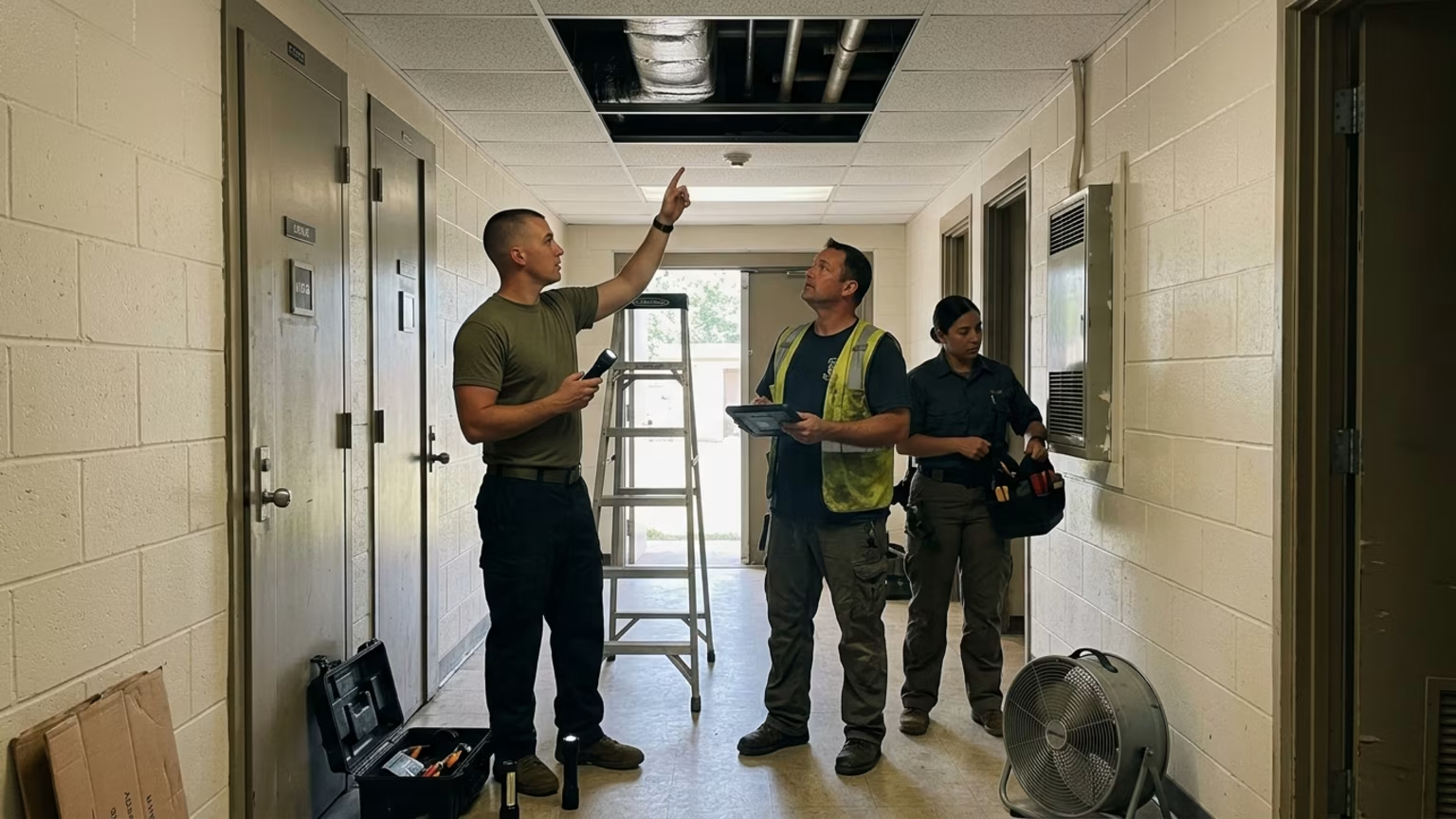
The Army’s HVAC task force targets hot barracks. Here is what its project figures mean and how to assess future housing and sleep-related claims.


The BRIDGE Act proposes a whole-family military transition pilot. Read who it would serve, what support it includes, and what remains unresolved.

Combat Stress’s workplace guidance emphasizes listening over diagnosis. Recent U.S. veteran insomnia research adds context for sleep and recovery concerns.
Build better habits around strength, recovery, sleep, hormones and healthy aging with practical guidance for active military personnel and veterans.
Explore BattleVet