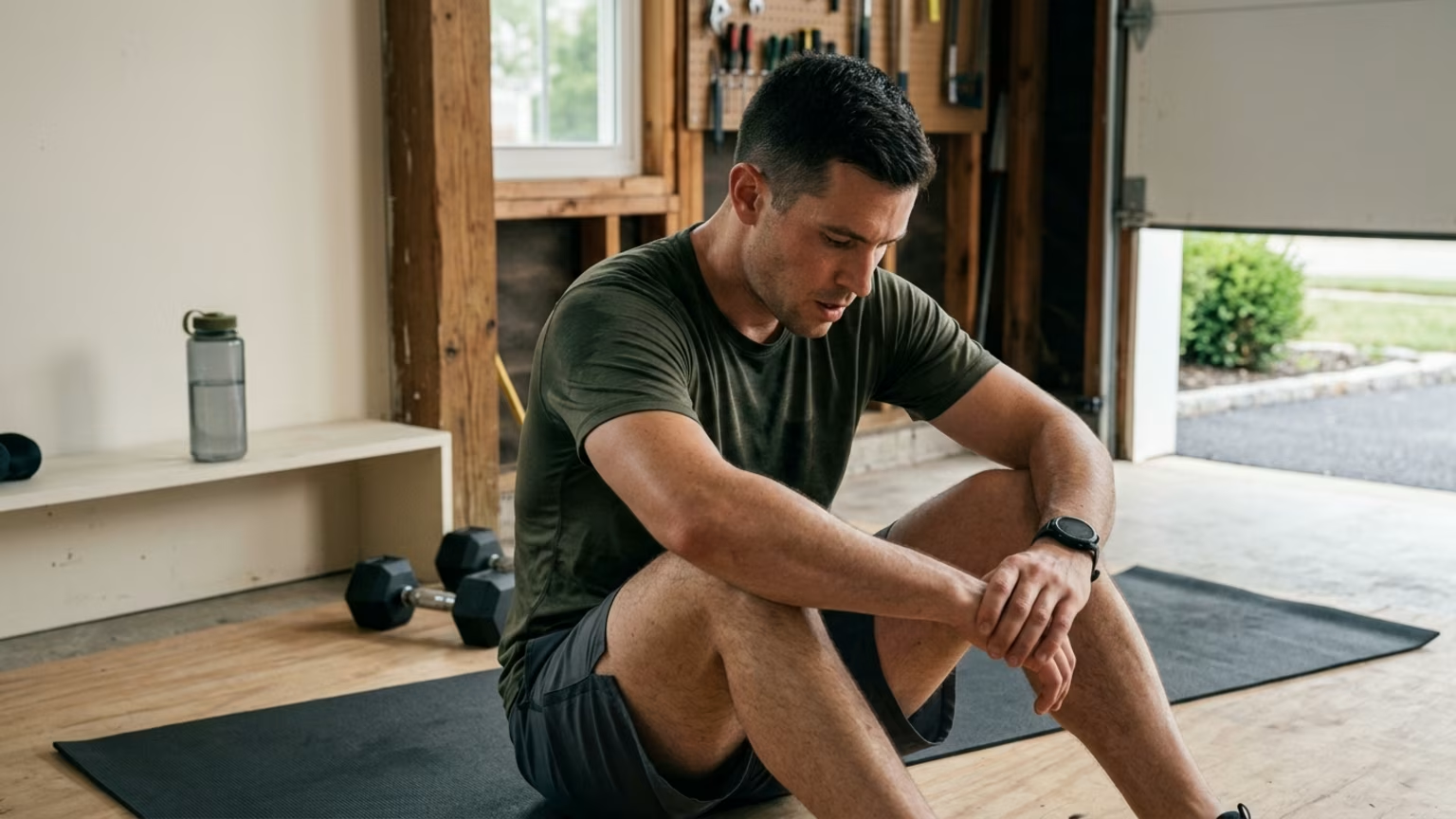

Men’s Journal recently published a 15-minute military core circuit. Discover how this bodyweight routine fits into broader functional readiness and recovery.





On September 21, 2026, Men’s Journal published a 15 minute bodyweight core workout from Dan Fahey. Fahey is a military fitness coach and the founder of Gritty Soldier Fitness. The published sequence contains 14 distinct movements performed for a single round. Trainees complete 40 seconds of work and 20 seconds of rest for each exercise.
This new publication matters for active duty personnel and veterans who want to maintain their physical capability without specialized gym equipment. Fahey states that military style conditioning should emphasize performance, endurance, functionality, and transferable strength. He believes trainees should prioritize these practical attributes over simply pursuing a temporary muscle pump. The resulting workout focuses heavily on anti-extension, anti-rotation, hip stability, and plank based control.
However, readers must understand the broader context around standalone fitness circuits. The article presents this sequence as Fahey’s personal military style workout. It does not establish that this 14 exercise circuit is an officially issued program universally used by soldiers. We emphasize this distinction because comprehensive physical preparedness requires much more than an isolated abdominal routine.
In our experience, true readiness demands a wider lens than single workout sessions. I remember waking up after a poor night of sleep and realizing that my training recovery was taking much longer than it used to. I realized that readiness is more than just pushing through the fatigue. It requires a dedicated approach to sleep and hormonal health, which completely shifted how I view long term capability.
The Gritty Soldier Fitness routine involves precise time intervals for the 14 selected exercises. The sequence requires exactly 560 seconds of active work and 260 seconds of designated rest. These active and resting intervals total 820 seconds of continuous effort. This translates to roughly 13 minutes and 40 seconds of actual exercise time.
Therefore, the published label of 15 minutes acts as a rounded session description rather than a strictly timed protocol. The article does not state whether the 40 second intervals are intended to be maximal effort bursts. It is also unclear if they should be submaximal technical work or a fixed number of repetitions. Because of this, readers should not infer a standardized intensity prescription for the circuit.
Trainees begin the circuit with alternating dead bug style reaches and a bear hover. The routine then moves into a single leg glute bridge, a bird dog, and a forearm plank. These early movements demand steady trunk control and deliberate breathing under tension. Men’s Journal explicitly warns that bodyweight training can still be extremely difficult for experienced individuals.
The second half of the sequence introduces rotational and flexion focused movements. Trainees perform bicycle style rotations, flutter kicks, heel taps, and hand release push ups. The workout then concludes with several remaining static and dynamic posture holds. Trainees perform a hollow body hold, shoulder taps, and reverse crunches. The circuit finally ends with a side plank and a high plank.
While this specific circuit requires minimal equipment, the military views physical readiness through a much wider structural framework. The Army’s Holistic Health and Fitness system takes a broader view of readiness than standard test performance alone. This model incorporates strength, conditioning, recovery, nutrition, and injury prevention into daily military life. The Army describes this system as an embedded performance and health framework.
This infrastructure is intended to align training, education, and advisory support with total force fitness. The Army’s published doctrine serves as the authoritative framework for common training language across the force. An Army report summarized a 2026 Sports Medicine evaluation of this embedded approach. The extensive evaluation covered 56 brigades and more than one million soldiers between fiscal years 2019 and 2023.
Brigades equipped with Holistic Health and Fitness Performance Teams showed significantly better health and operational outcomes. These supported units had 61 percent lower odds of musculoskeletal injury referrals. The positive readiness outcomes extended far beyond physical injury rates. Supported brigades also experienced 79 percent lower odds of concerning substance use profiles.
Furthermore, these units saw 44 percent lower odds of behavioral health profiles lasting more than 90 days. The embedded support teams also improved fundamental military skills across the evaluated population. These supported units achieved 33 percent higher odds of expert rifle qualification. The military estimated that this comprehensive resourcing prevented 1,363 adverse readiness events per brigade annually.
It also successfully restored 37,484 duty days per brigade each year. This infrastructure includes Soldier Performance Readiness Centers staffed by certified performance professionals. These centers are explicitly designed to support conditioning, education, injury reconditioning, and athletic development. This data highlights that comprehensive professional support yields better results than isolated fitness routines.
This new publication reinforces how service members can implement trunk control work within a broader health routine. Men’s Journal tells readers to prioritize strict form and follow the exact work and rest clock. Active personnel should use this sequence as a short conditioning tool rather than a complete fitness program. A balanced approach to training and performance requires combining physical training with structured recovery practices.
Movement quality must remain the absolute main performance target during this 14 exercise circuit. Trainees need to keep their lower back controlled during dead bugs, flutter kicks, and reverse crunches. Hips must remain entirely level during standard planks and side planks. Athletes should also minimize any trunk movement during bird dogs and shoulder taps.
Trainees should progress cautiously rather than immediately adding extra workout rounds. The source specifically outlines a single round and does not guarantee that additional volume improves outcomes. Furthermore, the article links the workout to the muscle definition associated with a visible six pack. However, readers should not view visible abdominal muscles as a guaranteed or direct result of the routine.
Service members should pair this core circuit with complementary physical activities. A comprehensive routine includes lower body strength training, pulling movements, and dedicated aerobic work. The Army’s movement quality education materials show that movement screening is part of the injury prevention conversation. This indicates that veteran life routines must account for individual joint health and mobility limits.
Veterans who require supervision or have chronic pain should evaluate these exercises very carefully. The sequence includes repeated spinal flexion movements and challenging shoulder loading positions. Those returning from injury should consider professionally supervised exercise options instead of standalone internet routines. A balanced strength, fitness and body composition plan relies on safe execution over excessive intensity.
Relying on professional physical therapists can help veterans maintain their physical capability safely. This approach aligns perfectly with modern military strategies that prioritize long term health over short term fatigue. True readiness involves managing physical stress so that the body can recover and perform consistently. Proper load management ensures that service members remain capable well beyond their active duty years.
The publication of minimal equipment routines highlights an ongoing shift toward accessible fitness methods. As the military expands embedded performance teams, individual soldiers are receiving better physical guidance. How will future veteran healthcare models integrate these targeted movement programs into lifelong physical preservation strategies?
Follow BattleVet for practical guidance on military and veteran health, strength, recovery, testosterone, sleep and healthy aging. Stay connected for new articles, research backed insights and clear information to help you stay capable for the years ahead.



Open Arms offers Australian veterans free counselling for sleep disturbance and stress. Read how new pilot programs and DVA funding support long term health.

A 2026 GeroScience study associates lifelong aerobic exercise with higher vitality capacity in older adults. Learn what this research means for veteran health.
The September 8 executive order aims to improve military records sharing and transition benefits. Learn how these updates impact separating service members.
Build better habits around strength, recovery, sleep, hormones and healthy aging with practical guidance for active military personnel and veterans.
Explore BattleVet