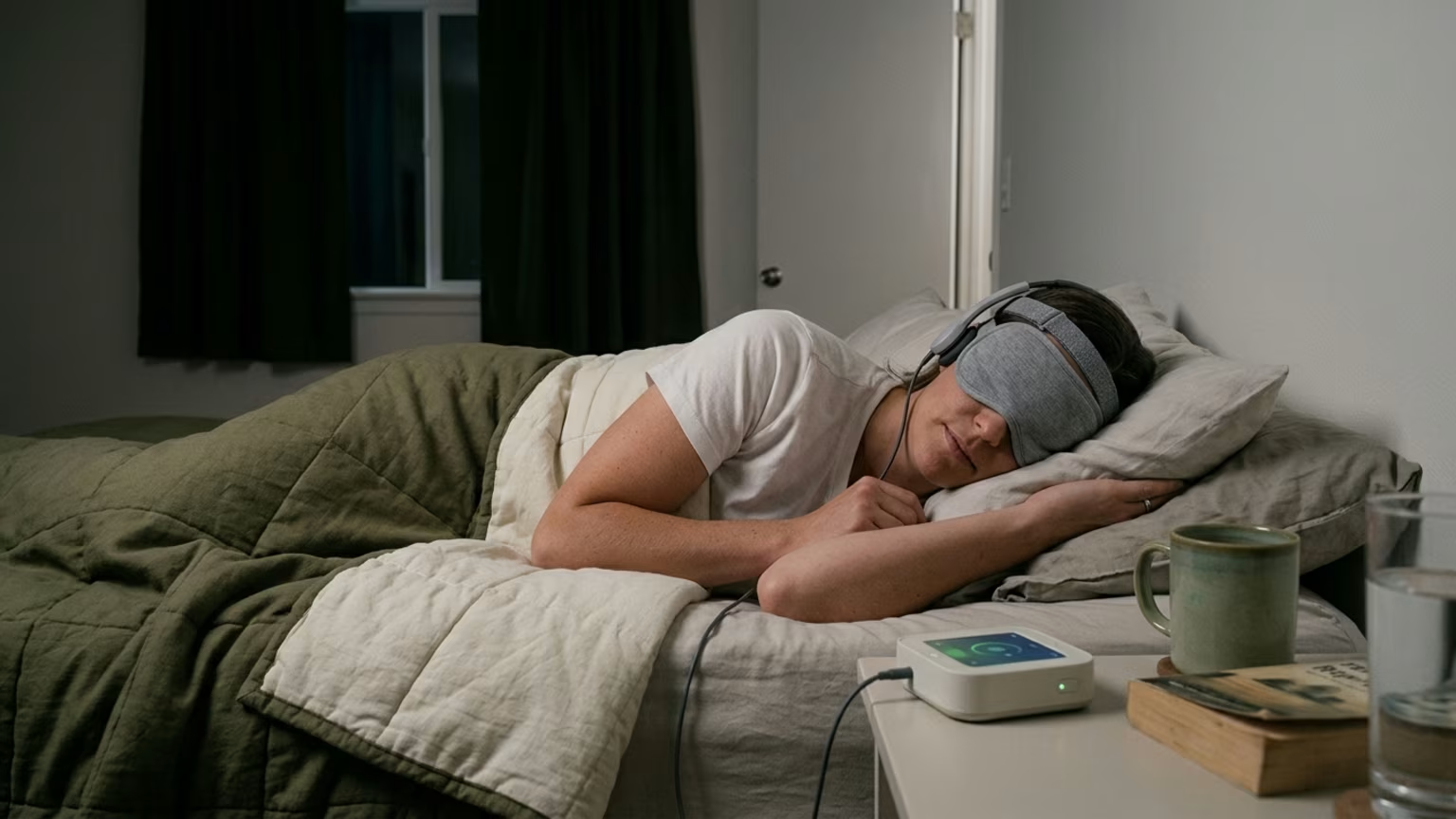

MIT researchers found that timed pink-noise bursts during sleep strengthen fluid waves tied to brain recovery. Here is what this means for veteran health.





In September 2026, MIT researchers reported that precisely timed bursts of pink noise during sleep can strengthen cerebrospinal-fluid waves. The study was published in Science Translational Medicine. The researchers found that these fluid waves are closely associated with the brain's waste-clearance processes. This early research points toward potential non-drug sleep technologies that could eventually influence recovery protocols.
Sleep is not simply a passive state of rest. It is a highly active biological process that dictates physical recovery and cognitive performance. I remember waking up after a poor night of sleep and realizing that my training recovery was taking much longer than it used to. I realized that readiness is more than just pushing through the fatigue.
It requires a dedicated approach to sleep and hormonal health, which completely shifted how I view long term capability. The Military Health System includes sleep among its primary warfighter-performance priorities. These priorities stand alongside mental health and cognitive performance. They also include brain health, physical fitness, and human-performance research.
The Military Health System describes its Warfighter Performance Optimization initiative as a way to help service members perform at their best. Active-duty personnel frequently face irregular schedules, deployment demands, and sustained cognitive workloads. This makes efficient overnight recovery critical for maintaining operational readiness. Cerebrospinal fluid helps remove waste products generated by daily brain activity.
These waste products include lactic acid and worn-out proteins. The fluid also cushions the brain and spinal cord while supplying nutrients such as glucose. Strengthening the flow of this fluid could theoretically improve how the brain repairs itself overnight. Veterans often struggle with significant sleep disruption long after their active service ends.
Research from the VA identifies a close relationship between insomnia and PTSD among women veterans. Healthy sleep is heavily associated with improved mood, daytime functioning, and emotion regulation. It also supports better learning and overall psychological stability. These findings explain why non-drug sleep technologies attract considerable interest in military care.
The MIT experiment involved 14 healthy volunteers. Researchers recorded the participants' electrical brain activity using EEG equipment. They also used functional magnetic resonance imaging to monitor cerebrospinal-fluid movement. This combination allowed them to track electrical brain waves and physical fluid flow simultaneously.
Combining these measurement tools presented a significant technical challenge. MRI equipment typically interferes with delicate EEG signals. The research team developed processing methods that removed much of that interference in less than 100 milliseconds. This rapid processing allowed a computer algorithm to accurately predict the timing of slow-wave peaks.
The actual intervention consisted of 50-millisecond bursts of pink noise. The researchers delivered these bursts exactly at the peak of the brain's slow electrical waves. Pink noise contains a broad range of audible frequencies with a greater emphasis on lower frequencies. The researchers compared the resulting sound to steady rain or a distant waterfall.
This precise auditory stimulus increased the amplitude of the brain's slow electrical waves. It also increased the amplitude of the cerebrospinal-fluid waves in the studied volunteers. The volume of the pink noise was carefully controlled. It was intentionally kept low so it was not loud enough to wake a sleeping participant.
The proposed mechanism involves a highly coordinated biological sequence. Slow brain waves are associated with blood-vessel constriction and dilation. This vascular activity helps drive cerebrospinal fluid through the brain tissue. Laura Lewis, the study's senior author, noted the significance of these findings.
She stated the team successfully increased the size of the cerebrospinal-fluid flow wave during sleep. She described this as a capability that had not previously been achieved to the researchers' knowledge. Lewis compared the precise timing challenge to pushing a child on a swing. An auditory stimulus can strengthen a slow wave only when delivered at the correct point.
This analogy highlights the importance of precision in the process. The intervention is not simply playing pink noise continuously throughout the night. It depends entirely on detecting actual brain activity and synchronizing the sound with it. This new study builds on earlier work by the same research group.
They previously showed that cerebrospinal-fluid waves are tightly coupled with slow brain waves during sleep. They also found that auditory stimulation delivered at the peak of slow waves can deepen those electrical waves. The new contribution is the reported ability to increase the fluid flow wave itself. This makes the work a mechanistic proof-of-concept rather than a completed therapeutic trial.
This research reinforces the importance of approaching sleep as a serious medical priority. It does not validate consumer sound machines as proven recovery devices. A conventional speaker playing continuous pink noise will not reproduce the MIT intervention. The researchers relied on complex EEG processing and an algorithm to time each brief sound burst perfectly.
The research did not demonstrate that pink noise improves memory, prevents Alzheimer's disease, or treats insomnia. It also did not produce measurable improvements in daytime performance for the volunteers. The reported improvements applied only to electrical slow-wave activity and cerebrospinal-fluid-wave amplitude. Joshua Levitt, the paper's lead author, discussed the future implications of this clearance process.
He noted that improving brain-waste clearance could eventually be relevant to diseases involving harmful molecule buildup. These molecules include amyloid and tau proteins. However, the experiment did not establish that the technique removes a clinically meaningful quantity of these proteins. The connection to dementia is a motivation for further research, not a demonstrated therapeutic effect.
Levitt has started a company that hopes to develop a home-use device like a headband. This device would ideally deliver auditory stimulation at the appropriate time during sleep. The existence of this commercial effort does not mean a consumer device is clinically validated. It is not currently proven effective for military personnel or veterans.
Readers can explore our library of articles on physical restoration and rest to learn more about established methods for capability maintenance. The sample size of the MIT study was very small. Results from 14 healthy volunteers may not generalize to active-duty personnel or older adults. They also may not apply to people with PTSD, insomnia, or neurodegenerative disease.
Watch for future trials that include service members, veterans, insomnia patients, and PTSD populations. People with sleep-disordered breathing should also be included in future research. These groups were not represented in the current study. We advise our community to treat the MIT result as an early research finding rather than a ready-to-use sleep treatment.
These measurements do not confirm broad clinical outcomes like faster reaction time or reduced fatigue. Increased wave amplitude should therefore not be presented as proof of improved brain recovery in everyday life. A non-drug technology is not automatically risk-free for your health. Poor device fit, startling sounds, or inaccurate timing could easily undermine your recovery.
If you experience persistent sleep disruption, seek professional medical evaluation. Service members or veterans with loud snoring, breathing pauses, or significant daytime sleepiness need proper clinical assessment. Do not attempt to self-treat serious sleep conditions with unvalidated sound applications. Delayed diagnosis of a condition like sleep apnea carries significant health consequences.
Our materials covering stress management and physiological resilience offer more information on maintaining strong habits. The VA maintains sleep-medicine services that diagnose and treat sleep problems. This includes difficulty sleeping and breathing-related sleep disorders. A future auditory-stimulation technology would need to be evaluated alongside established clinical treatment.
MIT researchers hope to study whether stronger cerebrospinal-fluid flow can support more restorative sleep in people with insomnia. They also plan to test its relevance to normal aging, mild cognitive impairment, and early Alzheimer's disease. The current study did not evaluate veterans with deployment-related sleep disruption. Will future clinical trials prove that closed-loop sound technology can definitively improve daytime cognitive performance and operational readiness?
Follow BattleVet for practical guidance on military and veteran health, strength, recovery, testosterone, sleep and healthy aging. Stay connected for new articles, research backed insights and clear information to help you stay capable for the years ahead.


A new study reveals how short, vigorous movement bursts and a faster walking pace can protect cardiovascular health and longevity for aging veterans.


The Army has moved its Holistic Health and Fitness program under the Maneuver Center of Excellence. Learn how this integration of sleep, nutrition, and strength impacts physical readiness doctrine.
The VA announced a three month VGLI premium holiday saving veterans nearly 150 million dollars. Learn who qualifies and how to manage your active policy.
Build better habits around strength, recovery, sleep, hormones and healthy aging with practical guidance for active military personnel and veterans.
Explore BattleVet