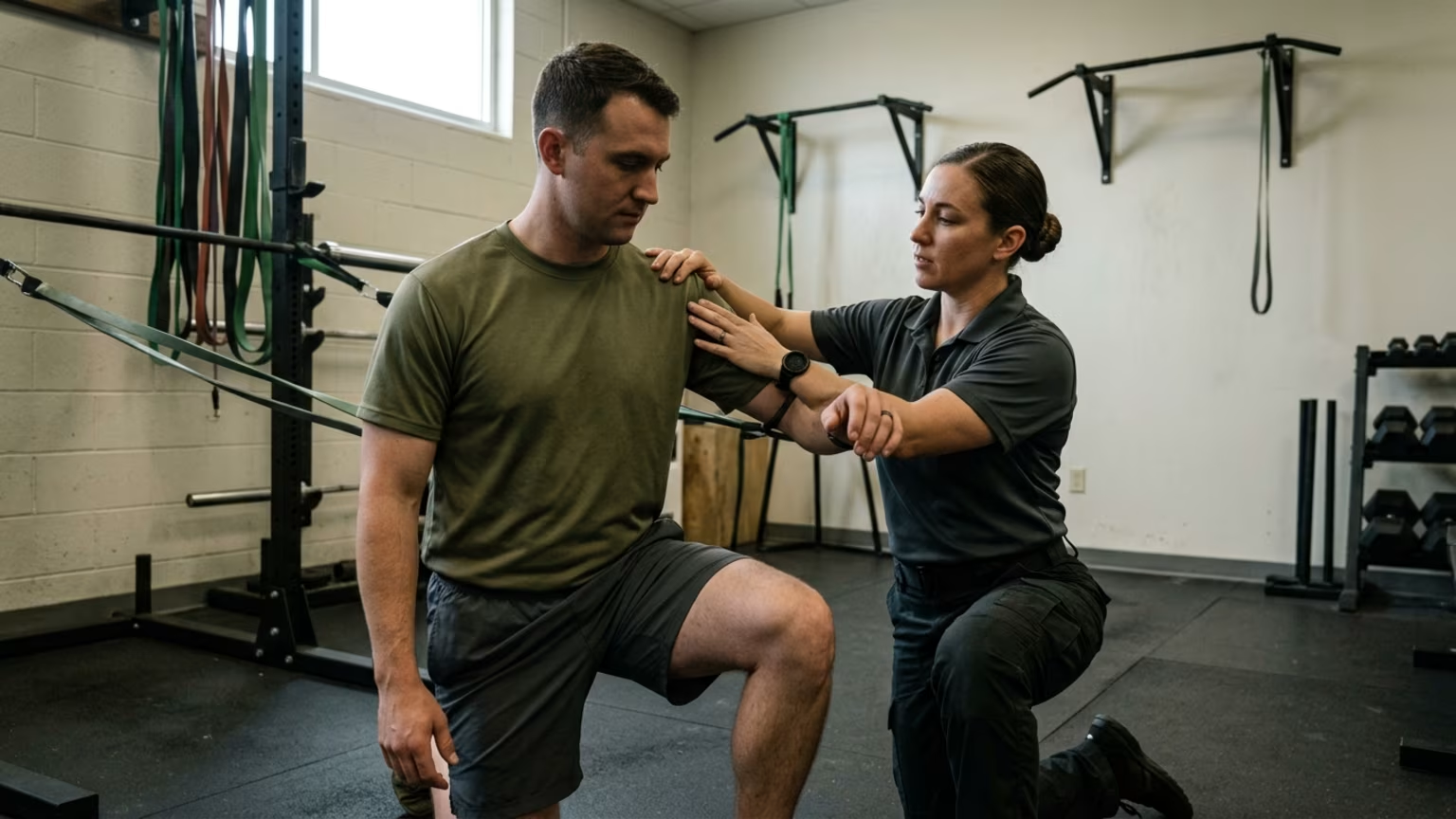

The U.S. Army recently highlighted APEX Fitness training for The Old Guard. We review H2F brigade injury data and structured military performance protocols.





On September 1, 2026, Soldiers assigned to the 3d U.S. Infantry Regiment participated in an APEX Fitness training class at Joint Base Myer-Henderson Hall in Arlington, Virginia. The 3d U.S. Infantry Regiment is also known as The Old Guard. The U.S. Army released official imagery of this physical training event on September 14, 2026. The released photographs, credited to Sgt. Megan Gaston, document how structured fitness programming is being applied to active personnel.
According to the official caption, the training session emphasized proper exercise techniques. The class also focused on using the APEX app to develop physical-training plans. This specific event is part of a broader pattern of APEX-related training within the regiment. Leaders from across The Old Guard previously participated in APEX Path physical training at Fort Myer on August 27, 2026. The Army describes APEX Path as structured fitness training intended to improve physical performance and overall readiness for Soldiers.
The public event material serves as documentation of a training class rather than an evaluation of program effectiveness. It does not identify the class instructor, the specific exercises, or the training loads used. The imagery does not establish that the class directly reduced injuries or improved measured performance outcomes. However, it clearly documents the training activity and states its purpose for improving operational readiness.
The APEX training event illustrates a significant evolution in how the military manages physical capability. The Army’s current Holistic Health and Fitness doctrine, known as H2F, frames this system as a comprehensive operational framework. It is intended to create a common training language and unified standards across the entire force. The Army states that H2F represents a critical shift from a reactive healthcare model toward a proactive human-performance model.
Commanders are now expected to integrate specialized H2F Performance Teams directly into their units. These teams are designed to support both physical and mental readiness on a daily basis. The Army reinforced this approach by publishing an H2F doctrine update in September 2026. This update identifies several official reference documents, including the H2F Operating Concept and FM 7-22. It also lists the H2F CALL Handbook alongside related technical publications.
The doctrine details the establishment of specialized Soldier Performance Readiness Centers. These unit-owned facilities are designed for integrated physical and mental conditioning rather than serving as conventional medical clinics.
Our team has seen the practical necessity of this transition firsthand. I remember waking up after a poor night of sleep and realizing that my training recovery was taking much longer than it used to. I realized that readiness is more than just pushing through the fatigue. It requires a dedicated approach to sleep, stress and resilience, which completely shifted how I view long-term capability. The H2F framework officially recognizes this reality by defining readiness across five distinct domains. These domains include physical, nutritional, mental, sleep, and spiritual readiness.
An Army report detailing H2F implementation at Fort Rucker expands on these categories. The report states that the physical component combines physical therapy with structured strength and conditioning. This approach places a heavy emphasis on rehabilitation, injury prevention, and functional power. It demonstrates that modern military preparation requires far more than simply passing an annual fitness test.
The Army evaluates H2F integration through ongoing research and operational observation. A peer-reviewed retrospective observational study recently examined musculoskeletal injuries in a U.S. Army Stryker brigade. The researchers monitored the unit from October 2021 through September 2022. During this period, the study recorded 4,780 person-years of data. H2F providers evaluated 2,140 musculoskeletal injuries among 1,722 individuals.
The data highlights how embedded medical support functions in a military environment. H2F providers evaluated 63% of the recorded musculoskeletal injuries within one week of onset. The median time from injury onset to an H2F evaluation was five days. Furthermore, providers assigned no initial time loss to 58.8% of the injuries they evaluated. The study’s abstract summarized this finding as managing 59% of injuries without assigning time loss.
Despite the presence of specialized teams, structured physical preparation carries inherent risks. The Stryker brigade study found that unit physical training accounted for 50.5% of the injuries evaluated by H2F providers. This made it the most common recorded injury activity in the brigade. Injury incidence also varied significantly by battalion type. Field artillery recorded 31.8 injuries per 1,000 person-months, while infantry recorded 50.0 per 1,000 person-months.
The researchers cautioned that the study was descriptive and observational. Therefore, the data could not establish that H2F caused lower injury rates or reduced time loss. The study also could not measure several potentially important factors. These missing variables included physical-training volume, training intensity, prior injury, cumulative time loss, and physical performance. The study warned that its H2F injury rates may have underestimated overall injury rates because outside healthcare providers handled some cases.
The study specifically recommended further research into the effects of strength-and-conditioning coaches designing physical-training programs. This recommendation was particularly focused on potentially overuse-related musculoskeletal injuries.
Other reports suggest positive associations for units using specialized performance personnel. An Army article detailing H2F promising practices reported notable improvements for brigades equipped with H2F Performance Teams. These brigades saw a 61% reduction in the odds of musculoskeletal-injury referrals. They also recorded a 79% reduction in substance-use profile odds. Behavioral-health profiles lasting more than 90 days decreased by 44% in these integrated units.
Additionally, the odds of achieving an expert rifle-marksmanship qualification increased by 33%. These promising practices figures were reported by the Army as findings attributed to Thompson et al. They should be treated as study-specific associations rather than guaranteed outcomes for every APEX program. The peer-reviewed injury study noted that H2F staffing models have changed over time. These changes include reductions in some brigade staffing categories and adjustments to the planned mix of strength coaches and athletic trainers.
The integration of APEX Path physical training and H2F doctrine changes how active personnel approach daily conditioning. The recent Old Guard event illustrates how coach-led, structured physical training can be incorporated into routine military preparation. It demonstrates that daily readiness does not have to be left entirely to informal or self-directed workouts. For active-duty personnel, the most defensible lesson is to emphasize movement quality and sound exercise technique. A training plan must match the specific physical demands of the job.
Soldiers and veterans can use the broader H2F framework as a practical standard. It serves as a reminder that readiness is multidimensional. Consistent training and performance programming should always be considered alongside recovery, nutrition, sleep, and mental readiness. Because more than half of the injuries in the Stryker-brigade study occurred during unit physical training, training sessions require careful management. These sessions should not be treated as risk-free simply because they are official or supervised.
Leaders and coaches must distinguish between the discomfort associated with exertion and symptoms that require medical modification. The public APEX event materials do not specify how instructors make those clinical decisions. The use of an app suggests a structured planning component, but the source does not explain the app’s programming logic or clinical oversight. Therefore, individual service members still need appropriate progression, proper recovery, and medical evaluation when indicated. Accessing credible military health resources remains critical for injury management.
Veterans adapting military-style training to civilian life must apply these principles cautiously. You should avoid assuming that a program designed for an infantry unit is automatically appropriate for your current occupational demands. Findings from the Stryker-brigade study cannot automatically be generalized to units like The Old Guard or to civilian veteran life. Age, injury history, and equipment availability all change how a training program impacts the body. Understanding veteran lifestyle and healthcare dynamics is necessary when building a sustainable fitness routine.
The strongest actionable takeaway from these Army updates is not a particular exercise or app feature. It is the value of organized programming, technical coaching, and appropriate physical progression. Relying on coordinated access to performance and healthcare professionals offers the best path to long-term capability.
As the military continues to integrate specialized performance teams and structured protocols like APEX Fitness, its approach to human capability is fundamentally changing. Will this data-driven shift in injury prevention and technical coaching ultimately redefine the standard of care for aging service members transitioning into the civilian healthcare system?
Follow BattleVet for practical guidance on military and veteran health, strength, recovery, testosterone, sleep and healthy aging. Stay connected for new articles, research backed insights and clear information to help you stay capable for the years ahead.



A recent Brown University study found younger military veterans have higher PFAS concentrations than civilians, prompting new clinical screening conversations.


A new survey highlights veteran perspectives on the Take Care of America's Veterans Act, detailing the debate over proposed disability rating changes.

TRICARE recently published updated guidance clarifying how Medicare, Social Security, and military health benefits coordinate for transitioning retirees.
Build better habits around strength, recovery, sleep, hormones and healthy aging with practical guidance for active military personnel and veterans.
Explore BattleVet